
Budgets and Campaign Finance
In Which: The FY 25 actuals are in and it's not looking good, Campaign finance reform is in the works, We look at the campaign finances of those making the new rules.

Are you free on October 18th in the evening? Come on down to the Hayward Night Market at St. Rose Hospital! We’ll be there giving away our new zine and stickers, plus you can ask us any questions you’ve ever had about what’s happening in Hayward! We can’t promise we’ll have an answer, but it’ll probably be more informed than what you hear on Nextdoor!
City Budget Looking Bleak
The Hayward City Council, like the HUSD Board of Trustees, will now get regular updates on the state of their budget. On Tuesday’s City Council meeting, Assistant City Manager Mary Thomas--who is also the Acting Finance Director--revealed the FY 25 actuals.The City spent $247,000,000 but only brought in $217,000,000 which yields a $30,000,000 shortfall in the General Fund.
Acting City Manager Jayanti Addleman was quick to explain that the shortfall only affects the General Fund and that many services will be unaffected. “This is a structural deficit,” she said. “I want to really assure our community that we do have funds to continue with all our services: sewer, water, garbage pick up--everything will continue as always.”
Luckily for us, utilities services like water, sewer, and garbage are paid for from a different pot of money: Enterprise Funds. According to the FY 25 Adopted Budget, the Enterprise Funds are paid for by water sales, service charges, and other forms of revenue. They are also maintained separately from the General Fund and pay for the personnel that operate those things. However, that also appears to be slowly spending more than it’s taking in, though at a much slower rate.
According to Assistant City Manager Thomas, one of the largest drivers of the General Fund deficit are overtime costs. “A lot of our overtime comes from our safety groups,” she said, “because they do have minimum staffing levels that they try and meet.” The strategies that the City is implementing to control costs take this into account. They include holding vacancies, reducing overtime, pausing “discretionary projects”, and increasing transfers into the General Fund--which has already identified $5,700,000.
Acting City Manager Addleman has also hired a consultant to perform an outside fiscal review which will include a cash analysis, beginning the annual outside audit--which presumably never flagged the issues leading to the current crisis, and beginning discussions with Labor groups. With a deficit of this magnitude, workers will definitely be impacted in one way or another.
Staff is also preparing a Fall budget revision for mid-November, which will propose a budget that doesn’t use any reserves. This would necessitate finding around $25,000,000 in savings between now and then. A new budget will be proposed in February and will include 5-year projections for the City’s finances.
Pinching Every Penny Possible
Councilmember Angela Andrews thanked City Staff for the budget report. “This is exactly what I was looking for,” she said. She then pitched several ideas for how to eliminate expenditures from the budget, including re-examining the strategic roadmap. “We can methodically look at each project that is deemed non-essential,” she said. Though the roadmap is re-evaluated every year, the next roadmap wouldn’t be approved until 2026.
She also suggested discussing various projects in conjunction with the Hayward Area Recreation and Park District (HARD), including La Vista Park and local events like Juneteenth. HARD is the only local agency that isn’t currently facing a multi-million dollar deficit. According to City Councilmembers, HARD has stepped up funding for local events like the Downtown Street Fairs and the Mariachi Festival.
Councilmember Andrews suggested downsizing the scope of La Vista Park. “Do something where the park is open but maybe not have all the features that we anticipated,” she said, “but at least something that will be accessible to the public.” She also directly referenced offloading costs to HARD for events, “so we can reduce that burden on the City budget,” she said.
Citing the newly-completed monument sign on Jackson and Silva, Councilmember Andrews suggested partnering with the Downtown Hayward Improvement Association (DHIA) and property owners to share costs for infrastructure projects. She also suggested streamlining processes to spur business development and its attendant tax revenue.
Councilmember Roche asked if there was a difference between holding vacancies and a hiring freeze. Acting City Manager Addleman explained that holding vacancies allows for each vacancy to be evaluated and approved if necessary, as opposed to a blanket freeze. She also said that any freeze would require discussion with Labor groups.
Councilmember Roche celebrated the grant that covered the cost of the Paramedic training for Fire Department recruits, asking if the money that was approved for it last week was then no longer necessary. Assistant City Manager Thomas explained that the money from last week was from the Capital Improvement Program budget--separate from the General Fund--and the resolution simply approved the vendor contract.
Working Together For A Common Goal
Councilmember Bonilla seemed glad that the budget was a priority and that everyone was on the same page. “It seems like we’re all working together and rowing in the same direction to face the reality that’s in front of us,” he said. However, he also wanted more transparency and updates, including a running tally of “how much [savings] these actions are starting to accumulate.”
Councilmember Syrop focused on the importance of working with the various Labor groups within the City to right the ship. “This will be a partnership and a group effort that pulls us out of this deficit,” he said.
Campaign Finance Reform For Districts
The City Council looked at changes to campaign finance rules ahead of the 2026 election, which will be the first election involving the newly-created Districts. The existing rules, which are similar to those found throughout the region, incentivize candidates to voluntarily limit the amount they can raise in exchange for being able to accept larger individual donations. The current limit is over $90,000 total funds raised and up to $1,800 donated per person.
But with a switch to districts, the average Citizen Voting Age Population (CVAP) shrinks from approximately 80,000 for the whole City to as low as 12,000 per district. The districts are divided based on population, and some districts have more registered voters than others. Because of this difference, Staff recommended that the fundraising limit be lowered to $60,000 total—maybe lower—and around $1,000 per person.
This recommendation is based on other local cities, which you can see in the chart below. Although the cities are smaller, they used the Expenditure Limit Per Resident to ballpark where the City of Hayward could be.
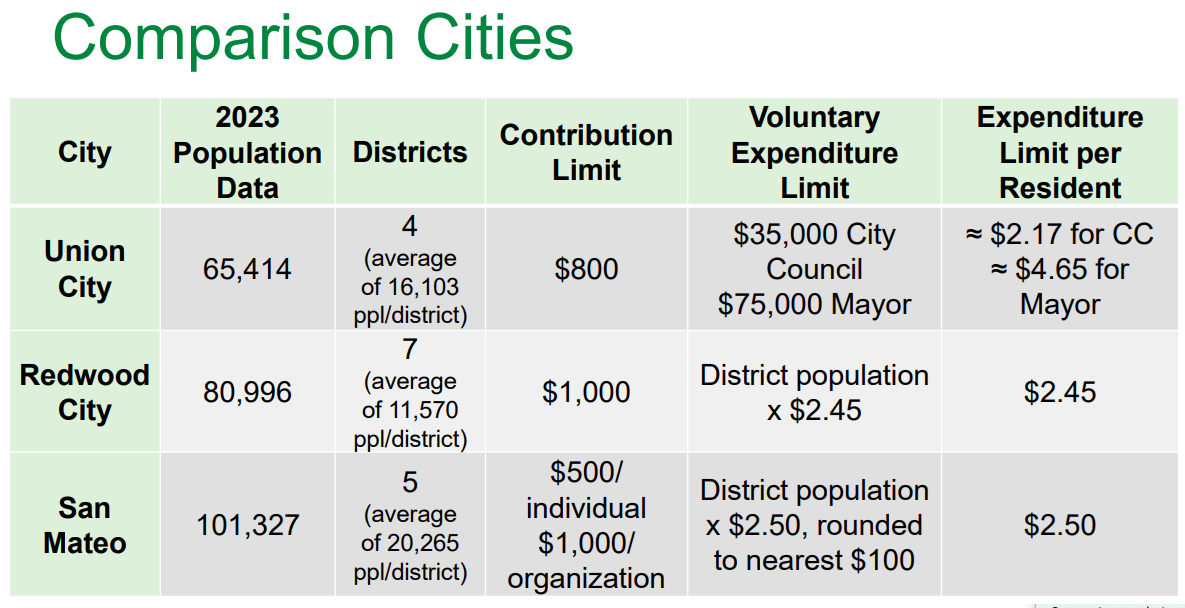
An important note is that the contribution limit only applies to individual people. Independent Expenditure Committees (IEs) and Political Action Committees (PACS) do not have to abide by this rule. That means donations from groups like trade unions and the California Real Estate PAC would not be bound by this limit. It’s unclear if it would apply to businesses, though they are listed as a separate checkbox on the campaign finance forms.
Staff wanted the City Council’s input on what the limits should be and when the changes should be implemented. 2026 would be the obvious choice, but pointed out that some candidates had already begun fundraising--Councilmembers George Syrop and Julie Roche will both be running for re-election in 2026 in Districts 1 and 6 respectively, along with the Mayorship.
Context Is Everything
Before jumping into City Council comments, it’s important to remember that people running for office in 2026--and the people who have donated to and supported their previous campaigns--are the ones changing the campaign finance rules. This item was a referral brought forward by Councilmembers George Syrop, Ray Bonilla, and Francisco Zermeño. And while they likely have the best interests of the democratic process at heart, their own position as campaigners will undoubtedly play a role in their comments. With that in mind, let’s take a quick look at the campaign finances of City Councilmembers and how it may be impacted by these changes.
Julie Roche
Julie Roche was elected for the first time in 2022 after having served on the Planning Commission for several years. According to campaign finance filings for October 2022, she brought in around $53,000 in donations before the election--well under the current limit. By the numbers, most of her donations were small-value donations well under $1,000 and most of those above that were from IEs and PACs.
However, she also received large early donations from Bill Quirk ($1,600), Louise Roche ($1,620), Aidan Roche ($1,620), and Bonni Moss ($1,620). Rick Ridder also donated a similar amount ($1,500) over several donations throughout the campaign season.
She only renamed her campaign in August of this year, but had been filing paperwork targeting the 2026 election since her January 2023 filing.
George Syrop
George Syrop was also elected for the first time in 2022 after having served on the Community Services Commission for a few months. According to his campaign finance filings for October 2022 he brought in around $37,000 in donations before the election. He also had many small-value individual donations, with some exceptions.
Early in his campaign he had several large donors from Jeff Syrop ($1,620), Ruey Syrop ($1,620), and Anthony Sutardja ($1,500). The remaining large donations were building trade PACs.
He very quickly transitioned his campaign to 2026 and has raised some funds, but they have all been under $1,000 so far.
Thanks for reading Hayward Herald! This post is public so feel free to share it.
Ray Bonilla
Ray Bonilla was appointed in 2023 to fill the seat left vacant when Elisa Márquez was appointed to fill the seat vacated by Richard Valle after his passing—a great reshuffling. Mr. Bonilla had served on the Planning Commission for some time prior to his appointment. By the end of 2024, he had raised almost $38,000 in donations.
Most of his donations ($20,000) were given in 2023, and there were many large individual donors. Ana Alas ($1,075), Maria Burks ($1,500), Susan Fuzesi ($1,550), Darrell Gordon ($1,250), Gricela Trujillo ($1,700), Bill Quirk ($1,699), Emon Usher ($1,699), Kimberly Smith ($1,700), Shimika Brame ($1,700), Yolanda Arango ($1,700).
Mr. Bonilla also had a number of large donations from various building trade PACs and the Real Estate PAC.
Dan Goldstein
Dan Goldstein ran in 2022 after having been on the Planning Commission for some time. He did not win then, but was appointed to fill the seat left vacant by now-Senator Wahab after she won her election. Mr. Goldstein ran for re-election in 2024.
For his 2022 race, he received large donations from Bill Quirk ($1,620), Bob Goestch ($1,620), Paul Martin ($1,620), Robin Wilma ($1,620), Bonnie Moss ($1,620), and Tom Silva ($1,620).
In 2024 he received large donations from Margarie Silva ($1,100), Paul Martin ($1,699), Robin Wilma ($1,699), and Bill Quirk ($1,600).
Like all other successful Council candidates, he also received a number of large donations from various building trade PACs and the Real Estate PAC.
Protecting Our Democracy
Councilmember Syrop, one of those pushing the change, framed it as the responsible move. “As we transition to districts, we should be doing so responsibly,” he said. “Even with this high limit [$91,096], everyone up here was able to run their election while raising less than $60,000.” He suggested that a $50,000 limit was, therefore a very reasonable ceiling for a much smaller district.
Councilmember Syrop pointed to the Alameda County Board of Supervisors, which is poised to double campaign contribution limits and would increase the influence of money in politics. “I think we’re capable of thinking critically about the principle of the original ordinance and protecting that principle,” he said, also hoping to at some point add more strict rules to IEs and PACs, as well.
“I think the focus that we all want to achieve here,” Councilmember Syrop said, “is if the person that’s running for office is really embedded in their community and wins by talking to as many people as possible.” He recognized that he had already begun fundraising, but had not received any donations above $1,000. “I’m happy to throw myself out there and see how it works.”
An Issue Of Scale
Councilmember Goldstein supported the staff recommendation of a $50,000 total fundraising limit and a $1,000 individual donation limit. But he expressed concern about fixed costs. He specifically cited the cost of printing which, because of economies of scale, gets cheaper the more you’re having printed. So having a smaller print run could still be quite costly.
Assistant City Manager Thomas said that Staff kept that in mind when developing the recommendations, which was why they didn’t take the current limit and reduce it to 1/6th the size—that would be $15,000. However, Councilmember Goldstein suggested revisiting the $50,000 limit in the future. “Costs,” he said, “It’s a little uncertain right now what the campaign consultants and the printers are going to ask.” He also asked if it could be adjustable to take into account inflation, and Staff said it would adjust with the Consumer Price Index like the current one does.
…Maybe Not That Low
Councilmember Roche agreed with the overall fundraising limit. “I’m fine with us adjusting the expenditure limit,” she said. “A lot of us didn’t reach barely that amount in the past.” However, she wanted to push the timeline out. “I’d like us to not start this in 2026,” she said.
“I don’t think I’d like us to go lower than $1,500,” Councilmember Roche said. “I think the way a lot of it works is some of us are able to get a few donations and then the bulk of it becomes smaller individual donations” She suggested that the larger individual contributions “seed our campaigns” for future donations, though those later large donations are usually PACs, which are not subject to the change.
Councilmember Bonilla was supportive of some of the changes. “I do agree that this is the time to be revisiting this,” he said, “especially as we move into districts and making sure that we have the most level playing field for our elections as possible.” However, he drew the line at the individual expenditure limit.
“Because I don’t want to over-impact people who have already started their fundraising,” Councilmember Bonilla said. “So I think $1,500 seems to be the right number.” The fear appeared to be, in part, that too much was changing at once. “Cap at nearly half of what is currently allowed is too much too quick,” he said.
Councilmember Zermeño agreed with the reduced caps, but was also open to putting it off until after 2026 due to the “economic situation” if it meant saving costs in terms of Staff time. Councilmember Bonilla asked how much Staff time would be necessary to make the change. “A few hours,” City Attorney Michael Lawson said. “It would not take more than a day.”
“I Can Live With That”
Councilmember Syrop relented on the individual contribution figure. “I’m okay with $1,500 as well,” he said. “I do feel it’s important for us to initiate this and revisit it.” All Councilmembers agreed that the Mayor’s seat—which is the only at-large seat left on the City Council—would remain at the current limits.
Mayor Salinas said, “We can plan it for the 2026 election. It’ll be a $50,000 campaign limit… and then individual contributions cab be made to $1,500.” Staff agreed that this is what they had heard, as well. “I can live with that,” Mayor Salinas said.

Comments ()