
Cannabis Businesses Clash Over Hayward
In Which: Unions fight against layoffs close to Christmas, Dispensaries may have fomented rage against a future competition, And Mayor Salinas rails against dispensaries for 20 minutes
Unions Give Council Coal For Holiday Layoffs
Despite efforts to close a $30,000,000 budget gap, the City of Hayward issued layoff notices on December 17th to an undisclosed number of City Staff. New City Manager, Jennifer Ott, outlined the measures that have been taken and insisted that workforce reductions were necessary to balance the budget. Members of SEIU 1021 Clerical and Maintenance and IFPTE 21 pushed back on the idea, urging the City to meet with them to generate creative solutions beyond layoffs.
Budget Still Needs Work
During the budget presentation, City Manager Jennifer Ott revealed a modified list of things the City is doing to close the budget gap. Much of it—$9,750,000—was taken care of with Measure C money, but over $6,700,000 is still expected to be saved through “personnel-related savings.”
According to the presentation, $3,000,000 of that has already been realized due to concessions from the IAOF 1909 and the Hayward Fire Officer’s Association. According to a Staff Report, the Side Letter Agreement will reduce staffing minimums and defer salary and benefit increases until 2028. This move will save the City $3,100,000 this year and $2,900,000 next year, though costs will increase in 2028.
City Manager Ott then addressed other potential solutions and why they weren’t being considered. Pulling more from Measure C would eliminate the only source the City has left to even its cash flow. Enterprise funds are “legally required to be separate” and taking a loan would incur interest payments. Regarding tax revenues, the consultant recommended that the City adjust its forecast downward, but they are instead keeping the Optimistic scenario in their budget forecast.
When it came to layoffs, the announcement came suddenly. “We are not able to close the $30,000,000 gap without making some workforce reductions,” City Manager Ott said. The notices were sent on December 17—the day after the meeting. “I think they are needed to be able to stabilize this organization long-term and be able to get the City financially back on track.”
City Council will be meeting on January 6th to brainstorm ideas for how to address the structural deficit for next fiscal year. Those ideas will be studied and brought forward during a longer work session in late February.
Holiday Layoffs Tank Staff Morale
Almost a dozen speakers from both Service Employees International Union (SEIU) 1021 Clerical and Maintenance and International Federation of Professional and Technical Engineers (IFPTE) 21 asked the City Council to find ways to avoid layoffs, especially so close to the holiday season. At one point, a member of SEIU stepped forward and placed novelty coal on the dais as a show of disapproval.
Lack of Transparency And Collaboration
One member of SEIU alleged issues with developing budget solutions. “There is no transparency in any of the process that we’ve been a part of,” she said. She also said there had been no meet-and-confer between the City and Unions. The speaker said there were “hopes that there was transparency in coalition with the City to come up with ideas to get out of this deficit… that is not what happened.”
Emily Wallace of IFPTE 21 pointed out that the concessions from the Fire Department eliminated half of the need for workforce reductions, and that it would go even further if the dispensary was approved. “Your decision to lay off City workers is no longer in response to a projected budget deficit,” she said.
Another speaker from SEIU said that all labor groups are expected to give 3.5% in concessions no matter what. If true, this could mean that workforce reductions may exceed the amount given in the presentation. A speaker from IFPTE 21 was apparently told “No one is going to get out of this unscathed.” She continued, “That is not just inaccurate, it’s deeply dismissive.”
December Layoffs For A Problem They Didn’t Cause
Many speakers pointed out the unfairness of being laid off so close to the holidays, especially for workers who did not cause the deficit. “For many of us,” SEIU Secretary Amber Parras said, “this isn’t about numbers on a page, this is about our lives. This crisis was not created by the workers… yet we are the ones being asked to absorb the impact.”
“There is no heart in the Heart of the Bay when workers are treated as expendable,” an IFPTE 21 member said. “There sure as hell is no caring in issuing layoff notices one week prior to Christmas.”
City Services Are Already Being Impacted—And It Will Get Worse
Multiple speakers from the Library and the Water Facility pointed out the impacts that layoffs will have on public services that our residents rely on. “Our most vulnerable stand to lose friendly shelter from extreme temperatures and services that are increasingly being slashed across the City,” one Librarian from IFPTE 21 said.
Another Librarian pointed to the reductions in part time staffing that have already happened. She said that four part time Librarians have been cut and that any more may have serious consequences for Library operations. “Hours have been cut, but the workload has not,” she said.
A lab technician from the Water Facility pointed out that their team works Monday through Friday, regardless of holidays, to test both incoming water and wastewater to ensure both are safe. She highlighted the plummeting morale among workers who disproportionately bear the burden of the budget deficit.
Mixed Messages From City Council
While everyone on City Council admitted responsibility, the responses ranged from solutions-oriented to scolding to open irony. But all Councilmembers stressed that it was important to work with the unions to find ways to minimize layoffs.
Working Together To Minimize Cuts
Councilmember George Syrop emphasized action “The best apology is action,” he said. He pushed for a collaborative approach to minimize the layoffs as much as possible, especially for next year. “Everything that we do from now until our January 6th meeting needs to be aligned with minimizing as many layoffs as possible,” he said.
Councilmember Syrop said he met with three Unions in the previous week and committed to exploring revenue generating ideas to minimize layoffs. “Every revenue idea must be explored,” he said.
I’m Not With Them
Councilmember Angela Andrews appeared to distance herself from her colleagues. “The Council will further need to reduce our salaries to match concessions made by [labor groups],” she said. “I am compelled to give back in solidarity for our workers who have made concessions.” She also committed to going after County Measure W funding and to eliminate what she called “council pet projects.”
Don’t Know What Else To Do
Councilmember Julie Roche acknowledged the pain and took responsibility, but insisted that she needed to trust Staff recommendations. “I am in this position,” she said, “needing to trust my new team. And I know that is an ironic thing to say, because that is how we got here.” She continued, “I don’t know what else to do now but take the direction from our experts and move forward.”
Kind Of Help Us Out
Councilmember Ray Bonilla appeared to act like layoffs weren’t settled, despite the announcement. “The book is not written yet,” he said. He pivoted to solidarity. “It’s going to take all of us, not just our firefighters,” he said. But his final comment sent a different message. “I hope all of the energy that was brought out tonight could be directed in the next few weeks to come up with some real solutions.”
Councilmember Francisco Zermeño took a similar tone. He asked for clarifications about when the unions had been contacted about concessions—in September—despite Union insistence that there had been no meet-and-confer. He then placed the onus entirely on the Unions to solve the problem. “You’ll have an opportunity to sit down and come in with the concessions that I think would help everybody,” he said. “I’m hoping that our union folks who have not come to concessions with us can kind of help us out.”
Listening and Doing
Councilmember Dan Goldstein appeared to take full responsibility and committed to fixing the long-term problems. “You deserve better,” he said. “We screwed up.” He continued, “Long after I’m gone, I want people to look back on this moment and say, ‘You know what? That City Council did it right. They put the structures in place to make sure this never happens again.’”
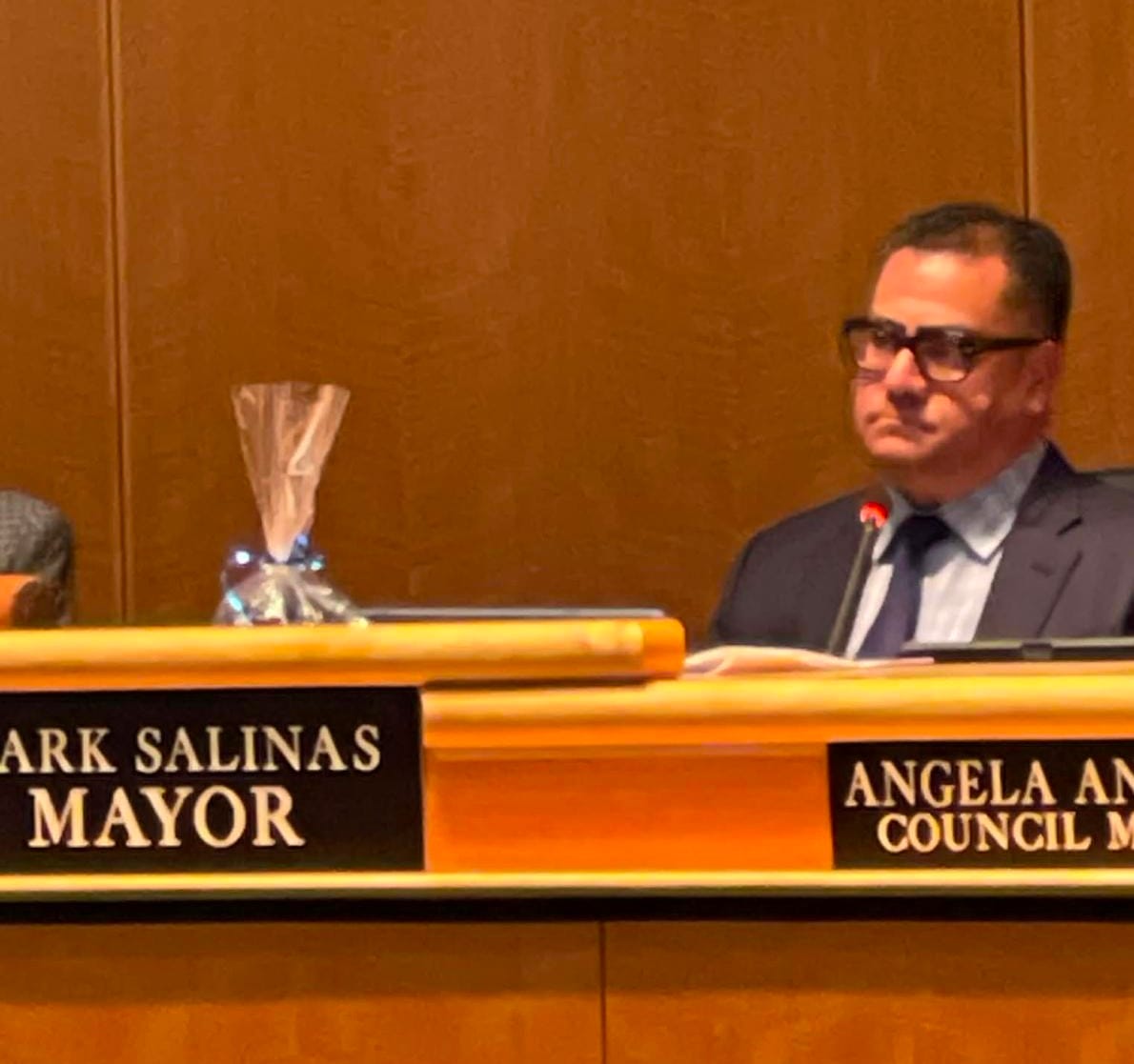
Mayor Mark Salinas said, “We’re listening to you and we’re hearing you.” He highlighted Councilmember Syrop’s emphasis on action and pointed to changes made in response to the ousting of former City Manager Ana Alvarez. Although he offered no solutions himself, he expressed an openness to listening to anyone who wanted to talk.
Big Turnout In Response To New Dispensary
An enormous crowd turned out again for the proposal to open the second cannabis dispensary in Hayward. According to Mayor Salinas, over 100 people had registered to make a comment either in-person or online. Many commenters were from outside of the City, from as close as Castro Valley and Cherryland to as far away as Fresno. And while the City Council ultimately voted to approve the new dispensary, Mayor Mark Salinas spent almost 20 minutes speaking against it.
Phenos Hayward Eyes Old Walgreens Location
The City Council considered approving the Conditional Use Permit of Phenos Hayward to operate at the former Walgreens location on Foothill and Grove. Although the Planning Commission voted against recommending approval due to community pressure, the presentation took pains to show that the applicant, Esther Lopez, had met all the requirements set by the City.
 Collin Thormoto
Little about the project had changed since the September 25th meeting, though they had multiple slides showing the concerns expressed by the community and how the applicants had addressed them.
A new addition was a generous Community Benefits Package of over $1,000,000. The company offered to advance the City $1,000,000 in tax revenue on top of donating around $200,000 to local nonprofits in a show of good faith.
Addressing Safety Concerns
Many of the City Council’s questions focused on the idea of safety. Councilmembers Roche and Bonilla asked the Police Department about call volumes and security protocols at the proposed location. According to Detective Gabriel Wright from HPD’s Vice Division, calls for service at the existing dispensary are “very relatively low,” she said. “We are not seeing it as an issue.”
Councilmember Bonilla asked if it would be a significant impact on the Police Department. “It does not appear that they would create an undue amount of calls for service,” Detective Wright said. She also said that it meets all security requirements, and that tests for ID compliance are harder with cannabis businesses than alcohol and tobacco businesses. “Generally at the front they’re gonna deny you right away,” she said, since cannabis businesses are required to scan IDs before letting anyone in.
Councilmember Goldstein asked about parking concerns, but Planning Staff said that they used a nationally-recognized formula that indicated a dispensary would not impact traffic as much as the previous drugstore. “The [traffic] numbers for a dispensary are less than for a drugstore,” he said.
Mayor Salinas asked about oversaturation, but Director of Development Services Sara Buizer pointed out that the Ordinance lays out the rules clearly. The cannabis ordinance doesn’t allow dispensaries within 500 feet of each other—Garden of Eden would be 750 feet away.
He also asked why the applicant chose that particular location and not something closer to Downtown. She said that, using the tools that City Staff gave to her to find locations, this was the only viable location available in the City.
Hours Of Comments On Both Sides
The over 100 public commenters spoke on both sides of the issue seemed to mostly come from outside the City. While Phenos brought in employees from as far away as Fresno, local opposition came largely from Castro Valley and Cherryland. However, both Councilmember Syrop and a member of the Phenos team alleged that local opposition had been coordinated by a political operative, possibly working for nearby dispensaries to squash competition.
A Very Familiar Playbook
Dozens of people from nearby Unincorporated Alameda County gave comment against the dispensary. Most of the comments covered the following: moral panic and safety, traffic and congestion, and over-saturation of businesses in one area. Many of these arguments were similar to what was expressed at the Planning Commission meeting, and that the Staff Report showed had been addressed to the best of the applicant’s ability.
However, a new group called “Our Foothill Voice” allegedly sent fliers to nearby homes, and evidence suggests that they crafted these talking points for many of the local speakers. According to our research, their website was only purchased on October 3rd and includes form letters and talking points—now deleted—for the City Council and Alameda County Supervisors Elisa Marquez and Nate Miley.
The website is only one page and has four talking points: Traffic, Over Saturation of Cannabis, Unsafe For Our Kids, and Too Close to Youth Activities. These align very neatly with the talking points expressed by opponents of the dispensary.
According to emails sent to the City Council on the issue, Founder and CEO of Garden of Eden Soufyan AbouAhmed, appears to have approached local businesses to get them to sign form letters protesting the new dispensary.
We attempted to contact the organization at their posted email— info@ourfoothillvoice.org—however, the email was returned undeliverable, indicating that the email address may not actually exist.
Many residents also said that they were fine with cannabis dispensaries in general, but didn’t want them in their neighborhood. Some recommended relocating them to an industrial zone, despite evidence suggesting that isn’t a viable business location for a commercial dispensary.
Bringing In Reinforcements
During the Planning Commission meeting, comments were overwhelmingly against the dispensary. This time, Phenos brought in multiple employees from locations around Northern California to vouch for the company.
Over a dozen people identified as either employees of a Phenos location or from a different city where Phenos operates. They celebrated the tax benefits it can bring the City of Hayward, the opportunities it can offer for veterans who have found employment and pain relief there, and the healthy competition that it can bring to local dispensaries—Cookies currently enjoys a monopoly in the City of Hayward.
Several residents spoke in favor of Ms. Esther Lopez as a pillar of the community and good businessperson. But between local residents being possibly hijacked by competing dispensaries and Phenos employees showing up from out of town, it was difficult to discern how actual Hayward residents may have felt about the project without corporate influence campaigns.
Phenos Gets A Statement
The applicants, as a part of the Public Hearing, were given up to ten minutes to speak in defense of their project. Esther Lopez reiterated how difficult it was to find a location for her business in the City and that she had used a set of mapping tools given to her by City Staff to find this one. She stressed that it had been a long seven years trying to get the project off the ground and that she would do everything she could to assuage community fears and be a good business neighbor.
Her partner, Bert Sarkis from the larger Phenos organization, pointed out that many of the comments were coming from outside City Limits and that Hayward had voted to legalize dispensaries by a 2:1 margin. He also highlighted the Community Benefits Package and challenged other dispensaries to also donate $200,000 a year to Hayward charities.
Thanks for reading Hayward Herald! This post is public so feel free to share it.
Mr. Sarkis also alleged that Garden of Eden had hired a political consultant—allegedly one familiar to City Council, though he did not give a name—to organize the opposition. But he closed by saying that, at all of their other locations, they have overcome local opposition with time by being good neighbors. “We promise we are going to set a new standard for the City of Hayward within this industry,” he said.
Council Points Out Good Business Practices
Members of the City Council generally supported the proposal, with some admitting that they tried to find ways to deny it and couldn’t. Councilmember Zermeño said, “I see a good business plan, I see a good project, I see a safety plan that will provide a safe environment for people who are in need of this product to go in and purchase it safely and then consume it at home. That’s what we all voted for back in 2016.”
Councilmember Andrews stressed that it was a land-use issue and that they should follow the guidelines. “This is a use issue,” she said, “and we need to provide predictability when businesses want to open in Hayward.” She worried about the signals it would sent to the broader business community if they denied the project.
Councilmember Bonilla said that any business should follow protocol and procedures. “I do believe this project has done that,” he said. He also highlighted the benefits to consumers. “Who wants to shop in Hayward if you only have one or two locations to go to?” he asked. “They’re going to buy their cannabis either way. Are they going to buy it in Hayward?”
Councilmember Syrop said he felt the cannabis ordinance was too restrictive and that this shouldn’t be contentious. “I’m really disappointed that we made this process so difficult for someone trying to contribute to the City, and for a City that’s trying to position itself as open for business,” he said.
He also took issue with the potential astroturfing campaign. “I feel like your concerns were taken advantage of,” he said to the residents in the room. “And you’re here speaking to protect somebody’s profits.” He said he was sympathetic to the concerns raised, but urged residents to work with the City to address them at their root instead of using Phenos as a scapegoat.
Councilmember Goldstein pointed out that few people would have stuck through a process like this. “For seven years she’s been pushing this,” he said. “How many hurdles are we going to throw at somebody to open a business in this town?”
Councilmember Julie Roche said she tried to find any excuse she could to deny the project. “I was looking for a way to point to [dispensaries being a problem],” she said, “and I can’t find it.” She recognized the fears that some parents and community members had, but recognized the potential benefits of the dispensary as well. She also said the applicants had done everything asked of them. “From a business decision, I’m having difficulty opposing it because all of the parameters have absolutely been met,” she said.
Mayor Salinas Does Not Like Dispensaries
Hayward Mayor Mark Salinas opened his 20 minutes of comments by saying, “Am I against people smoking weed? Smoke weed. Do I believe cannabis provides medicinal purposes? Yeah.” However, he quickly pivoted against the project. He took aim at City Staff for what he characterized as overly-positive report, the $1,000,000 advanced tax revenue to the City, and the existing dispensary in Hayward.
“The mileage projections by staff are incorrect,” Mayor Salinas said, without evidence. He then admitted that he opposes all dispensaries, seemingly on principle. “My opposition to cannabis dispensaries is well-known,” he said. He called the Castro Valley and Cherryland residents “my constituents” and personally thanked the Planning Commissioners who voted against recommending the project.
He then characterized much of Cherryland, Castro Valley, and San Lorenzo as Hayward. “While two of those [dispensaries] are technically in Alameda County,” he said, “anyone exiting 238 at Lewelling or Foothill knows the lived reality: that people know that they are in Hayward.”
Mayor Salinas then dismissed the potential tax revenue, despite earlier pleas from labor groups. “The projected revenue is tempting,” he said. “But we cannot balance our books by putting neighborhoods second.” He then alleged that it was easier to get a dispensary approved than a restaurant or daycare center. “There’s a guy on A Street that was building a child daycare center,” he said. “Couldn’t get that approved. Maybe he should have sold cannabis. Then maybe he would have been fast-tracked.”
He then took aim at districting. “So you won’t be able to hold the people accountable who vote for this,” he said. “That’s why I was against District Elections.” And closed by apologizing to the room. “I want to apologize to the neighborhood,” he said. “I hope [my colleagues] listen to the community.”
The project was approved 5:2 with Councilmember Julie Roche and Mayor Salinas voting against.

Comments ()