
City Plans Big Updates For Local Corridors
Big transit corridors may see big changes and improved bike and pedestrian safety. Plus regional money is transit-oriented changes near BART stations in Hayward.

The Council Infrastructure and Airport Committee received a presentation about proposed changes to some of the biggest transit corridors in the city. Focused on Tennyson Road, A Street, and B Street, the proposals seek to slow traffic and improve safety, though at the cost of parking and road capacity. Councilmembers were generally supportive, though the loss of parking near Lord Tennyson Apartments raised eyebrows and prompted calls for targeted outreach.
Community Supports Safe Streets
City Staff conducted multiple outreach sessions and received almost 500 survey responses plus over 1,000 public comments on three proposed approaches to each street. Base Enhancements changed as little as possible, with an emphasis on inexpensive solutions that minimized parking and traffic impacts. Connected Corridor was a kind of middle-ground that sought to minimize traffic impacts while also providing some pedestrian and bicycle enhancements. Reimagined Corridor was the most cost-intensive and impactful option that added robust protected bike lanes whenever possible at the expense of either traffic or parking.
Overall, survey respondents were more interested in preserving travel lanes over parking spaces for Tennyson, A, and B streets since they are large East/West travel corridors that handle a lot of traffic. And overwhelmingly the respondents supported maximum safety over building things quickly and inexpensively. This approach would drag out the timeline and increase the cost, but provide more substantial benefits.
Tennyson Road Reimagined
Community outreach overwhelmingly supported the Reimagined Corridor approach for Tennyson Road. Many commenters described Tennyson as "scary" for walking and biking, and many referenced recent pedestrian injuries and fatalities. There were big concerns about high speeds and running red lights as well as a strong desire for pedestrian safety. However, some also expressed concerns about lost parking or longer distances to businesses if parking is removed.
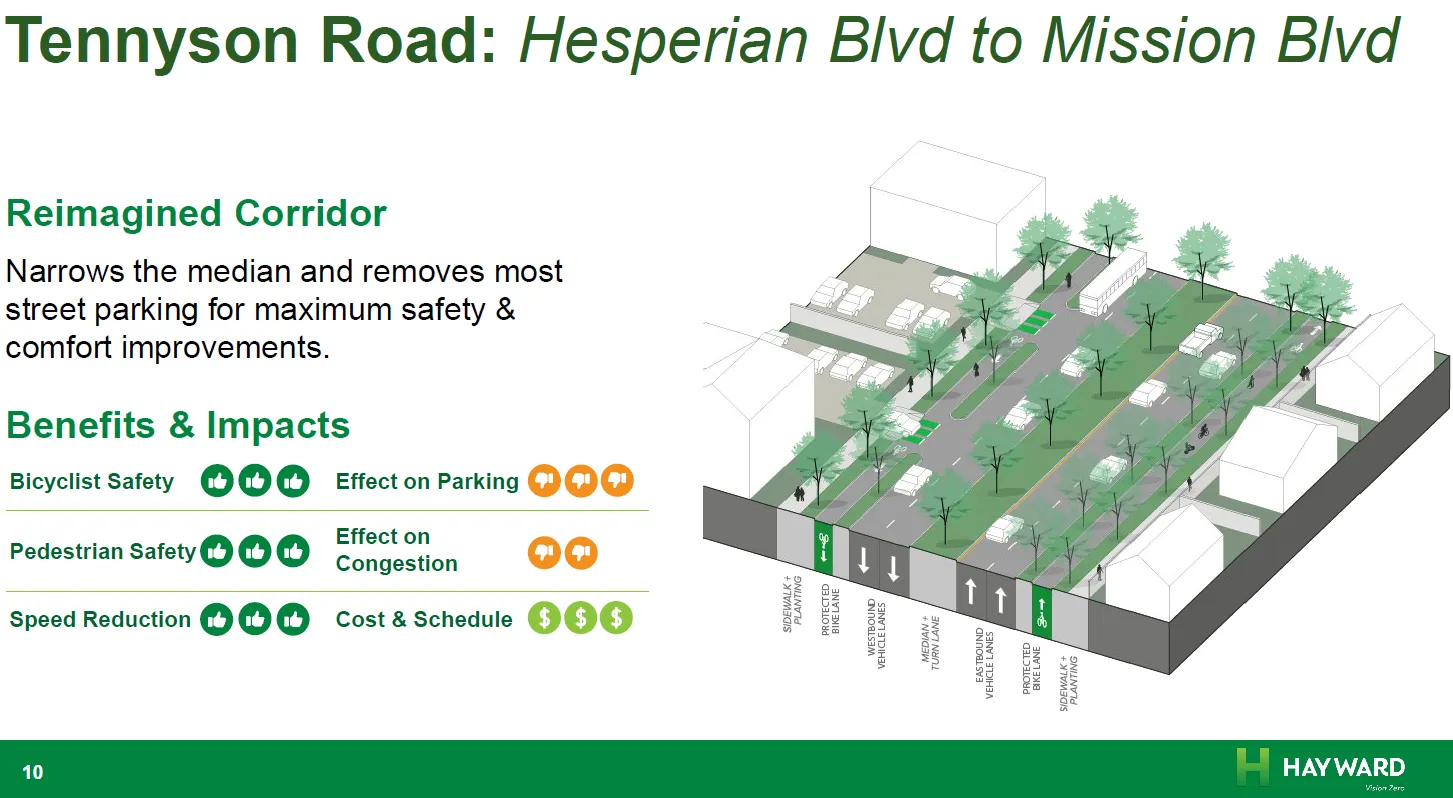
The plan divides Tennyson into two main sections: Hesperian to just past Tampa and from just before Dickens to Mission. But city staff were also mindful that within that, different areas have different needs. Most of the road, from Hesperian to Whitman, would have some kind of separated bike lane—either like shown in the image above or on the sidewalk. But from Whitman to Dixon, they proposed a separated two-way bike track on the Southern side of the street—likely to facilitate travel from the South Hayward BART station.
This road would require the most parking removal at over 100 parking spaces. However, almost half of it would come from heavily under-used parking near the BART station. The other area of heavy street parking is near Lord Tennyson Apartments, between Calaroga and Sleepy Hollow.
Public Works Director Alex Ameri said that the city would be in discussion with BART about their street parking, especially in light of their recent reduced ridership. However, he also said that BART is also interested in promoting alternative modes of transit to and from their stations. Also, a public commenter reminded the Committee that the East Bay Greenway was also expected to remove much of the same parking near the BART station.
Committee members were supportive of the proposal, with the exception of parking near Lord Tennyson Apartments. Mayor Mark Salinas explicitly called to preserve the parking near there, 35 spaces on Tennyson Road. He suggested more targeted outreach to that apartment complex specifically. Councilmember George Syrop framed the improvements as investment in a prosperous commercial corridor and asked if it was possible to include parklets in the design, though it would be difficult since parklets can't encroach on bike lanes.
Councilmember Angela Andrews expressed concern about businesses on Tennyson being increasingly set back from the road. Adding separated bike lanes and wider sidewalks on top of the expansive parking lots in front of businesses may make them even harder to see, she suggested. Staff pointed out that the rendering, which includes trees, is not final and it is something they would keep in mind when developing the final plan.
A Street Connects The City
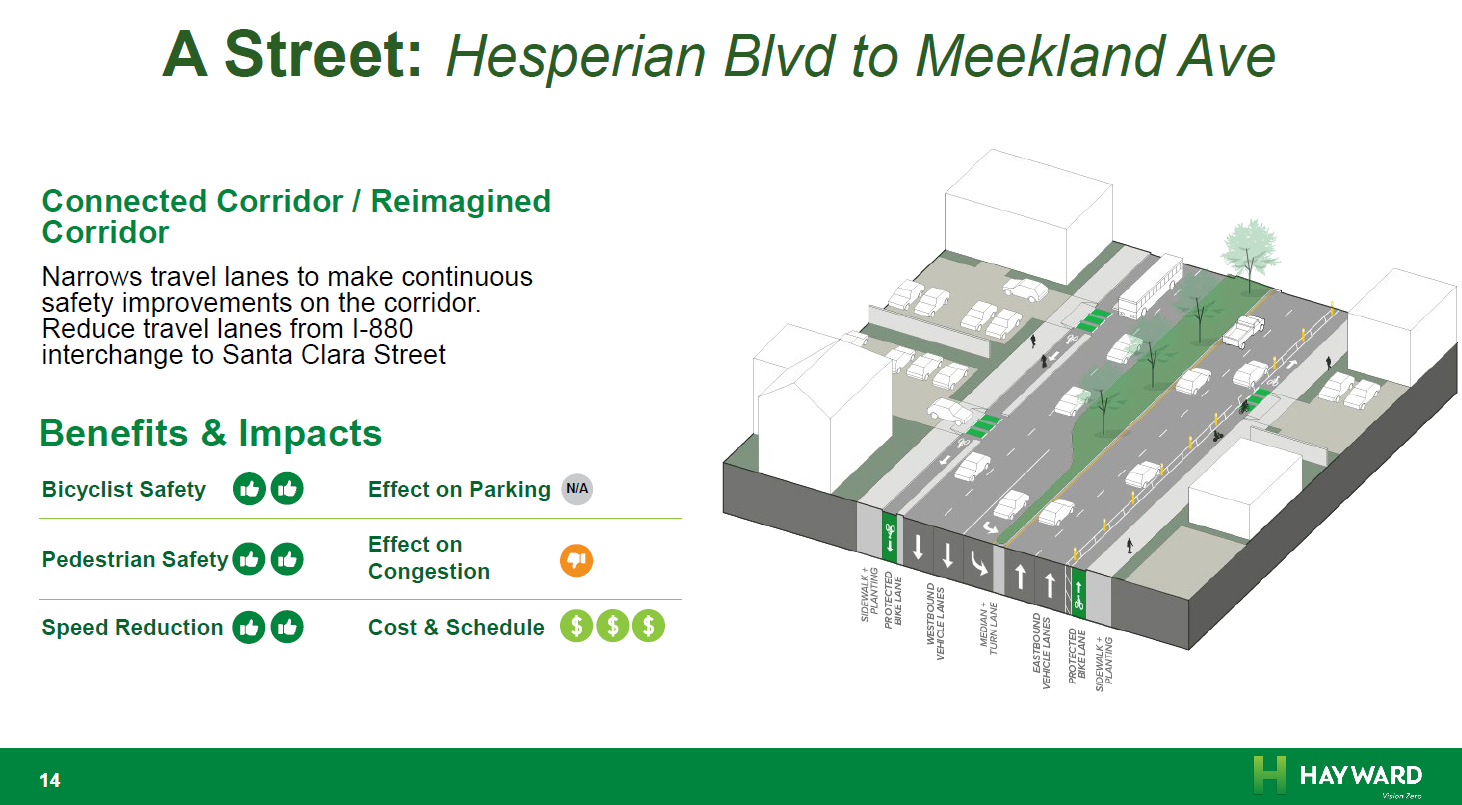
A Street was also divided into two segments with different needs. From Hesperian Meekland, support was most strong for the Connected Corridor plan when it came to A Street. There was concern about increased congestion for such a high-traffic corridor, with many viewing it as a cross-town connection more than a business corridor. However, there was concern about high vehicle speeds and aggressive drivers.
The Connected Corridor plan would maintain two lanes in each direction. However, between 880 and Santa Clara they plan to remove one of the lanes as it's the only section with three lanes in each direction. This would just maintain the number of travel lanes and may improve traffic by reducing merges.
In return, there would be a sidewalk separated bike lane on the South side of the street—similar to Mission Blvd north of A Street, and a buffered or shared path on the North side of the street.
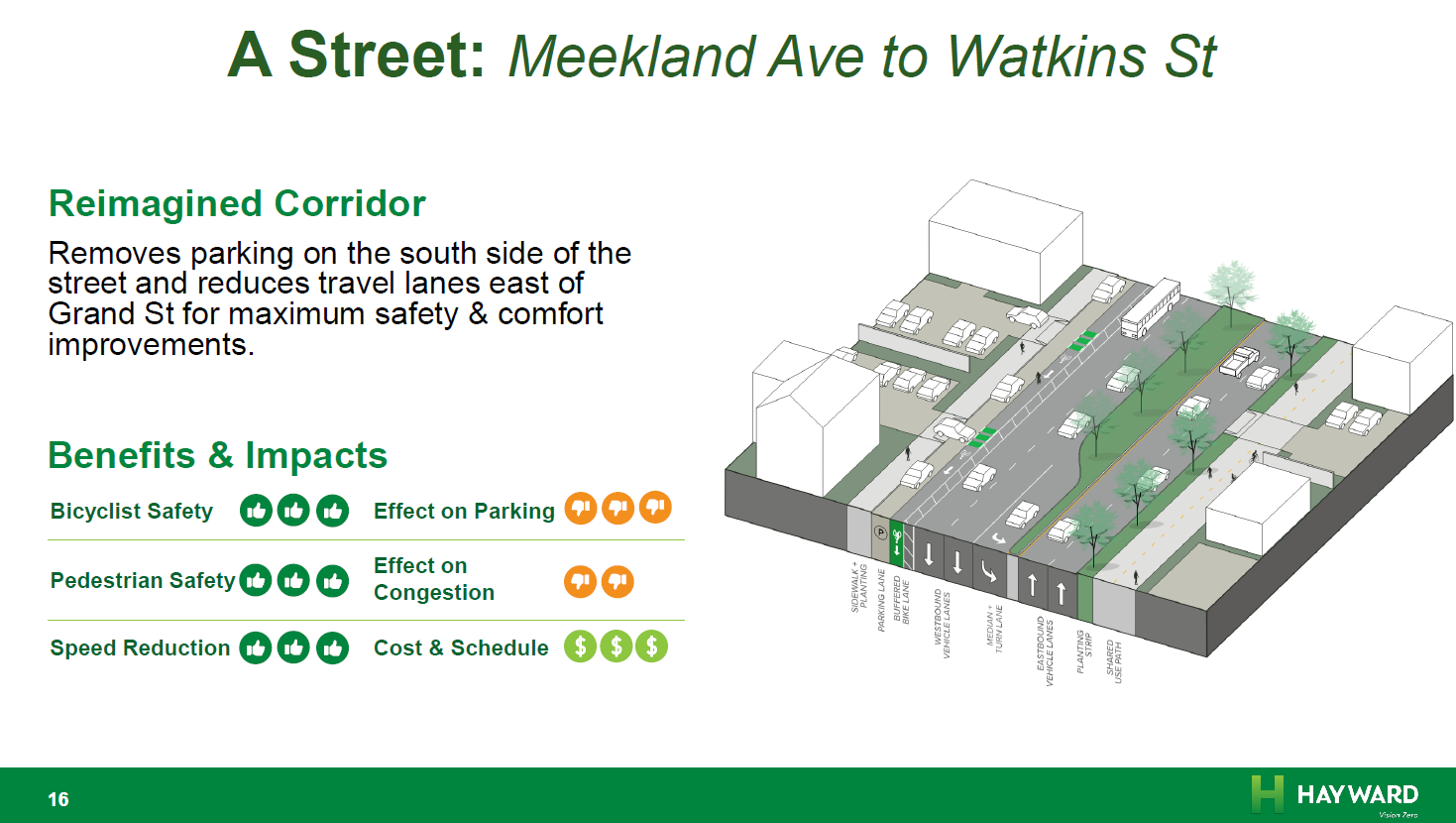
From Meekland to Watkins, which is more of a commercial corridor, the Reimagined Corridor plan was more popular. This is where most of the parking is removed, though primarily from the South side of the street. A separated shared path on the South side of the road and a buffered or shared path on the North side. The primary concern for respondents was the increased senior population near the Lucky and Grand Street. This segment also has a lot of businesses on A Street, which encouraged people to call for more crossings and traffic calming.
Other news outlets wouldn't know Artega's from Monarca, let alone cover in detail how the very streets around you are going to change. If you like the work we do, consider supporting us so we can better serve you and the rest of the Hayward community.
Of the 34 parking spaces removed across all of A Street, all of them would be from the South side of the street and all but three would be between Myrtle and Watkins. Most of A Street doesn't have on-street parking anyway. Councilmember Andrews expressed concern about the parking near A. Romos Cafe and Artega's Supermarket, but city staff reassured her that the parking was only being taken from the other side of the street.
B Street Serves Children And Residents
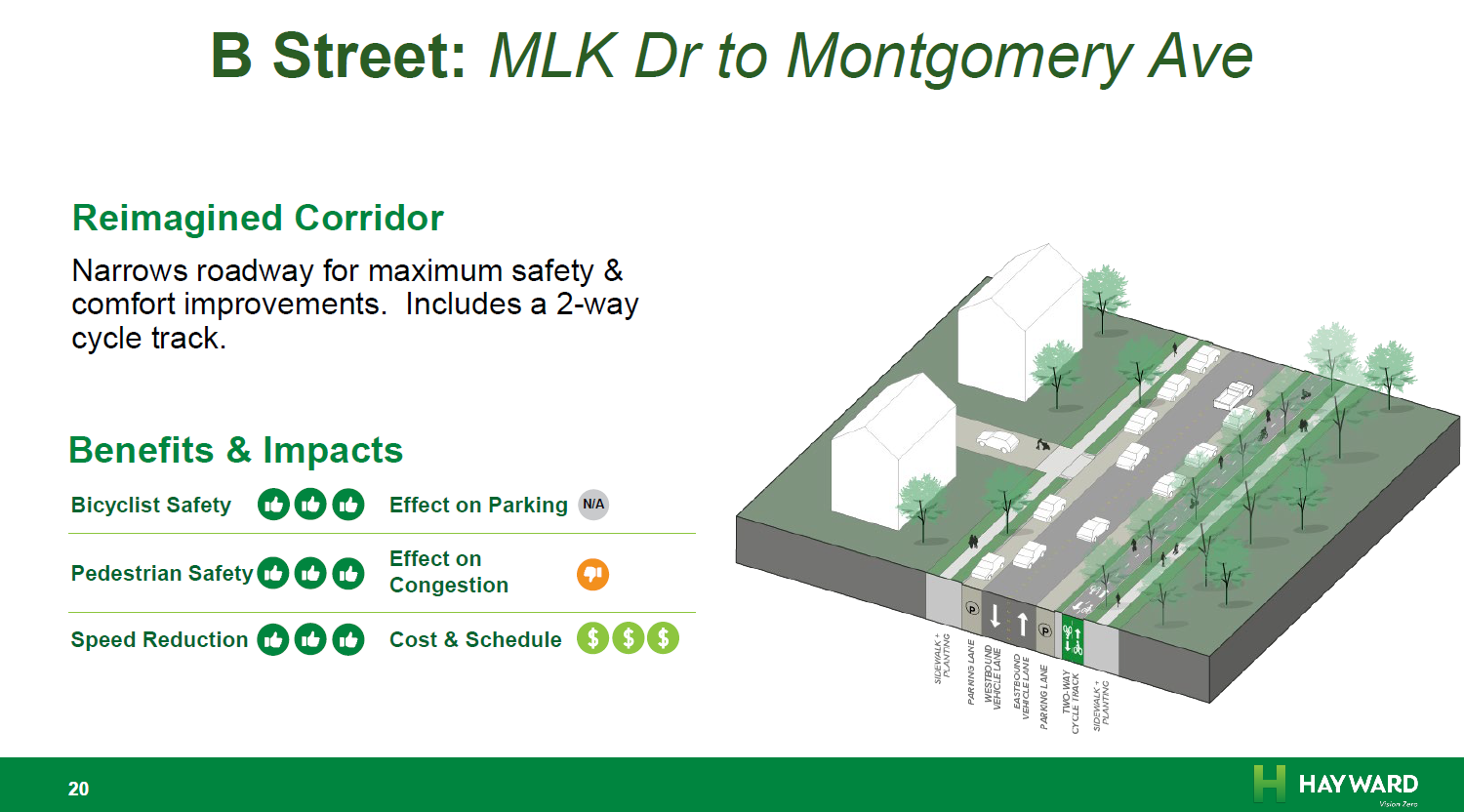
Much of B Street is a residential street and the respondents were looking to keep it that way. They favored the Reimagined Corridor plan which recommends traffic circles and speed humps to slow traffic, plus a two-way cycle track on the South side of the road—the same side as the park and the school—to improve safety of cycling children. However, the two-way track would only extend to Myrtle, at the school, and after that it would return to striped bike lanes, which already exist.
The rationale is that the two-way cycle track conflicts with driveways, of which there are many beyond the school. The improvements that slow traffic should also ensure that striped bike lanes are comfortable enough.
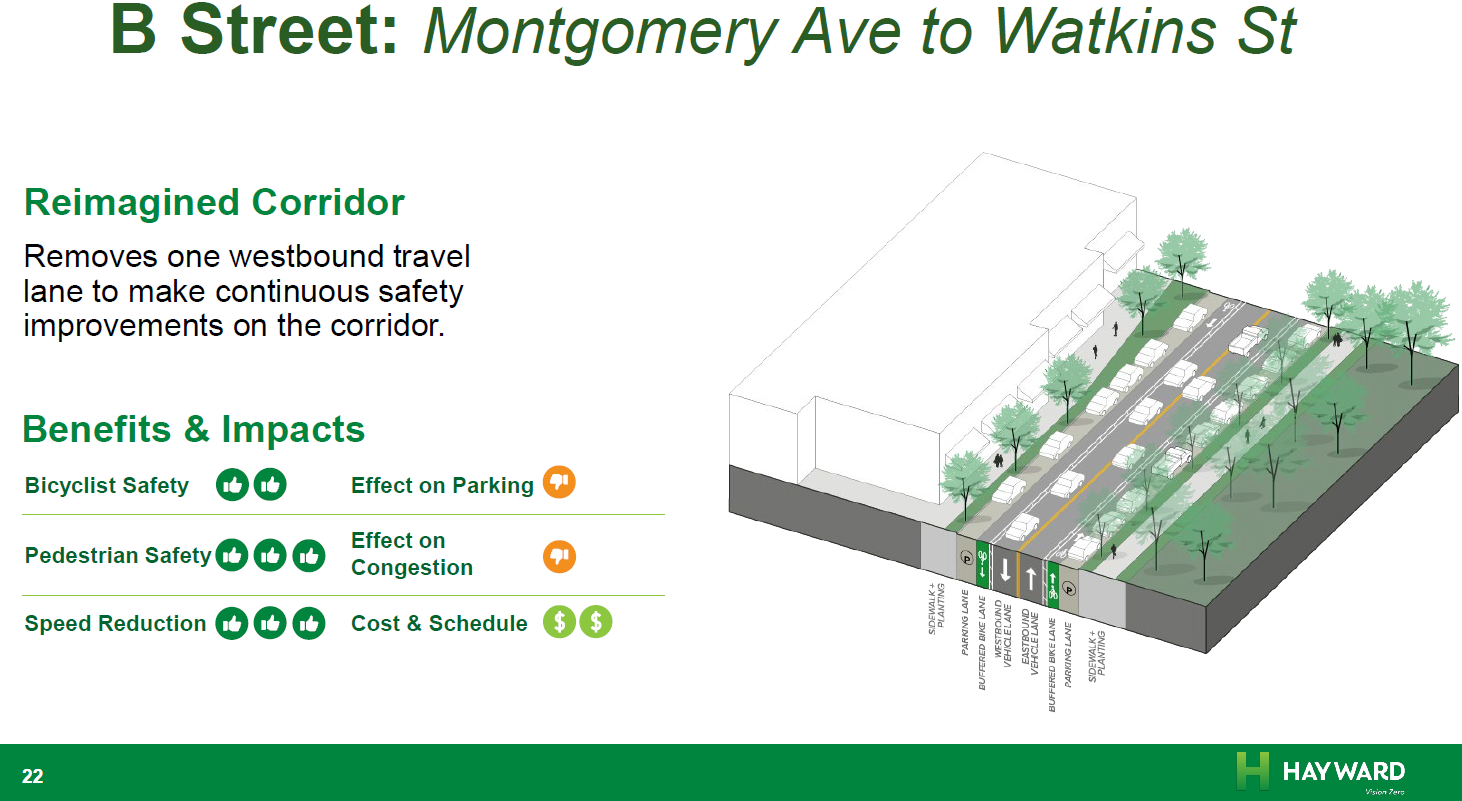
From Montgomery to Watkins, the only change is to remove an extra lane—so there will only be one lane in each direction—in order to extend the existing buffered bike lanes all the way to City Hall. The impacts on traffic should be minimal and may improve throughput with increased use of cycling and decreased merges.
Councilmember Syrop wondered what the plan was to transition from the two-way cycle track to separated bike lanes, an issue that frequently occurs when two-way tracks are recommended. City staff did not have a plan beyond saying they will need to "develop some protected intersection elements." Councilmember Syrop asked if it was better to be consistent across the entire corridor, but staff insisted that it would conflict with driveways beyond that segment.
Mayor Salinas said that it might be possible to get Union Pacific to pay for the improvements in return for losing the Amtrak station. "If they say no, we'll sue them and force them," Mayor Salinas said. "Did I say sue? I meant take them to court." He characterized the relations with Union Pacific as "not friendly to the City of Hayward."
There will be another round of outreach this summer, according to staff, but the plans are a long way from becoming a reality. The first section, a piece of Tennyson Road, won't even have the design completed for at least 2-3 more years.
Regional Funds Drive Changes Near BART
The Metropolitan Transportation Commission has earmarked a special tranche of money for Transit Oriented Communities compliant cities, which may grab Hayward an extra $2,000,000-$4,000,000. The funds would require areas within 1/2 mile of a BART station to meet certain policy requirements that promote a car-free lifestyle. A number of points are awarded for different policies like high maximum residential densities, removing parking minimums, having parking maximums, among a number of other policies.
Given the financial state of the City of Hayward, the city may adopt a number of different policies to meet these goals and secure additional funding. Some are already in progress, but below are some additional proposals:
- Adopt secure bike parking minimums for residential and commercial development
- Allow unbundled and shared parking for residential and commercial
The above are the easy steps. The following are possible, but require more political will.
- Adopt parking maximums for residential and commercial development
- Implement Priced Parking
Committee members were supportive of the bike parking minimums and unbundled and shared parking plans—the Planning Commission was against unbundled parking in the past. Councilmember Syrop was interested in playing with parking maximums, as partial points could be awarded for certain policies. There was also interest in some kind of priced parking, but staff worried about the amount of back-end work needed to implement it. Ultimately, Mayor Salinas seemed to promote getting the money. "Whatever are the easy things, let's do it," he said.


Comments ()