
Council Brings Ideas For Budget Solutions
In Which: Council looks to offload services to other agencies, ideas for making money are suggested, and Council worries about rebuilding trust.

New Year, New Budget Update
During the January 6th City Council meeting, new City Manager Jennifer Ott presented on the status of the City's budget after enacting some of the actions Council approved on November 18th. The majority of the cost-savings—which totals over $27,500,000—come from a $9,750,000 transfer and loan from Measure C, over $8,300,000 in personnel-related savings, and $3,000,000 from the OPEB Trust.
The OPEB Trust wasn't listed in previous cost-saving strategies, but according to Finance Director Deanna Hilbrants, the OPEB Trust is a pot of money set aside for future payments to retiree medical insurance. She said there is a way to use that money, which they'll request in two smaller payments. She also said that the Hayward Police Officer's Association (HPOA) gave concessions which contributed toward salary savings, but no details were provided and no MOU has been approved by the Council.
Beyond the savings already identified, Finance Director Hilbrants said she wanted to find an additional up to $4,000,000 to have as a buffer for unexpected expenses.
The primary purpose of this meeting was to give City Council an opportunity to identify "revenue enhancements" beyond those already suggested by City Staff. The only idea already being pursued by City Staff is a change to the Business Tax, which hasn't been changed since the 1970's, but would require voter approval through a ballot measure.
Finance Director Hilbrants showed a list of budget ideas from a variety of sources, including the community.
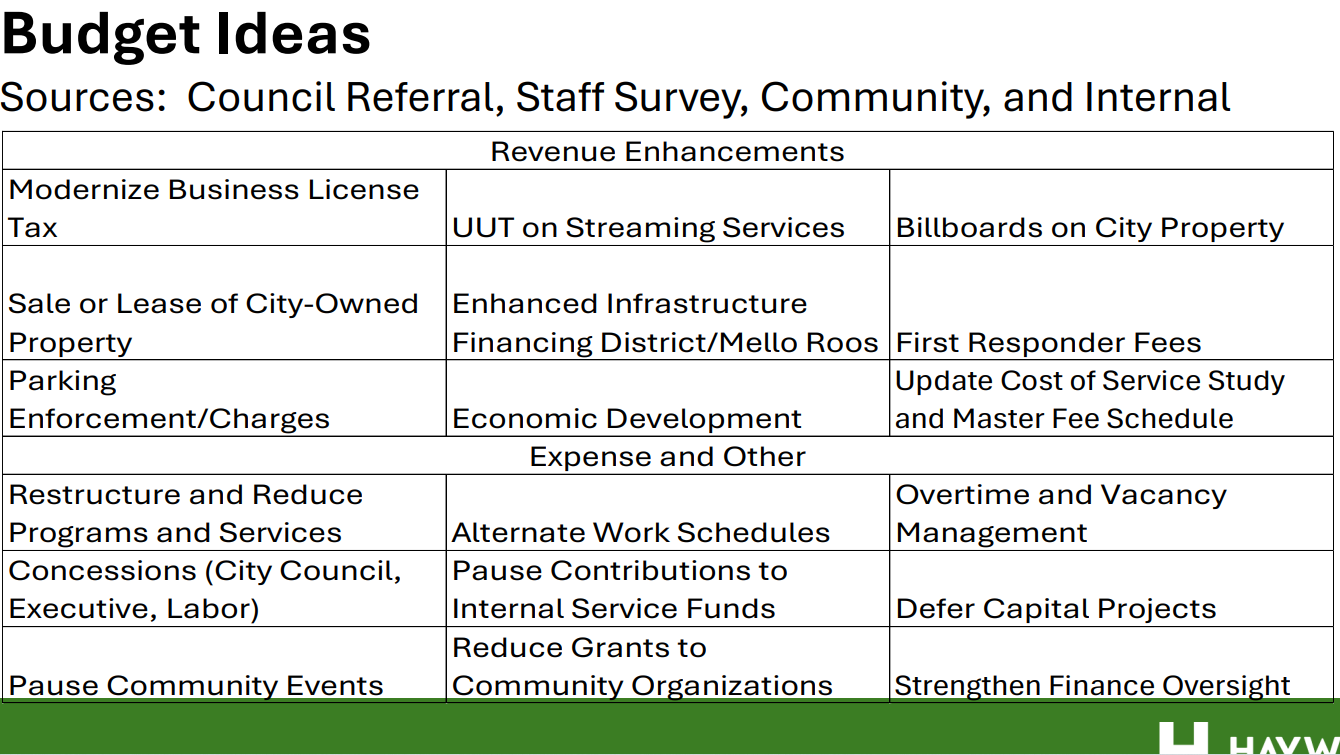
Finance Director Hilbrants stressed that nothing was being approved yet. "We're not judging these ideas at this point," she said. She said that any ideas brought forward today would be evaluated by City Staff for the February 28th budget work session.
Unions Continue To Push Back
During public comment, both union members and members of the public pushed back on how the City of Hayward was treating its workers. Emily Wallace of IFPTE Local 21 continued to push for revenue generation that didn't rely on cutting workers. She alleged that the business tax changes could increase the City's revenue between $13,000,000-$21,000,000 and also pressed Council to consider selling City properties.
Daniel Arnold, who said he was the partner of a City employee who was laid off, criticized how the City was negotiating with unions. "The City was never really interested in accepting concessions," he said. Union members have previously asserted that City negotiators wanted 3% staffing reductions across the board, regardless of that unit's impact on the General Fund.
Ideas For Saving Money
Councilmember Angela Andrews asked Staff to explore partnerships with the Hayward Area Recreation and Park District (HARD) and the Downtown Hayward Improvement Association (DHIA) to offload the expense for events onto other agencies. HARD is one of the only local agencies that isn't suffering from budget problems, and, according to City Manager Ott, they are open to funding 3-4 Downtown events in the coming year. Councilmember George Syrop supported the idea, as well.
Councilmember Ray Bonilla supported the idea beyond just events. He suggested looking for partnerships with any community organization to offload any service that is not considered a "core service" for the City to provide. He also pushed for a change in financial practices, including a policy for how the City deals with long-term vacancies. He suggested that if a position is open for over 180 days, it may not be critical to the City.
"It's better to make these decisions upfront as management philosophies," he said, "so that it guides the decision-making... so that we're not reactive and having to make cuts on the back-end." He also suggested a quarterly review of positions to see which ones can be "automated, consolidated, or eliminated," he said.
Councilmember Dan Goldstein also pushed for exploring technological solutions that would reduce costs. "Not to do away with jobs," he said, "but to make jobs easier."
Big Ideas For Making Money
The idea for generating revenue with the most support was re-evaluating the Business License Tax. According to a previous budget presentation, the City of Hayward earned about $3,000,000 from the Business License Tax in FY 25. Councilmember Andrews urged the City to develop the new tax structure in collaboration with businesses, presumably out of fear they may relocate if fees get too high.
However, Councilmember Syrop pointed out that other local cities have significantly higher Business License Taxes without losing local business. "Sometimes governments leave money on the table," he said. "This is money we have been leaving on the table and I think we need to pursue every available option." Revamping the Business License Tax was also vocally supported by Councilmembers Francisco Zermeño, Bonilla, and Goldstein—especially a more graduated tax that would not unduly impact small businesses.
Councilmembers Andrews and Bonilla pushed for speedier permitting processes, as well. "What would it take to get same day inspection and permit processing?" Councilmember Andrews asked.
Similarly, Councilmembers Bonilla and Syrop pushed for investments in other staffing that increases revenue, such as Code Enforcement and Economic Development. Councilmember Syrop pointed out that Airbnbs are illegal in the City of Hayward, and asked if additional enforcement could help local hotels which are facing an increased hotel tax this year ahead of the Superbowl and World Cup.
Councilmember Bonilla also put forward the idea of a First Responder Fee, which was recently adopted in the City of San Jose. This fee would cover the cost of paramedic-level care provided by the Fire Department and be charged to insurance providers, not individuals without insurance. "It looks like it ought to be an easy win," Councilmember Goldstein said.
Councilmembers also brought up economic development practices to increase sales tax revenue. Councilmember Zermeño continued to encourage residents to "Shop Hayward first" and asked if Economic Development could create a project around that theme.
Councilmember Syrop and Goldstein suggested using rezoning—specifically Accessory Commercial Units—to spur economic development activity. He framed this in opposition to some Councilmembers who were calling for a harsher crackdown on unlicensed street vendors. "We have 81 street vendors," Councilmember Zermeño said, "I think they need to be contained." Councilmember Syrop countered, "We're giving them a pathway to establish themselves."
Councilmember Andrews asked to review City-owned properties in the Economic Development Committee. "Not just because of the budget situation," she said. "I think we need to practice what we preach" and not be absentee landlords.
Councilmembers Andrews and Bonilla both suggested looking at ways to either sell or activate City-owned property. Councilmember Bonilla called for a "review and disposition on City properties, including the movie theater," he said. But both Councilmember Syrop and Mayor Salinas cautioned against using one-time funding—like property sales—to pay for ongoing financial problems.
Councilmembers Bonilla and Golstein supported the idea of a Melo-Roos Tax, which establishes a Community Facilities District—similar to a Special District or Landscape And Lighting Assessment District. With voter approval, the parcel tax could be used to pay for City services and be set to expire after a certain duration, according to Councilmember Goldstein.
Rebuilding Trust And Transparency
Some Councilmembers pushed for ideas that would help to rebuild trust and ensure that future City Councils don't make the same mistakes. For example, Councilmember Syrop asked for a mandatory Council training on financial literacy and labor negotiations. "We inherited loose financial practices," he said. "There was $34,000,000 of Federal funding that came in that allowed us to ignore this problem for a set period of time."
Councilmember Bonilla spoke at length about the need to develop prioritization policies regarding City services. He suggested things that are "critical to public safety, to legal, to compliance to revenue projection..." and pushed for the City to reassign work to increase efficiency. "I've seen organizations actually force rank services, one to n with no services being tied," he said. "That would be something that I think we should really do here as well." This would potentially provide a framework for future cuts, as well.
Councilmember Bonilla also called for a "risk-based financial decision-making approach" which would explore the effects of any cuts before actually making them. As an example, he pointed to the Library's budget being cut leading to reduced hours.
All of these ideas would, ideally, allow for clearer decision-making in a time of crisis which would help counter some of the feelings of distrust expressed by Union members and the public. Councilmember Roche asked for what she called the "story of the numbers" in an effort to reassure the community.
Assistant City Manager Mary Thomas said that much of the confusion came because of the tight timeline. She said that City Staff looked at the numbers, worked as quickly as possible and came to the 5.5% concessions needed to avoid layoffs. However by the end of November they weren't able to get the concessions and started the layoff process.
Councilmember Roche wondered how the City is going to get clarity and rebuild trust with the community. She compared it to her experience pushing back on her children's school district and feeling like "the money must be there," she said. "It feels very impossible right now up here for us."
City Manager Ott suggested that being in crisis mode and issuing constant updates with new information may have eroded trust. She said that going forward the City is going to try to get organized before releasing new information to build trust and transparency. "It's about trust and having employees and bargaining units trust us," she said. "We're going to keep working on it."
Mayor Salinas agreed about the need for the City to tell the story of the budget deficit. "We have arguably been probably the most transparent Council that this City has ever seen in years," he said. He took issue with accusations of a lack of transparency. He pointed to social media posts he's made where he said he "gets clobbered" and that he doesn't want people "stealing our narrative that what we have been doing up here has been transparent and accountable," he said.
Mayor Salinas tried to reassure listeners that borrowing from Measure C would allow the City to continue to provide the high-quality services that residents have come to expect. "We will continue to deliver on what we told voters that we were going to do," he said.


Comments ()