
Displaced Residents And Skywest Trees
In Which: Residents of Bridge Court complain about displacement, SOS Skywest brings high schoolers to City Hall, and Some on Council open to re-examining Airport Plans
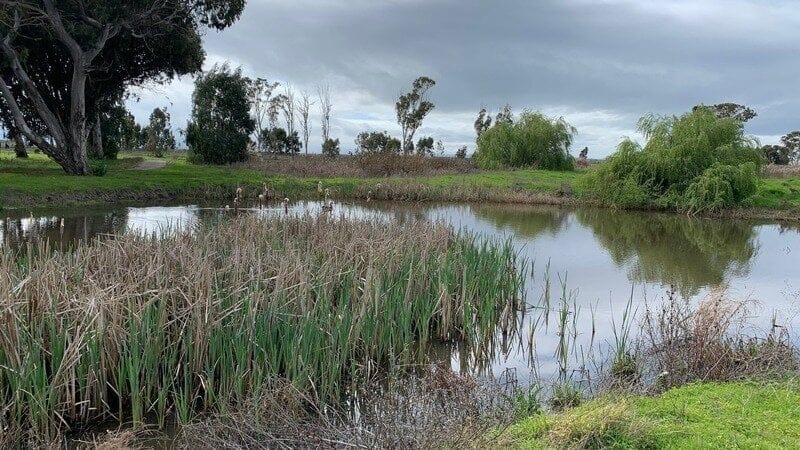
Students and Community Fight For Skywest
At Tuesday’s City Council Meeting, over half a dozen people spoke during Public Comment in support of maintaining the former Skywest Golf Course as a wild open space. Students from Arroyo High School in San Lorenzo, Hayward High School, and others joined community members concerned about the existing plans for the former golf course which is adjacent to the Hayward Executive Airport. The Airport Master Plan, which was adopted in 2002, informed the 2022 Development Plans for the area, which is technically a part of the Airport.
According to the Development Plans, the western side of the park would be turned into a Business Center, much of the eastern portion would become more aircraft hangars, and a large portion of the central area would be cleared as an FAA Airport Safety Zone. This plan was developed after a community engagement process which appeared to heavily favor other, more nature-focused, uses, including wild space, tiny homes, and urban agriculture.
“The majority [of the community] wanted Skywest as a green space for our community,” one speaker said, “or to be used for recreation purposes.” They said that less than 20% of the land in the 2022 Development Plan is designated as recreation. “We have been fighting to save the land to this day.” Many also highlighted the existing endangered and vulnerable species that have made their homes at Skywest, including one of the largest Monarch Butterfly groves on the West Coast and the water features which now house a thriving Western Pond Turtle community.
Commenters also pointed out that the airport disproportionately benefits people who do not live in Hayward. They alleged that a public records request revealed that most of the people who use the Hayward Executive Airport hail from places like Palo Alto. “We should not trade away our natural future for people that are not from our community,” one speaker said. “Community should have a bigger voice in land use decisions over people who are not living here,” another said.
Another speaker highlighted the benefits an open space would have for children and teens in the area. They said there was a “massive lack of open space in our area… it represents a safe open space where children could have fun.” They said that the lack of open space is part of why children are spending more time indoors. “Because they have nowhere else to go,” they said.
One speaker also highlighted a similar initiative being spearheaded by the East Bay Regional Park District (EBRPD) in Antioch. The former Roddy Ranch Golf Course is being considered for restoration and conversion into a natural park space, in partnership with the East Contra Costa County Habitat Conservancy. “So if Antioch can do it,” one speaker said, “I really think Hayward should be doing it, too.”
Complications at Bridge Court
The site of an affordable housing development on former Caltrans Parcel 8 was the center of anger and confusion at the City Council meeting on Tuesday. Multiple residents of Bridge Court, off of Grove Way near Castro Valley, spoke out against the City and its relocation plans for residents. The residents who spoke said that they felt betrayed by the City and were being forced to move out within three months—but that’s not exactly what’s going on.
After Route 238 was stopped from cutting through most of Hayward, Caltrans eventually gave the land that it had acquired for that purpose back to the City of Hayward. The City, per their agreement with the State, began trying to offload the properties—according to a set of criteria—to different developers. Parcel 8, located off of Grove Way to the East of Foothill Blvd, was slated to be developed into an affordable housing complex by RCD Housing.
But a set of homes, with tenants, already existed on the property. After the land was turned over, some of the residents moved out, but many stayed on the property because there was a “zero displacement goal.” This meant that if people didn’t want to move, they would be temporarily relocated during construction, and be offered a unit in the complex—if they meet income requirements. 6 households still live on Bridge Court.
Thanks for reading Hayward Herald! This post is public so feel free to share it.
But RCD’s first attempt to get funding fell through and the project has been delayed for at least a year. That means that the construction won’t be done until at least 2028. On top of that, the existing buildings have begun to fall into disrepair and the developers have no incentive to fix them because they’ll be demolished during construction.
Given the significant delay, the City is attempting to encourage the residents to move somewhere else. “We really wanted to encourage the tenants to find better housing,” said Deputy Director of Development Services, Christina Morales. She said that RCD is working with a consultant to “sweeten the deal and assist the residents at Bridge Court to find a better place to be.” These incentives have a 90 day timeline.
The City is also seeking to remove the “zero displacement goal” because they think it’s unlikely that someone would want to move back after three years of being away. “That two-year timeframe really turns into a permanent relocation, anyway,” City Staff said. Another important issue, is that the relocation assistance only applies to tenants who were living at Bridge Court at the time Parcel 8 was handed over to the City of Hayward—any residents who moved there after 2016 would be ineligible for assistance.
Councilmember Bonilla tried to clarify if the tenants were being encouraged to move or being required to move. Ms. Morales said that the City was offering an incentive, but that it may change after 90 days. She also said that if any evictions were served, they would be handled by the City Attorney’s office.
But Councilmember Bonilla was concerned about the zero displacement goal not being maintained. “It sounds like these residents have pretty deep roots in Hayward,” he said. “We definitely don’t want to be contributing to an already exacerbated issue of homelessness in our community.” Ms. Morales and the RCD representative stressed that the relocation consultant would work with tenants to find somewhere to suit their preferences, whether that’s in Hayward or elsewhere. “It would be really personalized assistance for the tenants for finding the relocation,” they said.
Councilmember Bonilla asked if there was an issue with there not being enough affordable units in the development, but Ms. Morales pointed to a different issue for Bridge Court residents. “[The bigger issue is] being over income for some units,” she said. Councilmember Bonilla asked if the item is not accelerating evictions, but offering an incentives to look at over the next 90 days. “Correct,” Ms. Morales said, “There is no eviction.”
Councilmember Andrews asked if there had been outreach to the residents about the item. Ms. Morales said that they had an in-person meeting with Bridge Court residents on July 21 and had been in close contact with the affected households. Evidently, this did not sway Councilmember Andrews, who was the lone vote against the item.
Tree Preservation And Airport Issues
This new law has been bouncing back and forth between City Staff, the Planning Commission, and City Council for almost a year. Despite concerns about government overreach into people’s rear yards, Staff held firm on the importance of that particular provision. “The intent is to preserve native trees on private property,” they said. “And that’s one of the most significant changes that we’re proposing.”
For clarity, here is an exhaustive list of native trees that would be covered by the ordinance:
- Big Leaf Maple - Acer macrophyllum
- California Buckeye - Aesculus californica
- Pacific Madrone - Arbutus menziesii
- California Sycamore - Platanus racemosa
- Coast Live Oak - Quercus agrifolia
- Canyon Live Oak - Quercus chrysolepis
- Blue Oak - Quercus douglassii
- Oregon White Oak - Quercus garryana
- California Black Oak - Quercus kelloggii
- Valley oak - Quercus lobata
- Interior Live Oak - Quercus wislizenii
- California Bay - Umbellularia californica
- California Black Walnut - Juglans hindsii
If you have any tree not on this list in your back yard, you can remove them whenever you like.
Other changes include adjusting the fees to a sliding scale—making them cheaper for removing a small number of trees and more expensive for a large number, adding an in-lieu fee option for when there’s no ability to replant trees on site, and creating a Heritage Tree designation that would require approval from either the Planning Commission or City Council in order to remove them. Staff said they have a robust outreach strategy for sharing out the information when the ordinance is approved and will return to the Council in Fall 2026 to allow Council to decide what to do with the in-lieu fees that are collected.
Airport Rules Cause Confusion
Most of the discussion revolved around how the Tree Preservation Ordinance interacts with the FAA regulations—which were only referenced in the Appendix for clarity. Councilmember Zermeno asked how these two things work together. Planning Manager Jeremy Lochirco said that the Preservation Ordinance is separate from the Airport District, but some of the confusion may have happened because the same consultant that developed the Ordinance also developed a list of recommended vegetation around the airport.
The FAA regulations, Mr. Lochirco said, exist whether the Tree Preservation Ordinance is approved or not. Any development at the airport would also have to comply with the Tree Preservation Ordinance, so any trees that are removed at Skywest would have to be mitigated in some way—whether on-site or off-site—in order to comply.
Councilmember Syrop drew attention to a map on page 34 of the draft Appendix. It shows a Planting Zone map, which includes a “Runway Object Free Zone” that extends beyond the length of the physical runway into the former Skywest Golf Course. He asked for clarification on what was required as opposed to recommended. “It feels like the requirements versus the recommendations distinction is being obfuscated,” he said.
A member of the Airport Staff said that the zone extends beyond the boundaries and is set by the FAA based on aircraft trajectories. They are areas that should be clear in case planes need additional space to stop in an emergency. Mr. Lochirco also tried to draw a boundary between the FAA and the City requirements. “The guidelines for aircraft planting,” he said, “that’s not regulatory from the City’s perspective. Those are FAA Guidelines on things they’re recommending that would deter potential wildlife interactions.”
Councilmember Syrop pressed for more clarity on what was required versus recommended. The Airport Staff read from an FAA document that seemed to say that it was important for the Airport to follow these guidelines in order to receive grant money from the FAA for infrastructure projects. “It seems like the large majority of the trees are not in the [Runway Protection Zone],” Councilmember Syrop said.
Councilmember Roche asked what would happen to the large eucalyptus trees in the RPZ that may need to be removed. Mr. Lochirco said that it would also have to go through the process laid out in the ordinance and would likely wind up being a City Council decision. “It does not give the airport free reign to start cutting down the eucalyptus,” Councilmember Roche restated. “That is correct,” Mr. Lochirco said.
Councilmember Bonilla clarified that the ordinance doesn’t hurt Skywest in any way. “We are years away from that potentially happening,” he said. Councilmember Andrews asked Staff to explain the engagement process required under CEQA, and they explained that a robust outreach process would be required by law for any development at Skywest.
Fire Danger A Concern For District 1
Councilmember Syrop, who will soon go up for re-election in newly-created District 1, asked questions about the fees and how that would interact with fire safety concerns. Much of District 1 encompasses the Hayward Hills, which was recently included in a draft Fire Hazard Severity Map from CalFire. Mr. Lochirco explained that there is an exemption for fire areas and that rules involving zone zero spaces was going to be coming before the City Council in the future, along with defensible spaces guidelines.
Councilmember Syrop asked if moderately high risk areas would be covered by the exemptions, saying that some in those areas are already losing their insurance coverage. Mr. Lochirco said that if a resident gets the okay from the Fire Marshall to remove trees, there will be no fee. “[We] want a case by case basis and be able for the city to review requests,” he said, “to make sure we’re just not obliterating our tree canopy.”
Councilmember Syrop pressed for Staff to allow residents to submit an insurance policy cancellation notice as opposed to relying on the Fire Marshall. Staff said that it could be included in the future defensible spaces policy.
SOS Skywest Achieves A Victory
Councilmember Syrop opened the final comments in support of the Tree Preservation Ordinance. “It’s better to have this than to not have this,” he said. But on the subject of Skywest, he recognized that things get complicated. “These are really complex ordinances,” he said, “we’re really trusting Staff here. And so if we sign off on this and then we’re seeing massive changes to the makeup of Skywest, for example, it’s going to feel like a betrayal of community trust.”
Councilmember Zermeno felt similarly. “I am leery a little bit about the inclusion of the airport,” he said, “because I see it, perhaps, as a way to kill all those trees around the airport… I’m not pleased with that particular notion.” He continued, “I don’t feel that any tree near the airport should give up its life.” Mr. Lochirco reiterated that the FAA regulations exist whether the Tree Preservation Ordinance is approve or not, it was only included to make people aware of Federal law.
Councilmember Roche took a tone of assurance. “My motivation here is to create more protection for our canopy in the city,” she said. “I don’t think there’s any boogeyman on some surreptitious way of taking out trees.” She said that previous issues around tree removal were actually caused by not having a robust ordinance like this in place.
Councilmember Andrews agreed. “It’s called Tree Preservation Ordinance,” she said. “The purpose of it is trying to protect our trees which is very important.” As did Councilmember Bonilla. “I share the concern about [Skywest], but I don’t think the intent of this is to pave that over,” he said.
Re-Examining The Skywest Plans In Future
Councilmember Syrop said that the old plans for Skywest and the Airport were old and approved by a completely different City Council, suggesting that perhaps they should be revisited. “Please don’t take advantage of the community trust here…Let’s not be Dr. Seuss villains,” he said, referencing The Lorax.
Councilmember Andrews seemed to agree. “I do think it’s time for possibly another conversation and reminder of what is happening,” she said. “We are continuing to see a lot of advocacy at every single meeting.” Councilmember Bonilla also seemed open to re-examining the plans. “[I see the] importance of keeping Skywest—or exploring Skywest as open space,” he said.
Mayor Salinas didn’t feel the need to say anything additional about the Tree Preservation Ordinance. “I know right now we’re landing on the best side possible,” he said, “so I will stop there.”
Comments ()