
Federal Action Brings Fear To Hayward
In Which: Federal agents in Alameda bring fear to region, City may cut funding for future community events, Zoning change shouldn't affect cultural fabric of neighborhood

ICE Scare Ripples Through Hayward
As word of impending immigration sweeps throughout the Bay Area spread, Hayward residents realized that they would not be immune from enforcement action centered in San Francisco. According to local advocates and residents, immigrant and undocumented communities made themselves scarce in public this morning, including day laborers around the Home Depot on Hesperian Blvd and street vendors throughout the City.
 Collin Thormoto
Last night and this morning, Hayward’s elected officials highlighted the City’s Sanctuary Status and shared information on the restrictions of Police in immigration actions. However, reports from Los Angeles and Chicago have said that, despite Sanctuary policies, local police in those areas did perform crowd control and clear streets on behalf of Federal Agents. It is unclear how the Hayward Police Department would respond in such an event.
Thanks for reading Hayward Herald! This post is public so feel free to share it.
Despite San Francisco Mayor Daniel Lurie saying that the raids have been called off, residents are still wary of future immigration action. If you believe you have seen Federal agents or Immigration Agents, please contact the ACILEP Hotline: (510) 241-4011 between 6am and 6pm. Make sure to take photographs, if possible, of the agents, their vehicles, and make note of the location and time.
ACILEP has trained volunteers who will confirm whether or not the sighting is, in fact, ICE in order to prevent rumors from spreading.
We will share verified updates on social media as they develop.
City Combs Budget For Savings
During the Hayward City Council meeting on October 21st, the standing item on the Budget outlined how the City is looking at everything to try to remedy the budget shortfall. Looking at historical budgets and expenditures, hiring financial consultants, and preparing more frequent financial reports for the Council are just some of the tactics City Staff are using to keep tight control on spending.
The Budget and Finance Committee looked at the last 10 years of budget to actual reports, revealing huge missteps in how the City budgeted overtime. The Finance Department is preparing a quarterly report for the City Council which will also include quarterly actuals—something which isn’t usually done until the fiscal year is over already. Assistant City Manager Mary Thomas also said that the City hired two financial consultants on a 45 day contract to work with the Deputy Finance Director and Accounting and Budget teams.
“[They] are working with [the consultants] daily to conduct a financial review,” Assistant City Manager Thomas said. The review will be presented to the City Council and used to create a long-range forecast, in addition to the annual audit. On top of that, all City departments are scouring their budgets for savings. “Each department is conducting an exercise to identify additional potential cost savings on top of the reductions that have already been made this year,” Assistant City Manager Thomas said. The recommendations will be presented on November 18th.
 Collin Thormoto
Ms. Thomas also relayed to the Council that the Notice of Funding Availability for Community Services Funding was cancelled. “This decision was really not made lightly,” she said. “We understand the really difficult impact that will have on agencies that apply for this funding. However, this was the fiscally responsible decision that Staff felt we needed to make.”
Councilmember Julie Roche asked for a “high-level understanding of what the community might feel as we make these cuts.” Ms. Thomas said that won’t be clear until after the department reviews, but the City is looking at all City grants for savings. She clarified that the cuts are coming from the General Fund, which she called the “public safety, library side of things” in contrast to services like sewer, water, and garbage.
Councilmember Angela Andrews asked City Staff to define the roles and responsibilities of everyone involved in the budgeting process—suggesting that the City Council’s hands may be tied on some issues. “I think education to the public of what we can and can’t do based on our Charter and our City Manager/City Council form of government… to provide transparency so people are aware of what we can and can’t do as a Council versus what Staff can and can’t do,” Councilmember Andrews said.
Councilmember Andrews also hinted that City funding for local events is likely to dry up, calling on local businesses to pick up the tab. “Our business community should be looking at how to support us,” she said, “if they want to have events as well as community engagement.”
Zoning Change Raises Fear Of Cultural Loss
The proposed zoning change at 900 Calhoun came before the Hayward City Council on Tuesday. Despite concerns about changing the cultural texture of the small agricultural enclave near Moreau Catholic High School, the City Council ultimately voted to approve zoning changes on the single parcel. They cited State law, which could have forced the City to enact the change regardless, while also making clear that any future development would need City approval.
Councilmember Ray Bonilla recused himself from the discussion and vote because he lives within 500 feet of the property in question.
We’ve Been This Way Before
The Staff presentation gave additional context to the reason for the rezoning. In 1987 the Mission Garin Neighborhood plan was approved by a neighborhood committee that included two representatives from the Calhoun neighborhood at the time. The 1987 plan included a rezone for the parcels at 890 and 900 Calhoun Street but, “it is unclear why the zoning was not updated to be consistent with the General Plan at that time,” Associate Planner Taylor Richard said.
The General Plan designation remained, but a past proposed change was denied in 2015 by the then-City Council. At the time, the denial was in accordance with State Law, but the law changed in 2019. Despite that, the Planning Commission recommended 6:1 that the City Council deny the project. They cited concerns around the existing General Plan and the potential for future development.
“Before we dive into the project,” Ms. Richard said, “I also want to share some applicable provisions in of California State Law.” She explained that State Law requires the zoning to be consistent with the General Plan zoning within 180 days of an application by the owner. If they don’t, the City has to allow the density outlined in the General Plan but can’t apply any design standards.
As it stands, the current property owner—if denied the rezoning—could potentially put 8 wild and wacky houses on the lot and there’d be nothing the City or anyone else could do about it. But Ms. Richard made clear, “Any future development would require review and approval by the City,” if the rezoning is approved. However, no additional development is planned—it’s just a rezoning.
Our Hands Are Tied, Right?
Councilmember Roche started by asking a clarifying question. “Am I right in that we’re caught in a bit of a state local technicality here?” she asked. Staff said that the City either needs to rezone the parcel or they won’t be able to apply any standards “that would preclude the density allowed in the General Plan.”
“So they could [build up to 8 units] currently,” Councilmember Roche said, “even if it was considered agricultural right now?” Ms. Richard confirmed that was the case, but she took pains to emphasize that rezoning was preferable so the City could enforce design standards like setbacks and height restrictions.
Councilmember Andrews asked what would happen if the Council denies the rezone. An attorney for the City explained how the previous denial was legal in 2015, but that the laws changed in 2019 and now Charter Cities—like Hayward—are required to be consistent between zoning and the General Plan. The City was apparently sued by the homeowner at the time, but the City won at the time. This time, however “the result of the lawsuit,” the attorney explained, “would be different.”
Councilmember George Syrop asked about any liability cost the City would incur. The attorney said that the courts usually just force the City to make the change, but it would incur attorney fees and a cost in Staff time.
Councilmember Dan Goldstein asked if the rezoning might actually be a good thing. “So doing the zoning change today actually upgrades the quality and consistency,” he said, “and otherwise improves upon what the current condition is for that zoning.” Ms. Richard clarified, “It would allow us to fully enforce all of our objective standards.”
Neighbors Are Not Having It
At least three different households, including the immediate next door neighbor, spoke against the change. The primary concern appeared to be a loss of agricultural culture and character. “We want our neighborhood to stay authentic,” one neighbor said. “We don’t want anyone getting pushed out.”
Another resident, a teen at a local high school said, “If you take this rezoning, It’ll change everything. It’ll even take away our culture… it changes who we are as a people… it might force us to move homes.” A concern about cascading effects of development seemed to weigh heavily on residents.
One went so far as to suggest changing the General Plan, which would be a huge undertaking by Staff. Staff later explained that downzoning in one area would require upzoning another area and the whole thing would require a new CEQA process, which is time-consuming an expensive.
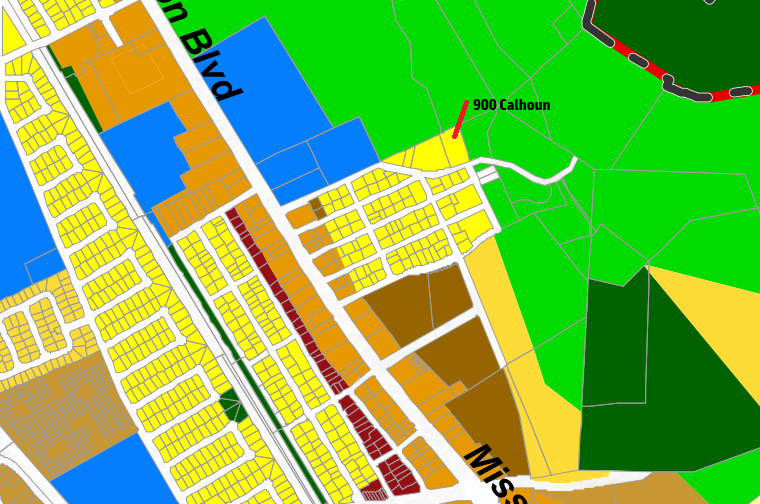
Fortunately for residents, the Land Use Diagram indicates that only a few parcels are affected by the General Plan. According to the local zoning map only one other parcel, 890 Calhoun, has the same issue. Everything else is listed as Agricultural in some form or another.
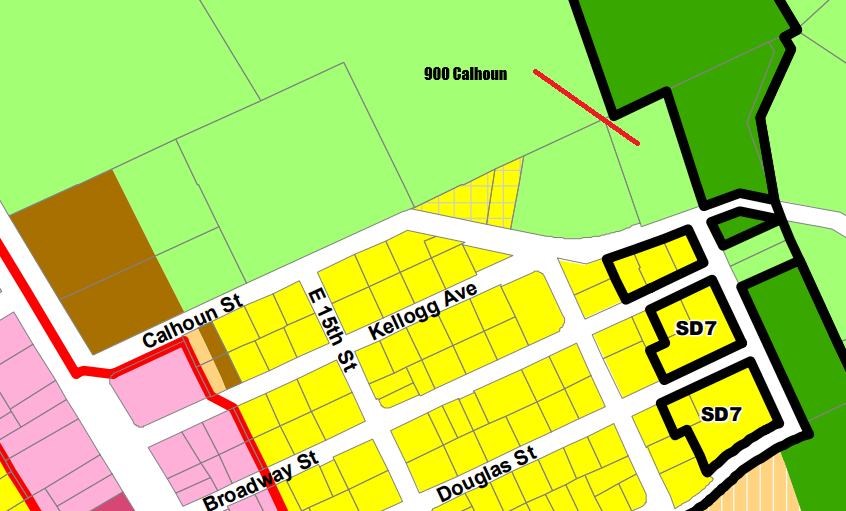
The Culture Is Still There?
Councilmember Roche, and many other Councilmembers, recognized the value of the small agricultural enclave. “It sounds like a wonderful neighborhood,” she said, “and I understand why you’d want to maintain your way of life.” But, after making sure that the change wouldn’t affect any other property and that agricultural would still be allowed on a small scale if someone else bought the parcel and that all the buildings are compliant, she ultimately voted in favor of the change.
“[This change] shouldn’t take away anyone else’s ability to work your land the way you want to,” she said. “There is a technicality that gives them the right to do this… I believe you will continue your way of life.”
Councilmember Zermeño asked about other neighbors losing livestock or other changes to neighboring properties. “There is no change that would impair their ability to maintain livestock,” Staff responded.
“Culture is still there?” Councilmember Zermeño asked. “Correct,” Staff said.
Councilmember Andrews accepted the need for the change, if begrudgingly. “We know that whatever is going to happen at this piece of property is going to change the character of the neighborhood,” she said. “But unfortunately this is where the Calhoun task Force agreed upon this particular area for that zone change.” However she also pointed out that any future development would need to be approved by the City and could be protested then by neighbors.
Councilmember Goldstein once again laid out the reality. “He can build eight houses on this property right now,” he said. “The zone change doesn’t affect your properties. Not directly, anyway. I think that our hands are tied by State Law.”
Hayward Mayor Mark Salinas took time to empathize with the neighbors. “I am very familiar with that block between Calhoun and Hancock,” he said, “with the legacies your families have carried for generations in that small little square of the city.” He then turned to the property owner. “In order to do anything on that property,” he said, “you’re going to have to come to us. They don’t want you building big monster houses on that property and I would hope you listen to that.”
However, he also agreed that the change was necessary. “Our hands are tied up here,” he said. But he had a parting message for the neighbors: “I don’t want the neighborhood to feel all hope is lost because down the road, you still have an opportunity to advocate and block future developments on the property.”

Comments ()