
Filipino Residents Support Disaster Victims
In Which: We outline the environmental crisis in the Philippines, Social services see allocated funding slashed, and CSC pivots to new role due to budget
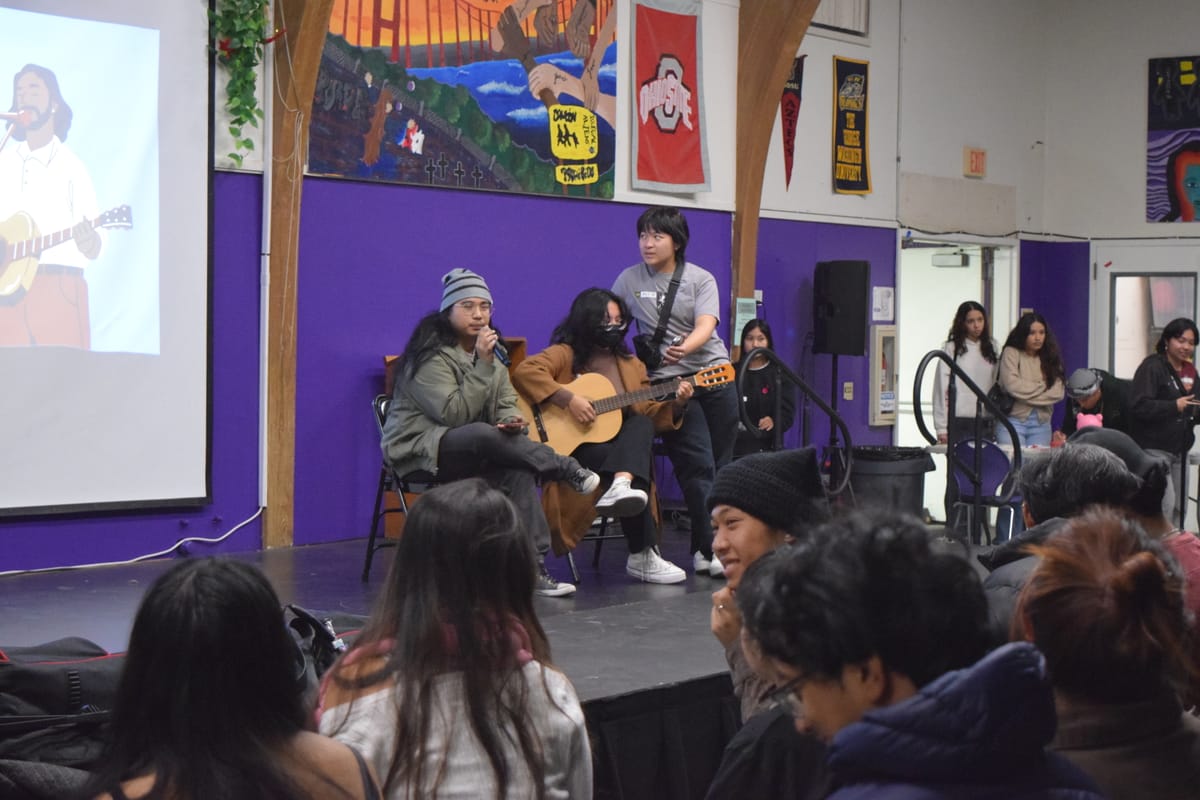
Hayward’s Filipino diaspora raise funds for typhoon relief
Contributed by Andrea Jiménez
Last Friday strumming harmonies, spoken word poems and Tagalog songs from the Philippines countryside reverberated through the auditorium at Impact Academy of Arts & Technology. The melodies and heartfelt recitals were all for one cause: to raise funds for typhoon relief in the Philippines.
The fundraiser, named Cultural Night and Open Mic for Typhoon Relief, was hosted by Filipino advocacy groups in Hayward and Union City: Hayward Coalition for Human Rights in the Philippines (HayCHRP), Anakbayan Hayward, Malaya Union City, Impact Academy’s Filipino Club and Migrante Union City.
“Open mics are just one of the ways that we thought, ‘Why not get people involved to express themselves?’,” said Anjo Ortega, a member of Ankbayan Hayward. “But also to build community with one another and continue to broaden the efforts that we have to send relief back to the Philippines.
On November 4, Typhoon Kalmaegi made landfall in the Philippines. The heavy rains caused flash floods and landslides, leaving over 200 people dead and displacing over half a million others. Only five days later typhoon Fung-wong struck, which raised the death toll to nearly 300 and the number of displaced residents to over 1.4 million.
While natural disasters in the region are not preventable, the Philippines has a history of corrupt government officials embezzling environmental funds that prepare for such disasters.
In September, Filipinos held demonstrations to protest the government after discovering that $17.6 billion dollars designated for flood relief projects were misappropriated. Flood relief projects that President Ferdinand Marcos Jr. had claimed to have been completed earlier this year were actually done poorly or were never carried out at all.
Outraged protesters called out government officials and other contractors linked to the scandal for living lavishly and grossly displaying their wealth while everyday citizens live in poverty and are put at risk of losing their livelihoods and even their own lives in floods due to the officials greed. The Philippines is ranked among the countries most affected by climate-related disasters. Natural disasters are exacerbated by human-led climate change, creating the perfect climate for more typhoons like Kalmaegi and Fung-wong to hit the country in the future.
All of the proceeds collected at the open mic fundraiser were donated to the National Alliance for Filipino Concerns (NAFCON), a non-profit promoting the rights and well being of Filipinos. Because of the existing distrust of the Filipino government’s ability to manage relief funds, NAFCON was chosen by the event coordinators because it sends funds directly to people and towards immediate relief such as the purchase of food and medical supplies.
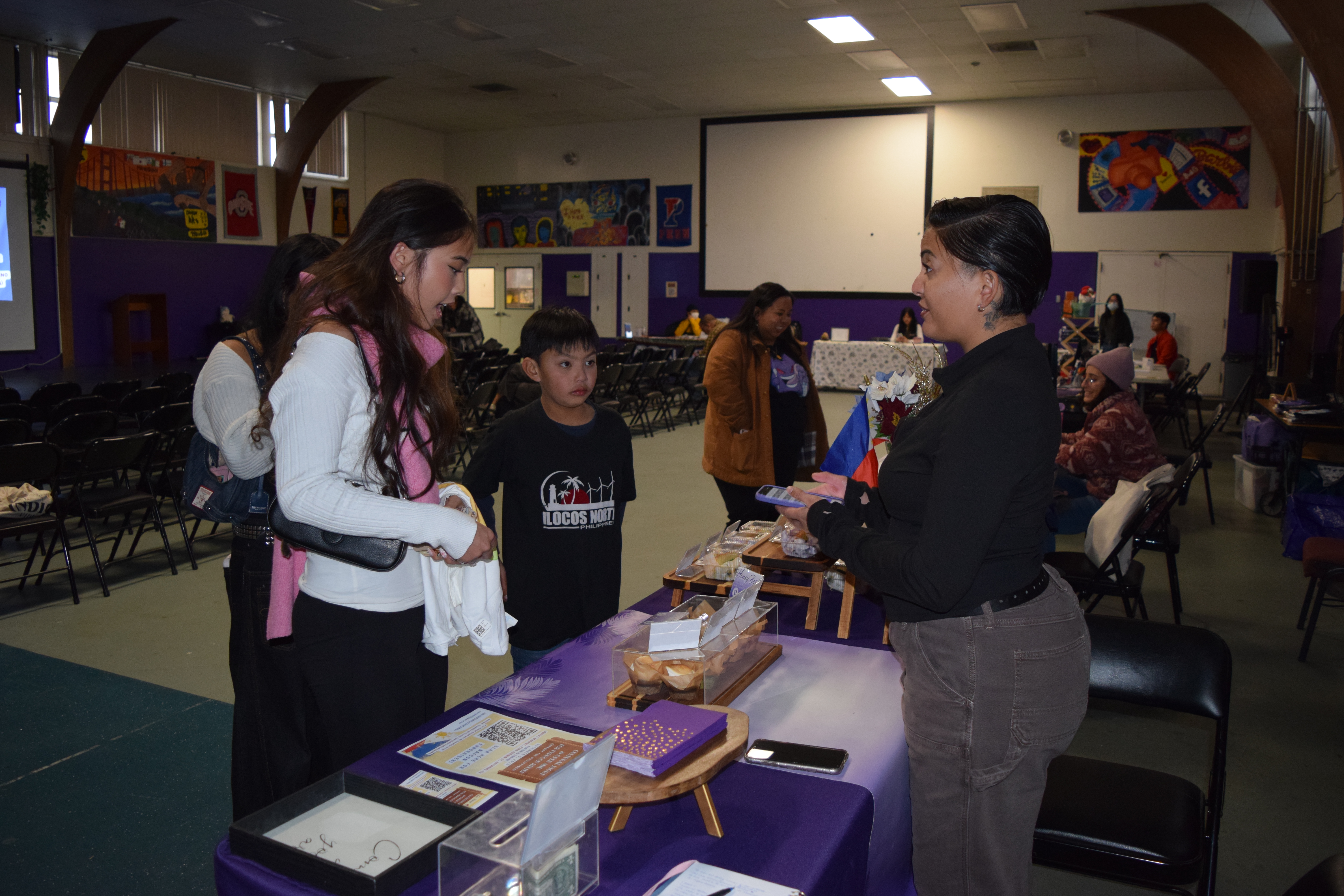

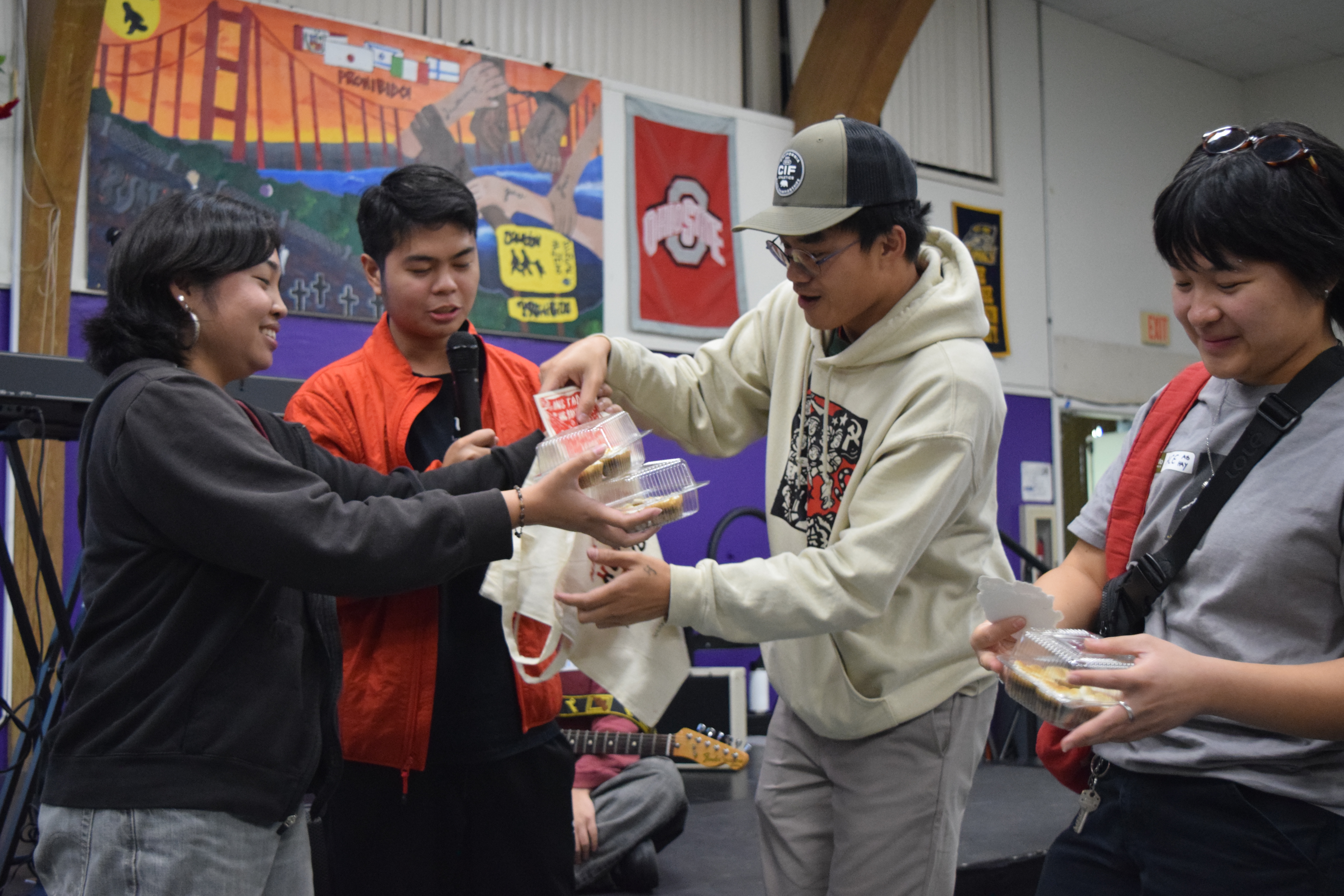
Attendees of the event were encouraged to donate funds by purchasing raffle tickets and traditional Filipino plates loaded with pancit and lumpia. The walls of the auditorium were lined with booths, all of them Filipino vendors, selling crafts and traditional Filipino desserts.
One of the vendors, Brianna E, the owner of Ube Bae, said 20 percent of the sales from her booth were donated to the cause, in addition to 50 mini ube muffins she donated to be raffled off to participants.
Brianna said it felt important for her to be a part of the event that aided her homeland. “No matter how many generations ago my family lived there, I still feel a connection because I am Filipino through and through,” said Brianna, who is of Filipino and Portuguese descent. “I wanna do my part from across the oceans to support in any way I can.”
For the event organizers, the event wasn’t a one off thing. They said typhoons are rampant in the region and anticipate hosting more typhoon relief fundraisers in the coming year. But the organizations also want to shine a light on the greater injustices and systemic issues happening in the Philippines as part of a larger mission to address human rights violations.
“The Philippines is a focal point for us due to the fact that it’s quite symbolic of American imperialism, the destruction of our planet and all of these different hot points that should be focused on but largely do not get focused on,” said Jamila Hayes, a member of HayCHRP.
According to the Human Rights Watch various human rights violations and abuses are being committed in the Philippines, “such as extrajudicial killings, enforced disappearances, and harassment and intimidation of critics through ‘red-tagging’.”
HayCHRP is a local chapter of a nationwide network of Filipino and non-Filipino members that are raising awareness to the rampant human rights violations happening in the Philippines, including residents not receiving adequate natural disaster relief.
“The desired outcome [today] is to get all the basic things that people need in the Philippines,” Hayes added. “But, really, it’s to create a sustained awareness so that way it’s constantly on the back of people’s minds.”
To get involved, reach out to HayCHRP via email at haychrp@gmail.com or follow them Instagram at @haychrp.

Cuts To Funding Force Commission to Pivot
By Collin Thormoto
At the November 19th Community Services Commission (CSC) meeting, the Commission was forced to reconcile their newly-limited role with the City Council’s decision to completely eliminate Community Services Funding for the coming year. The CSC is exploring different ways to provide non-monetary assistance to service providers to make up for the lost funding. However, one Commissioner pointed out that, despite Council’s support for this pivot, it runs completely counter to recent changes to the CSC’s purview by those same City Councilmembers.
City Cuts Half Of Funding For Services This Year
During the November 19th Community Services Commission (CSC) meeting, Community Services Staff explained that the usual funding for social services would be cancelled for the coming funding cycle. In the October announcement, the City explained that $1,400,000 of General Fund and Opioid Settlement money, which would usually be allocated to local social service providers, is instead being rolled back into the General Fund.
But even beyond cutting funding for the coming year, Community Services Manager Dr. Amy Cole-Bloom said that the current year’s funding would also be slashed. Pointing to a directive for all departments to cut 5% of their spending, the City Manager’s Office—which oversees Community Services—cancelled all existing General Fund contracts as of December 15th.
When members of the CSC questioned City Council’s decision to cut funding, Assistant City Manager Regina Youngblood explained that it wasn’t all up to City Council. “The City is barrelling very close to the edge of insolvency,” she said. “We will be laying off our own employees as a result of that shortfall. We have to show that we have done everything we can to pay our own bills first before we try to put the burden on employees. We just simply don’t have a choice.”
This will result in all previously-approved awards being cut in half. For example, the Mercy Brown Bag Program was allocated $50,000 to help alleviate food insecurity at retirement centers. They will only receive $25,000 and have no opportunity to access City funds next year. The full list, approved in June, contains around 25 agencies which were slated to receive over $580,000.
“Every competitive general fund recipient for our current fiscal year will only be receiving 50% of their award,” Dr. Cole-Bloom said. She explained that general fund recipients are paid in installments, with the rest being paid after the first reporting period in December, and the final amount some time after that. The agencies are not required to file any reports, but also will not be receiving more than 50% of the amount awarded.
Supporting Agencies In Other Ways
The Community Services Staff reached out to the affected agencies to ask how this year’s funding cuts would impact their services. The majority of the agencies said that it would cause a reduction in services for Hayward residents, impact staffing levels, and cause some financial strain for their organizations.
But when asked how the loss of next year’s funding would impact them, the response was much more drastic. A majority of agencies reported moderate to significant impacts to services provided to Hayward residents, staffing levels, financial strain, and the overall stability of their organizations. “Pausing the funding cycle for this year is significant,” Management Analyst Amy Hwang said. Though Dr. Cole-Bloom also said that other funding uncertainty—from donors and the Federal Government—likely also play a role in the responses.
Thanks for reading Hayward Herald! This post is public so feel free to share it.
The Community Services Division asked service providers about the kinds of non-monetary support the City could provide. The three top ideas were direct volunteering/recruitment support, support with promotion and advocacy, and assistance in identifying other sources of funding. According to Staff, the City Council have supported exploring other, non-monetary, ways the CSC can support service providers.
Uncertain Of Council Support For Pivot
Commissioner Calvin Wong generally supported the change to providing more support to service providers. However, he questioned whether such a move was something the City Council would approve of. As we covered back in March, the City Council made sweeping changes to the work the CSC is allowed to perform.
The Powers and Duties of the CSC, as outlined in Municipal Code, limits almost all of the duties of the CSC to the Community Agency Funding Process. “Promote interagency and intergroup coordination in the development of community social resources,” is the only thing that isn’t directly tied to a process which has been put on hold. “Three of the four duties and powers of the CSC are pretty much irrelevant,” Commissioner Wong said.
The CSC has a Council Liaison, Councilmember Ray Bonilla Jr, who could communicate the wishes of the City Council—he was also one of the primary proponents of the shift to focusing almost exclusively on funding. However, he was absent from the meeting. This caused some on the Commission to worry about making changes and doing work only for the City Council to declare it out of their scope or purview.
Dr. Cole-Bloom insisted that, since the City Council had vocally supported the change, it would be best to move forward and assume Council approval.
Same Format, Different Mission
In the past, the CSC would divide into groups to interview funding applicants based on three broad categories: Arts and Music, Infrastructure, and Services. With the funding gone, the CSC formed four working groups to develop strategies for supporting local service providers with non-monetary help: Direct volunteering and support, Promotion/awareness, Identifying Funding Sources, and Resource Development.
The Commissioners will work within these groups to develop strategies and proposals to bring to the full Commission in January.

Comments ()