
From The Brink And Back Again
In Which: The Sun Gallery finances go up and down, Directors are accused of embezzlement, and Where the Gallery finances stand today.
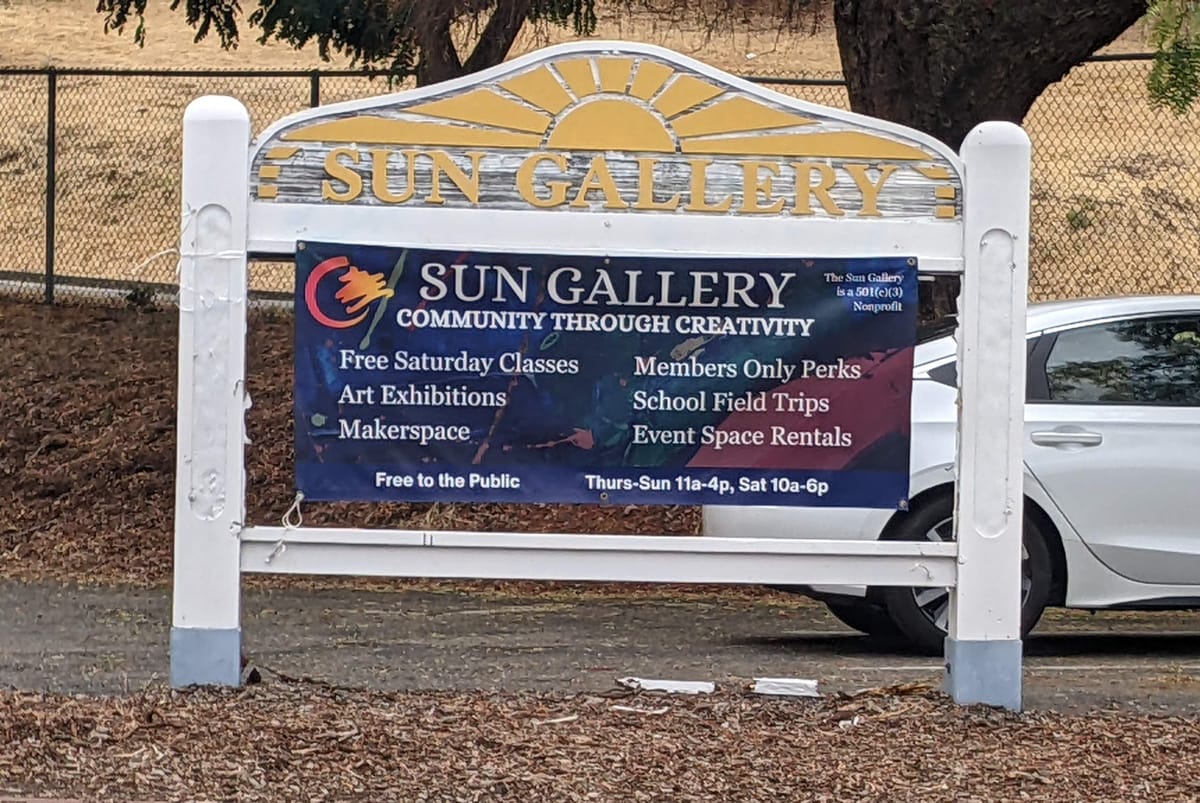
This is the second installment of our reporting on The Sun Gallery. Check out the first one, if you haven’t already. If you like this kind of reporting—or don’t—let us know! The final installment will drop next week, so thanks for bearing with us.
During their April 22nd meeting this year, the City Council discussed Community Agency Funding (CAF) for FY 25/26. This money—a combination of Federal and City dollars—is allocated by the City Council at the recommendation of the Community Services Commission (CSC). It’s a chance for the City to give money to nonprofits that improve the lives of Hayward residents.
One of the regular funding recipients has been the Sun Gallery. According to City records, the Sun Gallery has received funding every year since at least 2016, but this year they weren’t on the list. This concerned several City Councilmembers, but the biggest hint of their financial problems came from comments by Sun Gallery members themselves.
“I know we didn’t make it on the funding list since we weren’t considered for this round,” current Sun Gallery Treasurer Carl Gorringe said during public comment, “and unfortunately $10,000 was cut from our prior award. Is there any way we can get that back?” It is unusual for nonprofits to publicly ask for funding at a City Council meeting like this. “I suppose if you took 10% off each one of the 10 [Arts and Music Funding awardees], that adds to about $13,200. Any chance the City Council could vote on that for the Sun Gallery?”
But even Mr. Gorringe knew that any last-minute funding was unlikely. “I had to at least try,” he said. The City Council did not consider that course of action, but it was clear that the Sun Gallery was in serious financial straits. This is despite the former Treasurer, Alicyn West, also pointing out that the Sun Gallery had been awarded $15,000 last year—what happened?
Last week we explained why The Sun Gallery is important to our community, and this week we’re going to follow their money—which is also our money. We’ll look at the Gallery’s funding: its history of ups and downs, where it came from, and how—despite extensive support—it all disappeared over the course of one year.
Back From The Brink
Last time we pointed out that the Sun Gallery had been in bad financial situations before. In 2008, just before the depths of the Great Recession, then-Vice President of the Board, Valerie Caveglia sent a letter to the Daily Review pleading for funding in the face of an empty account.
According to Ms. Caveglia, the account balance was actually -$10 at one point, and it was then that she took over as Executive Director. “I was the only one with the time and willing to take it on for free,” she said, “which I did for three years.” She had been a part of the Sun Gallery Board of Directors since 1998 and had recently retired from teaching in the Fremont Unified School District.
 Collin Thormoto
Ms. Caveglia worked as Executive Director for 5 years, and said she only paid herself a $500 per month stipend for the last two years. “I figured I was working for about a dollar an hour,” she said.
It’s unclear what methods the Sun Gallery used to turn things around—tax records from that time are more difficult to get—but whatever they did worked well. According to tax records, by 2012 the Sun Gallery had around $88,000 in their accounts and the majority of the income was from gifts, grants, and contributions—programming and sales revenue made up around 25% of their funding.
This trend continued through 2013 while Leisa Leitzke was Executive Director, but things started to change in 2014.
A Note On Tax Records
Before we get deeper into the Sun Gallery’s finances, let’s explain the limitations of nonprofit tax records. When a nonprofit has more than $50,000 in the bank or raises more than that in a single year, they need to file a form called 990-EZ. It’s a less-robust version of the Form 990—which is for larger nonprofits—and recognizes that smaller nonprofits have less resources to spend on filing taxes.
The 990-EZ gives a very general picture of an organization’s finances. For example, there’s only one box for “Salaries, other compensation, and employee benefits.” That means it’s difficult to tell how many employees received a salary or what each person was paid. The same goes for “Contributions, gifts, grants, and similar amounts received”—all of those things lumped together with no details for how much came from which funding source (grants, donations, etc.).
It does have separate lines for “Program service revenue” and “Gross profit or (loss) from sales and inventory,” which are important. For example, when the Sun Gallery runs summer art camps that people pay for, that would be considered “Program service revenue.” Any sales from the gift shop or other merchandise would be considered “sales and inventory.”
These documents give a rough picture of how much of the money comes from donations and grants compared to programs and merchandise.
And when a nonprofit gets below $50,000 in annual revenue, the picture gets even more opaque. The smallest nonprofits are only required to file a 990-N, which is basically a postcard telling the IRS that they made less than $50,000 that year. They’re still required to file a CT-TR-1 to the State of California if they’re that small, which requires more detail, but not everyone does.
This is all to say that tax records can only tell us so much. But they are publicly available.
Entering Deficit Years
According to tax records, Dorsi Diaz took over as Executive Director of the Sun Gallery sometime between October 2013 and March 2015—the first tax document she signed as Executive Director was for Fiscal Year 2013/2014. That year showed a more than 70% drop in contributions, gifts, and grants—program and services revenue stayed about flat and membership dues increased a little. In total, revenue went down by about $30,000 that year.
At the same time, costs increased by around $10,000. Much of this came from Insurance ($34,735) and “PR Tax” ($4,984)—likely this means payroll tax. The result is an over $23,000 deficit for the year. Thankfully the Sun Gallery had over $100,000 in the bank, but it wouldn’t last forever.
Over the next four years, the Sun Gallery would continue to post deficits ranging from around $5,000 to over $30,000 depending on the year. This caused the reserves to shrink from over $100,000 in 2013 to only $16,000 in 2018. This was despite overall income increasing to over $70,000 with a combination of contributions, gifts, and grants and program revenue.
Salary costs also remained high—jumping to as high as $60,000—before dropping to $35,000 by 2018. This likely also corresponded to the increased Payroll Tax, which further sapped the Sun Gallery’s funding. According to Nina Starr, who was Board Secretary during this time period, it was the result of decisions made by the Executive Director. “I don’t think she stole it,” she said, “but I think she spent it unwisely.”
A Shift To Service Provision And Grants
Whether or not that’s true, there was also a shift in where the Sun Gallery’s money came from. Although revenue increased over this period, the money didn’t come from small-dollar donations. It came from the City of Hayward directly.
According to City Records, the Sun Gallery received over $27,000 every year between 2016 and 2019—making up between 70-100% of the Gallery’s public support. It’s difficult to know what those grants were meant to cover—the minutes don’t go into detail about each individual program—but in recent years, the Sun Gallery has requested funding to pay for arts programs and camps for local students and residents.
It’s possible that the art programs are the same ones—or similar ones—that the Sun Gallery uses to make up the remaining bulk of its revenue. And it wasn’t until 2019 that the Gallery took in many contributions beyond the City grants—it was also the first year that the Gallery ended the year without a deficit.
Shifting to a heavy reliance on City grants could have changed how the Sun Gallery is perceived by the rest of the Hayward community. When most of the Gallery’s revenue comes from providing services, the community may see it less as a public art gallery and more like a place to keep their kids busy for a week. There’s also less incentive for community engagement beyond providing camps when that’s such a large part of Gallery operations.
COVID Paychecks And Lagging Information
During 2020, the COVID-19 pandemic lockdowns took effect which meant that the Sun Gallery was closed for much of that year. It was also the first time that the Gallery made so little money that it didn’t need to file a 990-EZ, making the financial picture harder to grasp.
According to their FY 19/20 filing prepared by Ms. Diaz, the Sun Gallery took in around $47,500 and allegedly did not receive any government funding—though according to City records, the Sun Gallery was recommended for over $29,000 in CAF money. However, according to Ms. Starr, the Sun Gallery was closed during the majority of the pandemic—it wasn’t considered an essential service.
Thanks for reading Hayward Herald! This post is public so feel free to share it.
Ms. Starr also said that Ms. Diaz continued to receive a paycheck while the Gallery was closed to the public and no work could be done. The filing lists total expenses for that year at over $50,000, but it’s unclear from the records how much of that was for Staff Compensation—the Gallery did not file a Treasurer’s Report that year.
But according to the current Treasurer, Mr. Gorringe, Ms. Diaz stopped receiving a paycheck in March of 2020—shortly after lockdown was implemented—and did not receive another check until September of 2020— and even then at reduced hours. The remaining expenses were largely because of a fire that occurred on the premises, which cost around $10,000 to mitigate.
According to a report from Mr. Gorringe, the bank balance by the end of 2020 was less than $15,000. The 2021 Treasurer’s Report wasn’t filed until 2023, by which time there had been a lot of changes.
A Whole New Board With Cash Injections
In 2022, the Sun Gallery Board of Directors underwent a complete change. The active members of the Board had dwindled in number and, despite some controversy, the entire board was replaced. Around the same time, the Sun Gallery enveloped the Hayward Techies—a resident group of tech enthusiasts. As a part of the merger, three members of the Hayward Techies joined the Sun Gallery Board of Directors.
The remainder of the Board was made up of almost entirely new people. Carla Dozier became President of the Board, Sara Sammis became Secretary/Vice President, and David Larkins became Treasurer. They, along with the members of the Hayward Techies, were relatively new to the Sun Gallery as a whole—few, if any, long-time Sun Gallery members ran for the board and Ms. Dozier allegedly ran unopposed for President.
The Techies had received a grant of $31,000 from the Hayward People’s Budget to build a Makerspace, hosted at the Sun Gallery—Ms. Diaz signed the contract with the City. It’s unclear how that money was accounted for by the Gallery, though Mr. Gorringe said it was tracked in a separate fund.
Around the same time, in May of 2022, Ms. Diaz also submitted an Economic Development grant for the Gallery to improve the exterior of the building. According to the application, the Gallery planned to, among other things, “Upgrade front to include seating for guests for outdoor readings, coffee chat, outdoor painting & art classes, book readings and field trips, a mural outside (in kind donation).”
The City approved the grant for $21,000 of Federal Government money. According to the Treasurer’s Reports in FY 22/23 the Gallery took in $93,000 that year $52,000 of which is likely from the People’s Budget and façade grants. The façade project was to be completed by September of 2023—180 days after being told they received the grant. But that never happened.
The Problems Begin
After being elected in November of 2022, the new Board of Directors started falling into administrative problems. According to an anonymous former Board Member, Ms. Diaz didn’t give the rest of the Board detailed financial updates at meetings. “At no time did [Ms. Diaz] provide detailed records,” they said, “providing only a checking account balance at the beginning of her monthly reports to the Board.”
They further alleged that, 5 months later in April of 2023, Ms. Diaz was still the only person with access to the Sun Gallery’s accounting software. “[The Treasurer] reported that [Ms. Diaz] did not cooperate in providing reports or access to Quickbooks,” they said in a written letter to the City of Hayward. If true, the Treasurer and the whole Board would have been unaware of how money was really being spent and from what funds.
Façade Grant
According to a former Board member, Ms. Diaz only verbally shared the terms of the Façade Improvement grant with the Board of Directors. When work was set to begin, the Gallery was told by HARD that they weren’t allowed to make the improvements as intended. “When plans were mentioned to the HARD contact, [Ms. Diaz] was cautioned against modification of the front lawn area,” a former board member said. “The HARD contact specified nothing could be installed that would encourage sitting in this area as the clean-up of the site was required too frequently for current staffing.”
The City also alleges that the Sun Gallery did not have separated accounts to track how the grant money was spent. “CDBG funding was deposited into Sun Gallery’s general account, comingled with other funding sources, and could not be tracked within their accounting system,” the City monitoring report says. Current Treasurer Carl Gorringe disputes this allegation, however.
Unauthorized Expenditures
According to a former Board member, Ms. Diaz gave access to the Quickbooks financial system to the then-Treasurer, David Larkins, in September of 2023—after which he filed the Treasurer’s Reports for FY 20/21 and FY 21/22 that were overdue. In December of 2023, Ms. Diaz stepped down as Executive Director of the Sun Gallery, and Mr. Larkins took over the accounts as Treasurer.
According to a former board member, Mr. Larkins then created a separate checking account tied to the Gallery, made a $70 Zelle payment to himself with no documentation, and used the Gallery credit card to purchase “meals, games, and personal items.”
According to documentation given to the Hayward Herald, the fraudulent purchases totaled over $2,000. Mr. Larkins insisted that his bank account had been hacked, however he allegedly did not attend meetings with Bank representatives to settle the matter—though almost all of the money was returned to the Gallery by February of 2024.
Current Treasurer, Mr. Gorringe, insists that Mr. Larkins was not at fault for the purchases. The Sun Gallery Board is currently conducting an internal investigation into the matter, and were unwilling to share detailed records. However, Mr. Gorringe alleged that the then-Board President, Ms. Dozier, made the unauthorized purchases while casting blame on Mr. Larkin.
Dividing The Executive Director Payments
When Ms. Diaz stepped down from the Executive Director position in December 2023, it wasn’t a full retreat. Ms. Diaz had been both the Executive Director and Curator, being paid for a total of 20 hours/week. She chose to drop the Executive Director duties, but remain a paid Curator for 10 hours/week. That left 10 paid hours per week available for the Executive Director duties.
Ms. Diaz maintained her $300/week salary—$30/hour for 10 hours/week—as Curator of the Sun Gallery. Ms. Starr alleges that Curators had historically volunteered their time without pay.
Thanks for reading Hayward Herald! This post is public so feel free to share it.
The minimal salary left over—$1,200 per month—was seen by the Board at the time as “not feasible for a serious candidate search,” according to a document obtained by the Herald. The proposal—put forward by then-Board President Dozier—was to appoint Anthony “Paki” Ahkoi as Executive Director, with someone else—her husband, Anthony “Tony” Klein—also being paid to support the Gallery with building maintenance duties as Special Projects Manager. Each would be paid for 5 hours per week.
However, according to recent Sun Gallery Meeting Minutes, Ms. Dozier sent an email in November of 2023 saying that the Executive Director and Special Projects Manager were approved at “20 hrs a week apiece for a total of 40 as of Tuesday this week.” Mr. Gorringe reportedly argued against the increased hours, but the Sun Gallery Minutes allege that both Mr. Ahkoi and Mr. Klein were paid for between 15 and 50 hours per week between November 11, 2023 and January 16, 2024—a total of $7,875 were reportedly paid to them in that time period.
In response, the new Board of Directors voted, in November of 2024, to “file a criminal report to the authorities for embezzlement against Carla Dozier, Paki Ahkoi, & Tony Klein,” according to meeting minutes. The results of a police investigation, if they exist, are unclear.
A New-New Board Takes Over
The Herald received no record of whether these payments continued past January 2024. But the Sun Gallery Board was, in November of 2024, recalled by the Membership due to an organized effort by Mr. Gorringe and Ms. Diaz, among others.
According to Mr. Gorringe, who was elected as Treasurer in November 2024, the Sun Gallery’s bank balance was only $54.28. At the same time, the Gallery had almost $1,500 in unpaid bills and payroll costs from the previous Board of Directors.
Mr. Gorringe and Ms. Diaz appealed to the HARD Board of Directors for rent relief, which was ultimately granted. Rent, utilities, and maintenance costs had become some of the largest expenditures from the Sun Gallery in recent years.
Due to the turmoil of the recall, the Sun Gallery was ineligible for the Community Agency Funding (CAF) from the City of Hayward that it had relied upon for so long. The Gallery is also required to pay back the misspent façade improvement grant money. “[T]he City must reclaim the $21,000 in awarded funds from Sun Gallery,” the fiscal monitoring report states. However, the City allowed the Sun Gallery to repay the money in installments and pursue future City grants—so long as payments are made on time.
Moving Past The Damage
According to the current Treasurer, Mr. Gorringe, the Sun Gallery has started to recover financially from the low of November 2024. “Currently we've got about $19K in the bank,” he said in an email, “which is pretty good considering we've received ZERO grants this year.” There also appears to be no paid staff, aside from the contracts paid to the Art Camp teachers.
The financial picture of the Sun Gallery seems to be stabilizing—if in a more modest form than it has been in the past. But the disfunction and financial mismanagement from the previous Board of Directors has left many devoted members of the Sun Gallery on edge. Both Mr. Gorringe and Ms. Diaz expressed feelings of anxiety resulting from the interpersonal disputes between 2022-2024. But is it possible that the Sun Gallery could come out stronger because of it?
While the finances tell a part of the story, it’s important to examine what policy issues allowed so much of this to happen. Next week we’ll take a look at some of the more explosive interpersonal disputes at the Sun Gallery, and what polices were missing that could have prevented them from becoming so damaging.



Comments ()