
Layoffs Or Concessions Still Needed To Balance City Budget
Despite extensive cost-saving and revenue-generating plans, the city still needs labor unions to come to the table to balance the budget. Also, AI tools coming to local government.

During the final half of the February 28th Hayward City Council budget meeting, City Manager Jennifer Ott revealed that, despite cutting costs and raising revenue, Labor concessions or layoffs are still needed to balance next year's budget. Over $15,000,000 will be saved with one-time funding sources and fee increases, and around $10,000,000 in cost-saving measures, while the remaining $5,000,000 will need to come from either labor concessions or additional layoffs.
Filling The Budget Gaps
Revenue Manager Michael Barnes presented other methods to plug the gap in the city budget. Most of the money would come from one-time transfers from Measure C ($10,000,000), the OPEB Trust ($4,500,000), and Community Development Block Grants ($500,000). Another $1,000,000 is expected with changes to the Fee Schedule. Finally, between $900,000 and $2,000,000 in revenue is expected from the two data centers that are either partially occupied or under construction.
Revenue Manager Barnes said that data center revenue is expected to increase to over $4,000,000 within the next 5 years. Though those projections likely assume that the AI bubble will not burst during that time.
Less certain sources of revenue include applying the existing Utility Users Tax (UUT) to streaming companies, which could generate up to $1,500,000. However, legal complications still exist, so it is not recommended until FY 28.
When the newest cannabis dispensary comes online, it is expected to generate at least $400,000 per year in tax revenue. However, the recent lawsuit may delay the opening of the location, slated for the former Walgreens on the corner of Grove and Foothill.
City Council Ideas On The Table
Councilmember Ray Bonilla's idea to implement an EMS First Responder Fee could generate an additional $50,000 to $350,000 per year by adding a line item to insurance bills. However, City Manager Ott explained that all insurance agencies in California are ignoring the fee with the exception of Kaiser. "So the results of the revenue are kind of varied and uncertain," she said.
Also, if the ambulance company is unwilling to take on the administrative burden, it would cost more in staff time than it would generate in revenue. Ultimately, City Manager Ott was lukewarm on the idea. "It's just not a ton of money," she said.
City Council members agreed that the First Responder Fee may not be worth pursuing. "I wouldn't want to invest staff time into something that the corporations are just going to ignore," Councilmember Syrop said. The primary concern of council members was staff costs. "I just don't want anything sort of folding back into the general fund," Councilmember Roche said.
Knowing what's happening in your home city is vital to making it work for you and your neighbors. The Hayward Herald is the only place covering local Hayward news, but we can't do it without your help. Consider becoming a member today.
Councilmember George Syrop's idea of enforcing the city's short-term rental ban would require spending $25,000 per year to a software vendor but could generate up to $452,000 in fines. The revenue may be short-lived, however since the enforcement will likely decrease the number of violations over time. It may also unintentionally displace renters since many listings are "rooms for rent," which may be tenants sub-letting their unit in an attempt to lower their rent burden.
There are potential benefits of increasing hotel tax revenue and opening more units for long-term rentals, as well.
Councilmember Syrop supported the idea of a 1-year pilot program that focused mostly on single-family homes. "As long as it's cash positive... [it] still feels like cash well spent," he said. Councilmember Francisco Zermeño was supportive as well. "This is hanging fruit," he said. "Let's pick it."
Councilmember Angela Andrews was wary of either proposal, citing issues with staff time. "I'm very conscious about staffing any new programs, even if they say they're revenue generators, because they can not be," she said. Councilmember Goldstein agreed. "I don't want this to turn into a multi-year unfunded project," he said.
The First Responder Fee idea was put on hold while the Short-Term Rental Enforcement will go forward.
Cutting Costs Wherever They Can
The city will implement cost-saving measures, including changing the contract for the Navigation Center, pausing PD hiring and downsizing the jail, not increasing Worker's Compensation contributions, and reducing transfers to Capital Improvement Projects (saving around $7,850,000).
Other strategies are either in-progress or uncertain, which include staffing reductions in the Fire Department ($4,000,000 over 2 years), shift changes in the Police Department ($2,000,000 over 2 years), and concession bargaining with labor groups ($3,500,000).
However, all of these ideas require negotiations with labor unions to implement. If no labor groups agree to negotiate concessions, an additional 1-2% in department costs will need to be cut, which would result in layoffs and "significant service impacts" according to the presentation.
Government Efficiencies
IT staff recommended implementing various new technologies, many of which use generative AI, to improve efficiency. Document review and creation, including development plan pre-checking, may be done with AI software in the future. They are also considering generative AI staff reports. "Imagine a world where 90% of our staff reports are created for us using document creation rather than having to go into research," they said. AI is also being considered for automated note-taking and official meeting minutes.
Councilmember Roche worried about the use of AI broadly, but ultimately agreed with the recommendation. "[How do we] keep a service level with the reduction in workforce?" she said. "We obviously have to look at technology."
Drone first responders were also presented. "Rather than send resources, which puts public safety at risk and arrival at a scene, you actually have a drone on site doing that for you," IT staff said. Police Chief Bryan Matthews said that the Police Departments in Fremont and San Francisco are already doing something similar.
The Hayward Police Department already has a number of drones, in 2024 it had 64 while in 2025, it alleged to only have 12.
IT is also developing an in-house tool to improve the experience at the Permit Center and providing an "Innovative Assistance program" to help departments develop more technology-based solutions.
Finally, City Manager Ott proposed cost-neutral department restructuring, reducing City Council meetings to twice a month, and reducing the number or frequency of Council Committees: Sustainability Committee, Economic Development Committee, and Public Safety Committee.
Fewer Meetings Coming
The City Council was supportive of having only two meetings per month, with the option of adding Special Sessions as needed. Councilmember Andrews suggested a third meeting just for Closed Session. "That still gives the opportunity for public comment," she said. Councilmember Syrop agreed with fewer meetings. "Right now it feels like two as a baseline is reasonable," he said.
Mayor Salinas worried about busy times and meeting length. "If we have less meetings, all that means is we have longer meetings," he said, "and I don't want to be here until midnight." Counclmember Bonilla suggested the city be more disciplined with fewer meetings to address this.
The majority of the Council was also supportive of reducing committee meetings. However, Councilmember Zermeño became agitated at the idea of eliminating the Sustainability Committee. "The moment you reduce it or get rid of it, we become less green," he said.
When City Manager Ott suggested folding it into the Infrastructure and Airport Committee, Councilmember Zermeño stood up and threatened to remove his shirt to show off his green T-shirt underneath. "We can't get rid of the committee," he said as he stood. "We need to be green!" It was ultimately kept, but will only meet twice per year.
Council Calls Out To Unions
Councilmember Syrop invited labor groups to come to the table. "There exists a configuration of all the contracts that allows us to protect as many jobs as possible," he said. "I'm hoping we can find that balance."
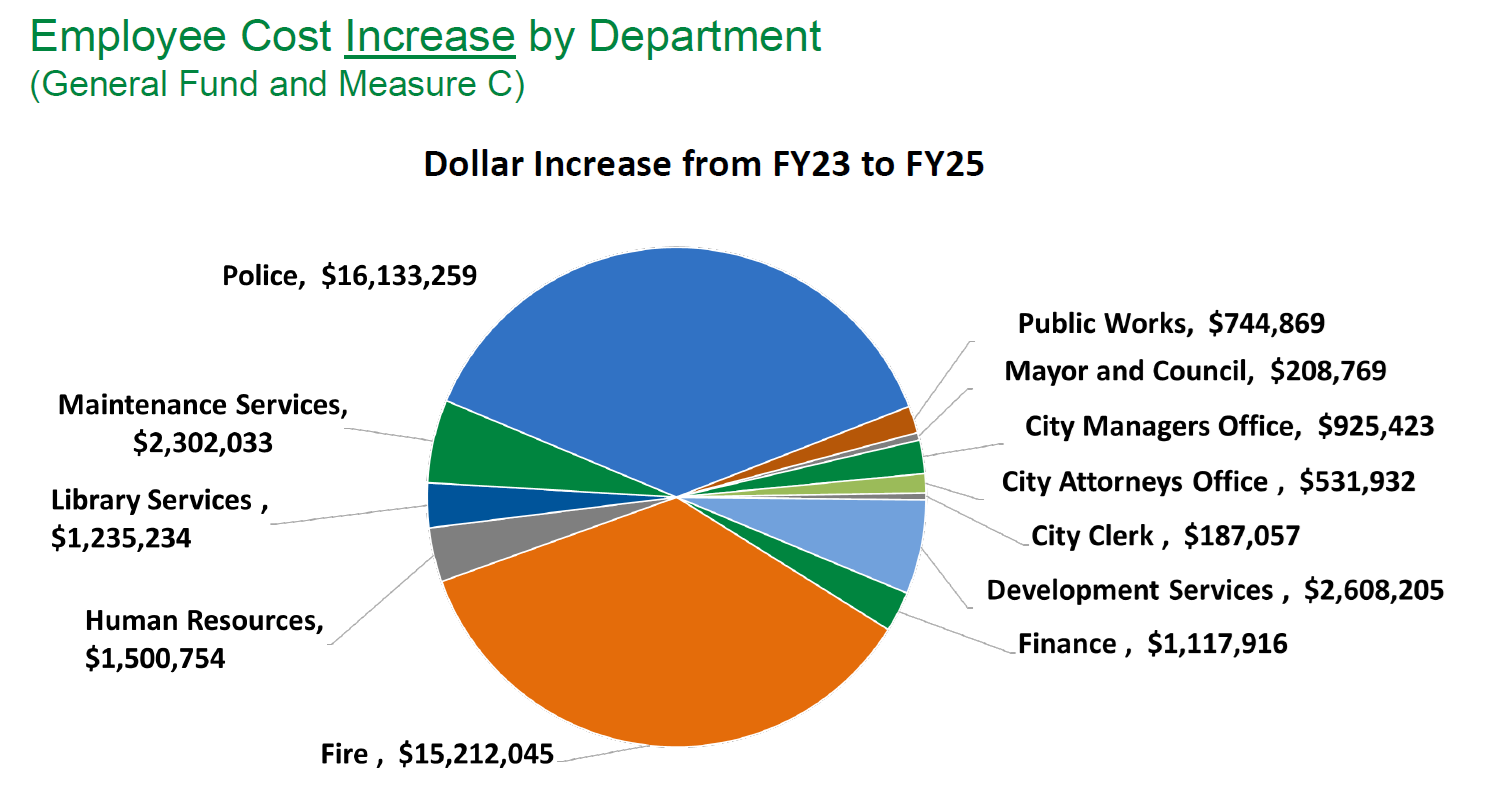
He pointed to the graphic above to suggest that there may be some departments who have more to give than others to help balance the budget. Councilmember Roche said, "2% or concessions, that's really hard. And that's going to be up to our labor partners."
Councilmember Bonilla pointed to the salary increase to the Police Department and Fire Department. "These increases are not sustainable," he said. "If we're going to continue to hold on to these very expensive salaries, it's going to come at the cost of jobs." Councilmember Andrews also addressed the graph. "Where did the money go? It's right here," she said.
However, she also highlighted the Bay Area cost of living and the salaries needed to support that. She pressed for more economic development and creativity from that department.
Councilmember Zermeño also called for unions to come to the table. "Somehow or other we need to convince our unions that the stability of our city is the most important of all aspects of it," he said. "Because it would mean them not losing any more of their members."
Mayor Salinas was supportive of the plan for balancing the budget going forward, pressing for structural and ongoing savings and rebuilding the reserves to 20% as soon as possible. "I, personally, am leaving here with a great deal of hope," he said.

Comments ()