
Pushing Through The Hard Times
In Which: We touch on interpersonal issues that plagued the Sun Gallery, Outline ways to prevent them happening again, And we explain that the Gallery is a community resource
This is the final story about the recent conflicts at the Sun Gallery. You can read Part 1 and Part 2, if you haven’t already.
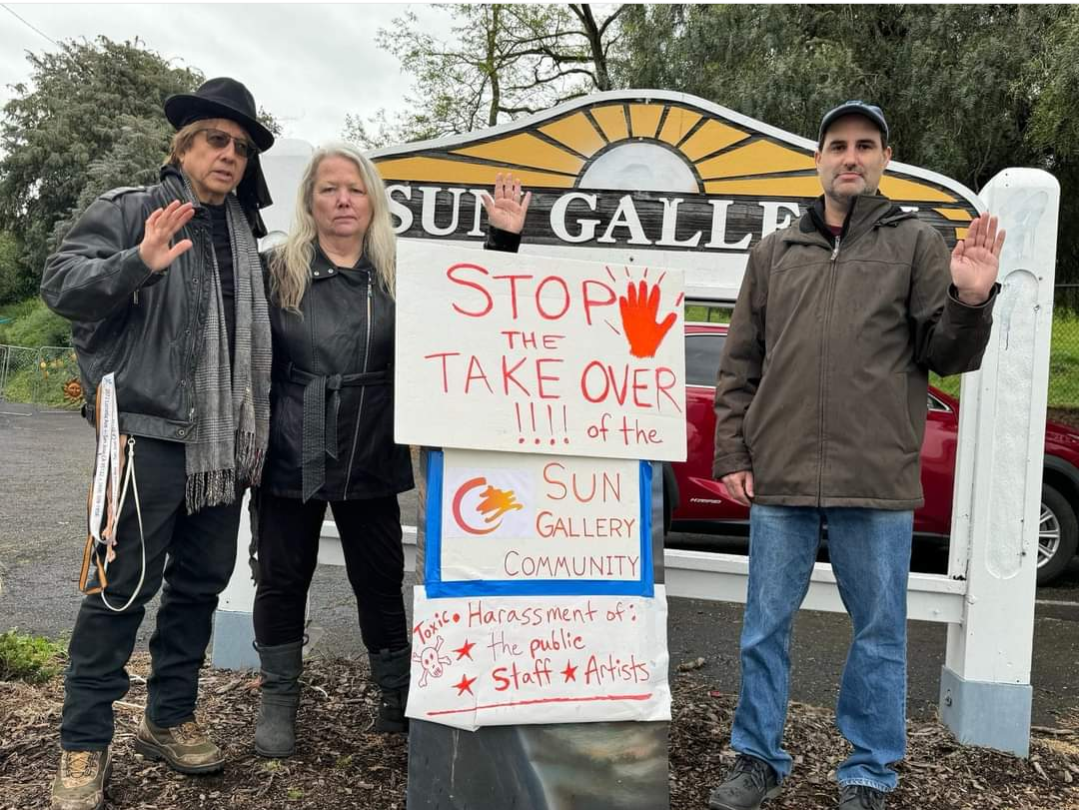
In April of 2024, someone sent me a screenshot of a Facebook post that included the image above. In it, three people are standing by signs that say “STOP the TAKE OVER !!!! of the SUN GALLERY COMMUNITY.” They’re standing in front of the Sun Gallery with one open hand raised, like a stop gesture. I was confused and concerned—I decided to find out more.
That was almost a year and a half ago and a lot has happened since. I’ve interviewed and asked questions—both on and off the record—of almost a dozen people. I’ve talked to current Sun Gallery Board Members, City Staff, former Gallery Board Members, and dues-paying members who weren’t directly involved. I’ve looked at over 75 different documents, including public records, Gallery Board Meeting minutes, tax documents, and prepared statements.
Even without funding issues, it became clear there were intense disagreements within Sun Gallery leadership. Criminal allegations, harassment allegations, name-calling, bans, non-disclosure agreements, and more. Almost every interview with someone involved has included some blame and finger-pointing. There was, in short, intense dysfunction within Sun Gallery leadership that resulted in a recall of the entire Board of Directors.
All of these feuds must have made the smallest tasks more difficult and taken a huge emotional toll on the people involved. But if the organization uses this as a learning experience, they can change policies and procedures to ensure it doesn’t happen again—or at least allow conflict to happen in a more productive way.
For this final installment on the Sun Gallery, we’re going to look at these conflicts through the lens of policies: what happened, what could have been done to minimize the harm, and steps the Sun Gallery leadership is already taking to ensure a healthier culture going forward.
Problems Around Money
As we covered in last week’s story, the Sun Gallery’s finances were in turmoil during 2024. There were allegations from previous Board Members that financial reports were limited to bank statement summaries for the month, there was resistance to implementing a two-signature security measure on checks, and reluctance to give the newly-elected Treasurer access to accounting and financial systems. If any of these allegations are true, the Board of Directors would not have had a full picture of their own finances.
 Collin Thormoto
There also appeared to be no standard procedure around applying for grant funding. Former Board Members alleged that the then-Executive Director applied for City of Hayward grant funding without sharing the full details with the Board of Directors. This resulted in a failure to complete the grant in the allotted time and required the Sun Gallery to pay back the full $21,000.
Transparency For All
Adding language about the Board’s fiduciary responsibility to the bylaws could help things. This would ensure that everyone on the Board knows that they should be acting in the best financial interest of the Sun Gallery, not themselves. It sounds weird to have to put in writing, but if it’s been an issue in the past, it couldn’t hurt to make it explicit.
Implementing a 2-signature requirement on payments should be standard practice for an organization of their size. This helps to ensure that multiple people literally sign off on expenses to make sure there’s no misconduct. Allegedly, this idea was put forward in the past, but it’s unclear if it was ever implemented.
Having a handbook of policies and procedures for the Treasurer would also ease transitions. This should ideally include how to hand off access to important accounts like Quickbooks and ADT, as well as full explanation of the Treasurer’s duties. Nobody is born knowing these things, and having good documentation can make it easier to step into one of the most important roles in the organization.
Having more open financial recordkeeping—at least within the Board of Directors—should be standard practice. If a simple summary of available funds isn’t enough for the Board to make good decisions, then they should spell out what is good enough. There should be standard financial reports that the Board can expect from the Treasurer.
The Treasurer Is Already On It
According to the current Treasurer, Carl Gorringe, he’s already implemented some of these changes. “[O]ne thing that I've been doing since I became Treasurer was to make sure there is Full Transparency with the Board,” he said in an email. “At every Board meeting, I show and go over every transaction that we've made. It may make the meetings a bit longer, but I feel it's really important considering what happened last year.”
This kind of transparency is a great example of a Treasurer keeping the Board informed of what’s going on financially. Documenting the duties and operations is in the works as well, but hasn’t been finalized yet. This will ensure that all future Treasurers give similar reports—Mr. Gorringe’s dedication to financial transparency won’t matter if he takes his procedures with him when he eventually steps down.
Why Can’t We All Just Get Along?
According to a statement given to the City of Hayward by Ms. Dorsi Diaz, until very recently—May 14, 2025, to be exact—there was no formal policy for dealing with misconduct. “We do not have a formal client grievance procedure that I am aware of,” she said. “Any possible legal issues, I've used my Legal Shield monthly membership, which I've had since 1994… any problems we had with clients has been very rare, and were handled professionally by the staff, or relayed up to the ED.”
Alleged Misconduct From Artist
This policy gap left the previous Board of Directors with no guidance when confronted with misconduct. For example, according to multiple former Board Members, there were complaints about the conduct of Andrew Kong Knight. One former Board Member alleged that they “personally witnessed and intervened” an incident involving Mr. Knight at the Gallery. They also alleged that members of the Sun Gallery Staff complained of harassment from Mr. Knight via personal messages.
Thanks for reading Hayward Herald! This post is public so feel free to share it.
Mr. Knight, in an April 14, 2024 Facebook post, responded to the allegations. “I heard nothing about these accusations during my visit last week from [the Executive Director, Anthony “Paki” Ahkoi] or his staff,” he said, “not a word from anyone.” Mr. Knight characterized the allegations as “false accusations” and alleged that he had been personally slandered via direct message from Mr. Ahkoi in response.
Alleged Confrontations From Board Members
Another issue occurred in October 2023, according to documents given to the Hayward Herald. The incident allegedly involved a member of the Board shouting at another member of the Leadership team and physically blocking them from moving away. A third member of the Leadership team intervened and diffused the situation, according to the document, but it allegedly got bad enough to warrant a formal written account.
Other allegations of harassment were levelled at two other members of the then-Board of Directors, though no details were available in the documents we received. Some of the allegations resulted in written complaints, while others did not. As a result, the Board Members were placed on a 3-month probation and barred from interacting with Gallery Staff. The Board Members in question, according to reports, disputed the allegations and deny wrongdoing.
Uneven Consequences
How these conflicts, and others, were handled varied quite a bit. Consequences ranged from “restricting access” to outright bans, but the former Board of Directors was making up policy as they went. By not having a grievance procedure in place, nobody knew what to expect and they were ultimately at the mercy of the Board of Directors—some of whom were making the allegations.
Clarity Is Kindness For Everyone
Having an explicit Code of Conduct is a way to ensure that everyone knows how they’re expected to behave at the Sun Gallery. Not only should there be something for the Board of Directors, but something for the artists, staff, and public should be standard, as well. It sets the tone for how people are expected to behave and offers a framework for consequences.
A robust procedure for handling disagreements of any kind—especially those that rise to full grievances—is also a must for organizations. Personalities are going to clash and a grievance procedure can help members navigate the conflicts that are bound to happen—potentially even diffusing them before they become larger issues.
The Gallery Is Already On It
The Sun Gallery’s Grievance Policy, approved on May 14, 2025, was shared with the Hayward Herald and covers almost any interaction that occurs at the Sun Gallery. “This policy applies to all individuals connected with the gallery, including paid staff, board members, volunteers, exhibiting artists, program participants, visitors, and community partners,” it reads.
It lays out general principles, encourages an informal resolution before it escalates into a full grievance, and includes an “Ask to Leave Policy” which can be used to diffuse situations in the moment and applies to everyone in the Gallery. There is also a formal Grievance Procedure that includes written statements, a committee review, a response and appeal process, and documentation procedures. It even includes steps to take in the event that Board Members are included—including the entire Board Leadership team at once, if it comes to that.
It concludes by highlighting why these policies are so important to have before conflicts happen. “A well-functioning grievance process protects the rights and dignity of all community members while strengthening our organization,” it reads. Having this in place earlier could have helped address the previous issues in a clear and constructive way before they got out of hand.
Safety And Security For All
In any organization—especially with property—there is going to be a need for security. Protecting important or sensitive information, as well as securing the physical building, are necessary for organizational health and for any artists looking to keep their work at the Sun Gallery. But past events have shown that the security culture at the Sun Gallery was lacking in some important ways.
Sensitive Information Getting Out
The new Grievance Procedure at the Sun Gallery stresses the importance of confidentiality for the written records. Unfortunately, former Board Members alleged that—before the Grievance Procedure existed—some on the Gallery leadership team shared confidential grievance information. Mr. Ahkoi appears to have sent direct messages about alleged misconduct to Mr. Knight, which were then allegedly shared on social media—the Hayward Herald could not find these messages to verify if they were shared or not.
Lacking any formal procedure, the then-Board President pushed for the Board to sign non-disclosure agreements in order to contractually prohibit the Board from sharing sensitive information. According to records obtained from the City of Hayward, it was “for the purpose of preventing the unauthorized use and disclosure of Confidential Information.” The Board then only allowed those who had signed the NDA into discussions of sensitive information—alienating at least one Board Member who refused to sign.
Digital Security
Another issue occurred around the use of Sun Gallery technology. According to Ms. Diaz, some of her personal accounts were allegedly hacked with one member of the previous Board allegedly monitoring her private conversations.
Former Board Members told the City of Hayward, after an internal investigation, that Ms. Diaz had been using Sun Gallery computers to log into personal accounts and left them logged in. They further alleged that Ms. Diaz had intermingled personal and Sun Gallery Google accounts, emails, and contacts, and placed personal documents in a Microsoft One Drive account paid for by the Sun Gallery.
Regardless of which is true, the result is that someone’s personal information was accessible to people who should not have had access to them, which is a huge security failure.
Physical Security
According to Sun Gallery Board Minutes and conversations with former Sun Gallery Board Members, sometime in the Summer of 2024 there was a break-in and assault during broad daylight. Then-Executive Director Mr. Ahkoi appears to have been knocked unconscious while working at the Sun Gallery. According to anonymous sources, an unused and obscured door on the field-side of the building may have been left unlocked. Mr. Ahkoi did not file a police report—the Hayward Police Department had no record of this incident—but the assault resulted in a severe injury.
There doesn’t appear to have been any footage of the incident, either. Sun Gallery Board Minutes from November 2024 indicate that the security cameras had been inoperative since at least June of that year—one person allegedly left the Sun Gallery because the cameras had stopped working and nobody seemed to have fixed them.
Improving Security Culture
Having security policies and procedures ensures that any organization is able to operate smoothly, safely, and with the confidence of its membership. The Sun Gallery’s new Grievance Process appears to be robust enough to make Non-Disclosure Agreements unnecessary—it was a heavy handed approach to begin with—and also provide better avenues for dealing with disputes in a confidential manner.
Cybersecurity procedures and expectations of what should and shouldn’t be allowed on work technology would also be helpful for everyone—no matter where you are or what work you do. If the Sun Gallery offers work laptops to employees, there should be clarity on the expected, allowed, and appropriate uses. Standard cybersecurity practices—not saving passwords in browsers, not using personal accounts on shared computers, etc.—would also be good to share with employees to prevent access to sensitive information.
Physical security is also important, especially for a gallery that will have valuable or irreplaceable pieces of equipment and art. Security cameras, alarm systems, and a comprehensive closing procedure could help prevent similar incidents from happening again.
How Do You Even Govern Something Like That?
How meetings are run is boring to think about, but can have a huge impact on how business is conducted. During 2023 and 2024, there were some heated disagreements on how to interpret the Sun Gallery Bylaws and how decisions are made.
One thing that’s important to remember about an organization’s bylaws is that they’re governing documents—a member can sue an organization for violating its bylaws. They’re registered with the State of California as Founding Documents and those are, for nonprofits, accessible to anyone. Boards may open themselves up to serious liability if they violate their bylaws.
Closing Open Meetings
According to the 2014 version of the Sun Gallery Bylaws (Article III.I.5), “All meetings of the Board and its committees are to be open. The Board shall conduct its business in public meetings and in accordance with the provisions of California’s open meetings act.” In an open letter, Mr. Gorringe said that members were prevented from attending the April 19, 2024 Board Meeting.
A response from a former Board Member said that this section is left over from a time when the Sun Gallery was considering joining with the Hayward Arts Council, which never occurred. They further say that there is no legal obligation for the Sun Gallery to comply with the Brown Act—which governs public agencies like the City Council. However, the Board is still bound by the bylaws.
Removing The Purpose
Mr. Gorringe also alleged that the then-Board of Directors was proposing to change the Purpose of the organization as outlined in the Bylaws. The 2014 Bylaws state, “The purpose of the Hayward Area Forum for the Arts is to stimulate continuing community interest in the arts and to expand the image of the City of Hayward as a cultural center.” However, the 2023 Bylaws have no Purpose for the organization listed anywhere that we could find.
According to Mr. Gorringe, current Treasurer of the Sun Gallery, the 2023 Bylaws were invalidated due to procedural errors. This would mean that the 2014 version of the Bylaws is currently in effect. “We may want to make some changes in the future,” he said, “but it will be a lengthy process which must be passed by the membership.”
Who Can Even Run For Those Seats?
There were also arguments over conflicts of interest and compensation. Mr. Gorringe alleged that hiring—even temporarily—then-President Dozier’s husband constituted a Conflict of Interest. The 2014 Bylaws state, “No Director shall be financially interested in any contract or other transaction entered into by the Board.” Mr. Gorringe appeared to argue that any compensation to Ms. Dozier’s husband would also count as compensation to her.
A response from the then-Board of Directors states, “This personnel issue was approved by the Board of Directors on October 17, 2023 as an interim solution for staffing needs and recognizing the budgetary restraints.”
This Looks Like A Job For…
Interpreting an organization’s bylaws is a real job that should be assigned to someone on the Board—usually referred to as a Parliamentarian. According to records, there is no reference to a Parliamentarian in either the 2014 or 2023 bylaws. Having someone whose job is to interpret the bylaws could have helped settle arguments like those above and prevent the Board from acting against its own rules.
Moving Forward Into The Future
The Sun Gallery can move past these issues and become a stronger organization, and there’s evidence that they’re starting to already. The last two years were hard on many of the people involved—just retelling events was stressful for some—but many were glad that someone was talking about it. One person said that meeting with me was an answer to their prayers and just about everyone I talked to was glad to have someone to talk to—at least at the time.
That’s why this story isn’t just airing dirty laundry in public. I didn’t spend dozens of hours over almost a year and a half keeping an eye on this just for the clicks—there are much easier ways to do that. I think the Sun Gallery is an important organization that could be the foundation of a vibrant arts culture in Hayward—it deserves everyone’s stewardship.
The purpose of the Sun Gallery “is to stimulate continuing community interest in the arts and to expand the image of the City of Hayward as a cultural center.” If the Sun Gallery can see that purpose to fruition, it could be one of the most important nonprofits in the City—a seed that changes how Hayward feels and is perceived.
It won’t be easy—no amount of policy and bylaws changes will prevent every possible issue. But according to Mr. Gorringe, the Board is making changes to policy, procedure, and even the Bylaws to reduce the risk of the events like those above from happening again. That should be welcome news to anyone who cares about the Sun Gallery.
And with community involvement, a willingness to try new things, and a healthy dose of public oversight the Sun Gallery can move past their difficulties, grow and help develop a Hayward-specific arts culture. With the right attitude, this new chapter could be a turning point for the organization that leads to a brighter future.
If you want to be a part of that future with the Sun Gallery, you can look into becoming a member. Or, if you want to help them through this rough financial patch, I’m sure they’d happily take your donations. It takes a community to bring a resource like this to its full potential, and I look forward to seeing how all of us move the Sun Gallery through their next 60 years.
The Hayward Herald will return to its regular schedule on August 19th.


Comments ()