
OTLS covers the Swalwell Sexual Assault Scandal, plus bonus content on Urban Agriculture
Over The Loud Speaker brings a new episode covering Swalwell's fall and urban agriculture. Then, the City Council debates carve-outs for small landlords to continue to pay no Business tax.
By now you've probably heard the news. Swalwell is accused of sexual assault by multiple women and has resigned from Congress, leaving Hayward without a congressional representative. At the time Collin and I were recording this episode, we had just found out that Swalwell had ended his campaign for governor. Tune into this episode to watch our reactions as we processed the news.
Over The Loud Speaker is the only place where you'll get in-depth discussions about everything from local political scandals to urban agriculture. To keep these programs coming, we need support from our community—that means you. Please help us out, if you can.
The second half of this episode is bonus content for our dear #OTLS listeners. If you were bummed out about the Urban Agriculture panel event being canceled last month, fret not, for we have brought on one of the speakers, Professor Antonio Roman-Alcalá, as a guest to discuss his work and experiences in Urban Farming.
As always, we hope you enjoy the episode. Oh, and good riddance, Swalwell!
Catch this episode and more on our YouTube channel.
Hosts: Nestor Castillo and Collin Thormoto
Producers: Nestor Castillo
Cover Art: Nestor Castillo
Summary
00:00 - Cold Open
01:24 - The headlines
04:06 - Swalwell sex scandal
32:08 - Interview on Urban Ag w/ Professor Antonio Roman-Alcalá
City of Hayward Seeks To Raise Business Tax
The City Council heard a presentation about proposed updates to the Business License Tax, which hasn't been updated since 1978. The proposal was initially floated during the February 28th Budget Retreat, where the Council debated the need for additional funding with the risk of scaring off businesses. Small revisions were made to increase the projected revenue by an additional $2,000,000. And although the tax polled well with voters, some Councilmembers worried about the impact on small landlords, who are currently paying no Business License Tax at all.
Getting A Little Bit More
Although Council generally supported the proposal in February, some suggested changes from the meeting were incorporated into the new proposal. New brackets were added to the Gross Receipts, with one for $5,000,000-$10,000,000 and another for $10,000,000 to $25,000,000, and some rate adjustments were made to certain categories like utilities, trucking/transportation, and rental properties. But the proposal maintained a minimum tax of $60 with the option of $0.70 per $1,000 as an alternative payroll tax.
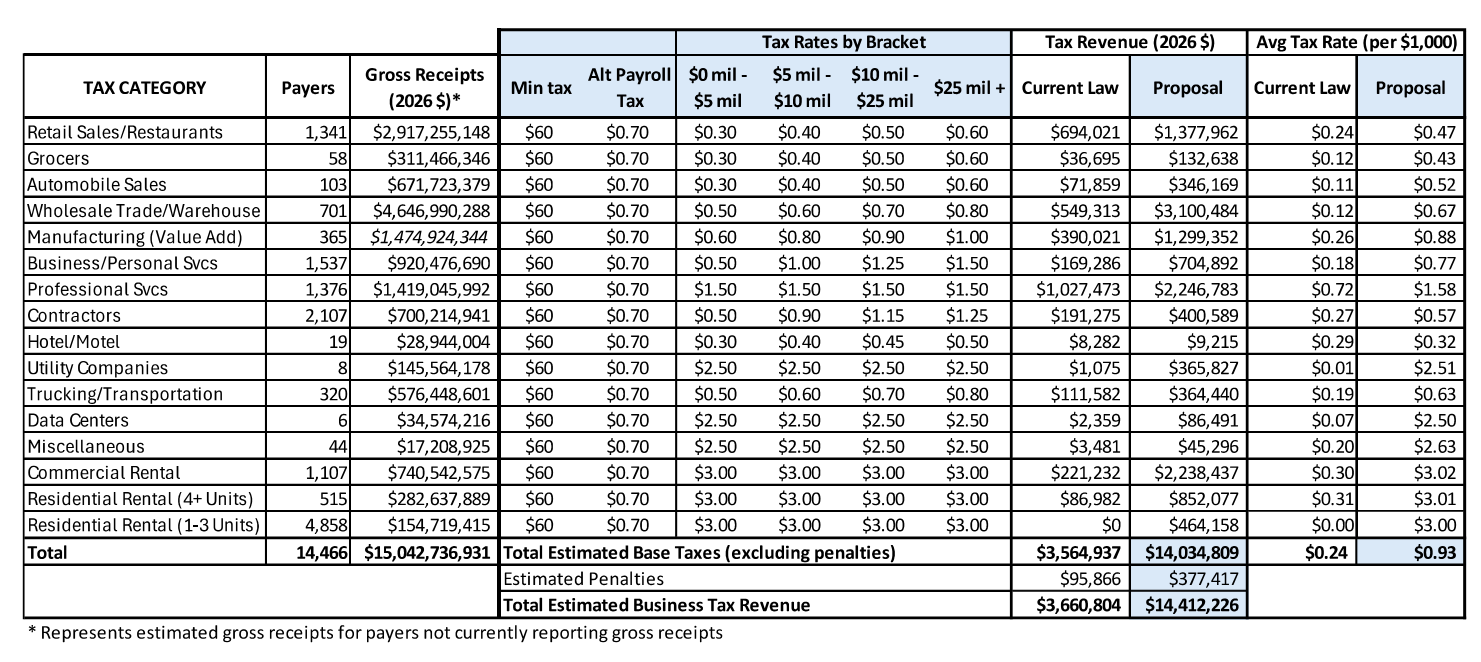
The proposed structure is expected to bring in an additional $14,000,000 per year, with the bulk of the revenue coming from Wholesale Trade/Warehouses, Professional Services, and Commercial Rental. The expected revenue of the entire taxable business community in Hayward is expected to be around $15,000,000,000, so the tax would be around 0.09% of business revenue. For context, sales tax in Hayward is 10.75%.
The consultant pointed out that the new rates align more closely with neighboring jurisdictions across most categories. Small businesses will remain relatively low-taxed and most of the increases are focused on higher-revenue businesses. On top of that, restaurants and small retail outlets will see very minimal changes. For example, if a small retail establishment brings in $1,500,000 per year, the tax would increase by less than $50 per year. And a restaurant that brings in $1,900,000 per year would see an increase of $58 per year.
Taking The Temperature
The City surveyed 154 businesses in Hayward to gauge their reactions to the increased tax. The majority of these businesses were small, with 1-5 employees, but they were represented across a range of industries. When it came to supporting the changes to the tax, the respondents were evenly split--30% each for Neutral, Agree, or Disagree with changing the structure. Many cited concerns about rising costs and 75% of the respondents said they were moderately to extremely "sensitive to tax increases."
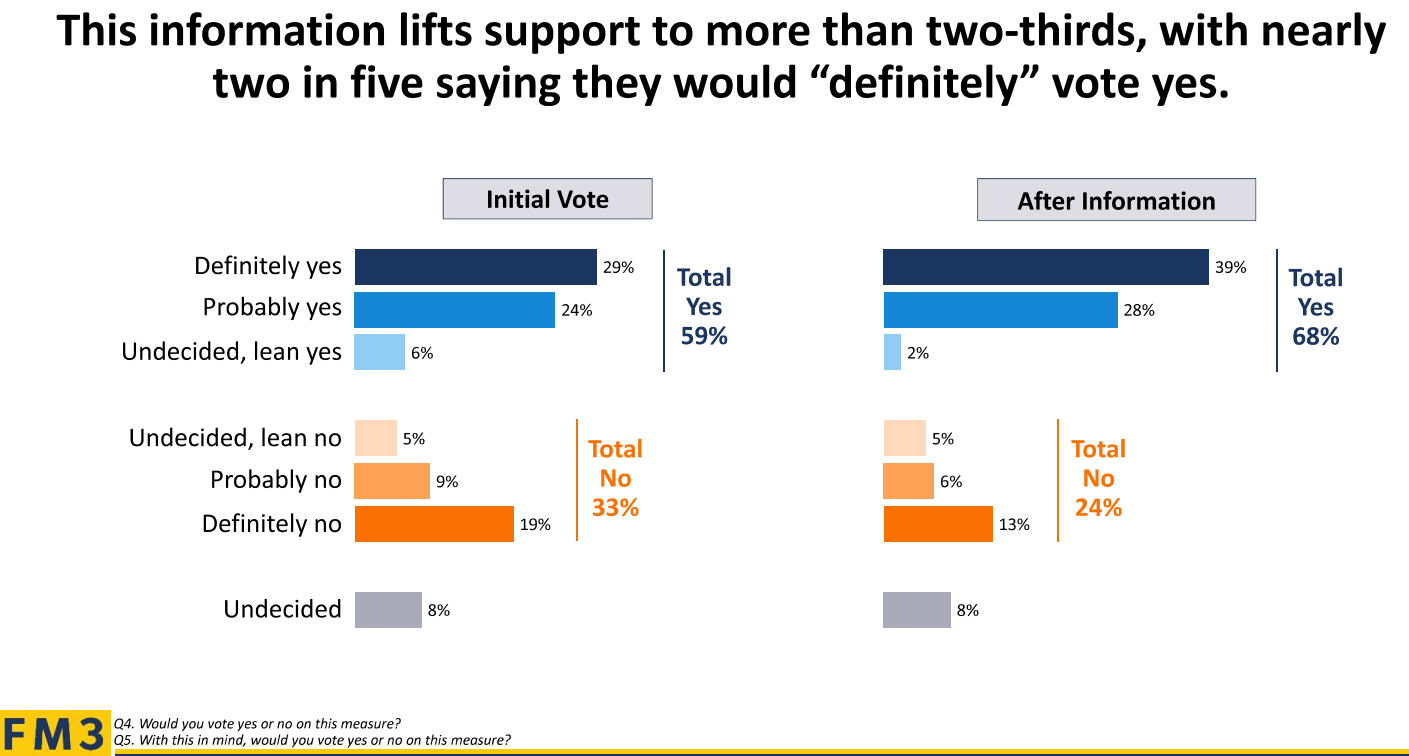
However, approval of the tax falls on the voters. Consultants at FM3 surveyed likely voters in the November 2026 election on the tax. 75% of respondents said that Hayward had Some or Great Need for additional funding, which is an increase from 2024. When asked about a Business License Tax increase specifically, around 59% of voters leaned toward approving it, and that increased to 68% after being provided some additional information. This support was strong, even with the other potential tax measures proposed for the November ballot.
Small Landlords Crave Carve-Outs
Derek Barnes, CEO of the East Bay Rental Housing Association, spoke during public comment against adding any Business License Tax to small landlords. He pointed out that the changes take "4,800 small rental property owners from effectively zero to a new gross receipts." Mr. Barnes pushed for a smaller, graduated tax on owners of 1-3 properties who make below $250,000 in gross receipts, but then pushed for full exemptions from the tax for "these small owner-operators." The East Bay Rental Housing Association's website points out that they support rent subsidies like Section 8, which guarantees revenue for landlords, but is opposed to rent control.
Councilmembers Angela Andrews and Ray Bonilla expressed concern about small landlords. Councilmember Andrews asked if they could be excluded or if the rates could be graduated, seeking to address the concerns of Mr. Barnes. The consultant who developed the tax structure pointed out that exemptions cause equity issues. "One concern is that you want to be sure you're treating all the tenants the same, too," he said, "and not disadvantaging tenants that live in larger buildings."
Councilmember Francisco Zermeno asked about waivers for people who are "having a hard time" paying the tax. The consultant said, "That's a bit unusual" since no other tax has an exemption simply because someone says they're having difficulty paying it. He also warned of the high staff cost of evaluating hardship as well as the lost tax revenue from the exemptions.
Councilmember George Syrop pushed back against any changes for smaller landlords. "If you only have 3 residential units that you're renting out, you're likely not bringing in over $5,000,000 worth of revenue," he said. "So there's not really a reason to graduate that specific category." He then demonstrated how little the impact would be by pointing out that median rent for an apartment in Hayward is $2,350/month, which is $84,000 per year if you own three properties. The tax on that would be $252 per year, or 0.3%. "That's pretty reasonable if you're running a business in the City of Hayward," he said.
But How Will The Businesses Benefit?
Multiple City Council members worried that the tax wouldn't benefit businesses enough without clear direction. Councilmember Andrews wondered what the City would be offering the businesses in exchange for the tax. City Manager Jennifer Ott explained that the money would go to the General Fund, so could pay for anything. "Predominantly, it is for public safety," she said. "So this would go to help us be able to sustain our public safety services."
Councilmember Julie Roche ultimately supported the changes, but expressed caution. "I don't think we can overreach in the business community to fix our deficit," she said, "but I do think it's timely for us t update this tax if we can." Councilmember Dan Goldstein supported additional messaging to reassure the business community. "If anything, we're looking to continue to provide great services to the residents and businesses in our community," he said.
Mayor Mark Salinas was, perhaps, the most adamant about making sure businesses benefit directly from the changes. He said he wanted "to figure out a defined benefit to the business community that we can say that this tax is supporting." He then went a step further. "I would not want to pay a tax and know that I'm not directly benefiting from whatever it is I'm paying for," he said.
Union Engagement In Dispute
Emily Wallace of IFPTE Local 21 called in during public comment to allege that no Union contact had been made about the proposed changes, despite the idea coming from the Unions. Multiple City Councilmembers responded by thanking the Unions for their support and trying to find a way to engage them in the process. Councilmember Andrews asked if IFPTE had been contacted. City Manager Ott said that they had been invited to the February session and asked about the tax at other meetings, but she did not say that they had been specifically engaged on the subject.
Councilmembers Syrop and Goldstein also recognized the Unions and their contributions. Councilmember Syrop asked that they engage with City Council members outside of meetings to provide any input. He later attempted to provide space in the process to incorporate any proposed changes from the Unions, but City Manager Ott and Councilmembers Roche and Bonilla pushed back. Councilmember Roche pointed out that the meeting they were having was a time to give feedback. Councilmember Bonilla said, "It's time to move forward," and was against adding any additional time for union engagement.
The item will come to the City Council for final approval in May.



Comments ()