
The Heart of Hayward: Animal Shelter In Crisis
Hayward’s animal shelter and the cost of structural neglect
Editor’s Note: The Hayward Herald will be taking a winter break until mid-January. We hope you enjoy time with the people you care about and we’ll see you in the new year.
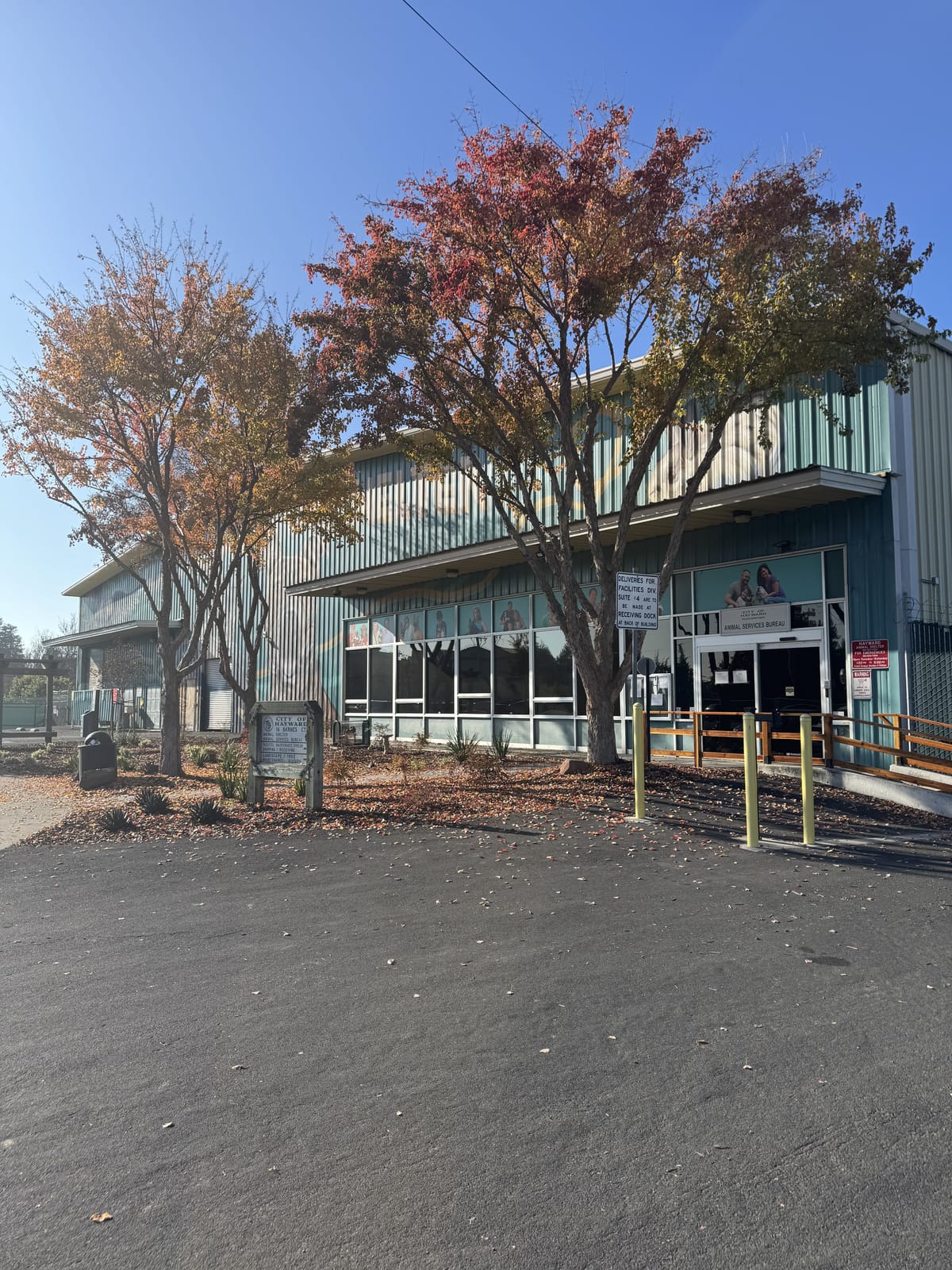
The tip came in quietly, but the reaction was anything but silent. In late November, the Hayward Herald was contacted by concerned residents regarding a proposal by the Hayward City Council to cut $1 million in staffing costs. While budget discussions are a routine part of municipal governance, the specifics of this proposal struck a nerve that reverberated across the city. The cuts threatened the stability of the Hayward Animal Shelter, specifically targeting per diem staff who make up nearly half of the shelter’s workforce.
Social media posts began circulating immediately, warning residents that the shelter’s ability to operate was in jeopardy. The online discourse was frantic and emotional, with many pleading for the community to intervene. The full scope of the community’s outrage unfolded at the December 2 City Council meeting.
A Quiet Proposal, a Loud Response
On Tuesday, December 2, the Hayward City Council chambers were packed. The atmosphere was heavy and filled with tension as residents, volunteers, and shelter staff filled the seats, many holding signs featuring animals that would be at risk if services were reduced.
Mayor Mark Salinas opened the meeting by acknowledging the intensity of the past week, noting that he had received emails and seen social media posts that he described as “ugly, toxic, mean, and rather threatening”. Salinas attempted to set a tone of shared values, reminding the audience that many council members were pet owners themselves. “My dog is very much one of my family members,” Salinas said, hoping to bridge the divide between the dais and the public. He assured the crowd that no specific plan regarding the animal shelter was currently in front of the council, nor were there plans to euthanize animals immediately, as some rumors suggested.
Despite the Mayor’s call for decorum and his assurance that they were listening, the public comments that followed were a two-hour crusade by volunteers, staff, and residents. They were there to hold the city leadership accountable, not just for the potential cuts, but for what they viewed as a failure of fiscal and moral priorities.
Sheila Merrill, a lifelong Hayward resident, opened public comment with a direct rebuke. She identified herself as the daughter of Ed Phillips, the former Director of Public Works who served the city from 1948 to 1985. Leaning into her family’s legacy of public service, Merrill did not mince words, condemning the council for approving significant salary increases for themselves while simultaneously considering cuts to essential services.
“The insistence of this massive raise during the city’s financial crisis by the current mayor and city council is irresponsible and self-serving,” Merrill said. She drew a sharp contrast between the sacrifices of past councils and the current leadership, arguing that they were “condemning helpless animals to death to line your pockets”.
After the opening testimony, the tone in the room was already heavy with frustration and concern over what the proposed cuts would mean. Jennie Comstock, the Animal Services Administrator who has dedicated 25 years to the department, approached the podium with a palpable sense of exhaustion and duty. She detailed the reality of her department, which has operated with a stagnant budget for years despite rising costs.
“I’ve been told year after year not to ask for any more staff unless I can find the money in my budget,” Comstock said. “I have given positions to get other positions. I have no more to give”.
Comstock highlighted the potential impact of the city’s proposal to eliminate “temporary” employees. She explained that 47% of the animal services workforce consists of per diem staff. These are not casual workers filling in occasionally; they are essential team members who work weekends and holidays, and who put their lives at risk during the COVID-19 pandemic to ensure the animals were cared for. Comstock warned that losing these positions would be crippling, likely leading to reduced service hours and increased euthanasia.

The volunteers who spoke were equally passionate, translating the bureaucratic language of budget cuts into the visceral reality of animal welfare. Charlene Chappel spoke about dogs she had helped shepherd through the shelter system—Arky who was renamed Calvin, now living in Half Moon Bay, and Arlo better known as Scooby-Doo, was adopted into a home in Hayward. These were not statistics, she made clear, but lives with names, histories, and futures shaped by the shelter’s capacity to care for them. Carlin Starrs, a volunteer of three years, described walking and playing with dogs and cleaning kennels, bowls, and bedding. She then invited Mayor Salinas and council members to visit the shelter, not for a photo opportunity, but to work.
“Come help clean some kennels first thing in the morning,” Starrs said. “And then you can say you literally helped clean up your own mess.”
Others, like volunteer Helen Botelho, reminded the council of the immense value volunteers provide, contributing an estimated 10,000 hours of labor this year alone. Botelho and Charlene Chappel also drive the animal shelter’s social media presence, creating posts that promote adoptable animals as well as community resources and events. Botelho made it clear that volunteers “refuse to be part of a kill shelter.” The shelter’s role as a point of civic pride surfaced repeatedly. Speakers described it as one of the city’s quiet successes—humane, functional, and deeply rooted in community support.
Subscribe now
Deficits Deferred
After intense public testimony, City Council attempted to respond to the wave of criticism. Council member Angela Andrews, who had visited the shelter the week before, acknowledged the reality of the situation. She also recounted a recent experience in which she surrendered a stray dog and witnessed staff’s compassion firsthand.
Andrews then addressed Council compensation directly, stating that she and Mayor Pro Tem Julie Roche have drafted budget strategies that included selling city-owned properties and reducing council salaries to help bridge the deficit. “We need to revisit our salaries,” Andrews said, while also acknowledging that their pay represents a mere 0.0013% of the general fund.
Council member Julie Roche admitted how difficult it was to sit through the comments but defended the broader context of the city’s financial decisions. She noted that City Staff had received “pretty nice raises” in an attempt to catch up to market rates and attract talent. Together, the remarks underscored an uncomfortable inconsistency: staff compensation routinely rises to meet market demands, while elected officials face scrutiny for raises that still leave them earning far less than the senior employees they oversee.
Roche emphasized that the council looks at the budget holistically and had not specifically directed the police department to cut eight shelter employees. She invited Police Chief Matthews to the podium who confirmed that while every department was reviewing vacancies and per diem positions, no specific conversation had occurred regarding the separation of the shelter staff. This exchange seemed intended to reassure the public, but for many in the room, the assurance felt tenuous.
Council member George Syrop closed the council’s comments before the break, accepting responsibility for the situation. “The buck does stop here with us,” Syrop said. He encouraged residents to review the previous council meeting to understand the depth of the crisis, insisting that the council’s goal was not to hide information but to put “all of our cards on the table.” He expressed gratitude for the shelter workers and volunteers, calling the shelter a “shining example regionally” and promising that labor partners were being consulted to protect as many jobs as possible.
As the crowd began to filter out of the chambers, a sense of pride lingered among residents, volunteers, and staff who had stood up for voiceless animals. However, the council remained to face the reality of the city’s finances. Assistant City Manager, Mary Thomas, provided a sobering report that revealed the city had been using one-time federal funds, specifically from the American Rescue Plan Act (ARPA), to plug structural deficits in the general fund.
Thomas explained that while using ARPA funds to rebuild reserves was allowed, the city relied on this “one-time money” to support ongoing positions and recurring expenses. Those temporary funds obscured a structural imbalance, allowing expenses to continue outpacing revenue without immediate consequence. When the federal aid expired, the gap became unavoidable, setting the stage for the cuts now under consideration.
It became clear from the public comment that many residents believe the recent raises for the City Council and Mayor are partly to blame for the $30 million deficit the city now faces. Though the council’s salaries are a fraction of the overall budget, the optical alignment of a 58% pay increase for elected officials alongside a proposal to cut low-wage per diem staff did not go unnoticed. A smaller number of speakers also pointed to what they described as bloat at the executive level of City Staff, arguing that reductions should begin higher up the organizational chart. Though not the prevailing sentiment of the night, those comments reflected a broader unease about how budgetary priorities have been set.
The meeting ended with the immediate crisis of the shelter temporarily stayed, but the underlying financial failures lingered. The city has yet to determine exactly how it will close the budget gap without sacrificing the essential services that define its character. As the lights went down in City Hall, the question remained: who will ultimately pay the price for years of structural neglect?
Subscribe now
The Economics of “Temporary” Labor
The Hayward Animal Shelter is more than just a pound. For Brandon Sprague, an Oakland resident with family ties to Hayward, it is an “exporter of good” in the Bay Area. It is a place where families are made, where lost pets are reunited with owners, and where the most vulnerable creatures in the city find sanctuary. But as the city grapples with a $30 million budget deficit, the shelter has become ground zero for a conflict between fiscal austerity and moral responsibility.
At the center of the shelter’s success is Jennie Comstock. As the Animal Services Administrator, she has led the department for 25 years, navigating a landscape of scarce resources with ingenuity and heart. Under her leadership, the shelter has achieved remarkable results: it has not euthanized an animal for space in over 15 years, a feat that requires sustained coordination among staff, volunteers, and rescue partners. That record stands in contrast to conditions in nearby cities, where overcrowding, staffing shortages, and declining adoption and transfer rates have driven increases in euthanasia. In both San Francisco and San Jose, shelter officials have reported rising animal deaths and euthanasia in recent years as facilities struggled to keep pace with intake. Hayward’s shelter, by comparison, has remained functional and humane despite similar regional pressures.
The shelter’s programs extend well beyond basic kenneling. Its Trap-Neuter-Return (TNR) program, critical to managing the city’s feral cat population, is projected to serve approximately 1,000 cats this year alone. The program operates almost entirely through volunteers and per diem staff, with funding drawn from donations and vacancy savings. Jennalee Duvall, a Hayward resident, began volunteering with the TNR program while five months pregnant, transporting cats to and from appointments. She now continues that work with her young son, using the experience as a way to teach compassion and responsibility toward animals.

Community events such as ZombieCon and SantaCon, organized by volunteer Anna May since 2012, allow local small businesses to sponsor adoption fees for animals in need of homes. These events further strengthen the shelter’s ties to both residents and the local business community. May shared the story of Frankie, a one-eyed, three-legged dog adopted by a family whose youngest son explained, “We wanted to give her the opportunity.”
However, this model of resilience is built on a fragile foundation of “temporary” employees. Nearly every program that relies on volunteer labor depends on per diem staff to schedule access, provide training, maintain compliance, and ensure continuity of care. Without that staffing layer, volunteers cannot legally or logistically perform much of their work.
The proposal to eliminate per diem staff threatens to collapse the entire operation. While classified as “temporary,” these employees are the backbone of the shelter. The shelter is budgeted for 14 Full-Time Equivalent (FTE) positions but currently operates with only 10. The gap is filled by 9 per diem staff members. These employees do not receive benefits, yet they fulfill the duties of full-time workers at a fraction of the cost.
An average full-time employee works 2,080 hours a year. Collectively, 9 per diem staff at the shelter can provide 500 additional working hours than 4 full-time employees. By using per diem staff, the city saves approximately $407,268 annually in benefits such as PERS retirement contributions and medical coverage.
Traci Young, a per diem employee of 22 years, highlighted how misleading the classification can be during the City Council meeting. Though her title is “Police Records Clerk,” she is a fully trained animal control officer who covers shifts in the field. “It would actually cost the city more to get rid of some of your per diems,” Young argued. The city would be forced to pay overtime to higher-salaried full-time staff. These workers are a bargain for the city, providing essential labor without the long-term legacy costs of pensions.
Subscribe now
The Human and Animal Cost
The tension regarding the shelter cuts is magnified by the broader context of city governance. The passage of Senate Bill 329 in 2023, allowed cities operating under general law to make salary adjustments to help City Councils reflect the economic reality of the job. The bill was authored by former CA Senator Bill Dodd who warned that inadequate compensation narrows representation and weakens accountability.
Research on municipal governance supports that view, showing that under compensating elected officials can restrict office to those wealthy enough to afford it, reduce transparency, and increase the risk of conflicts of interest and corruption. Overcompensation creates its own risks as well, so the balance is delicate.
As investigations by Mission Local have shown in San Francisco, corruption scandals in city government have often involved both elected offices and executive City Staff, but criminal convictions have largely centered on long tenured, career department officials, highlighting the accountability risks that arise when professional staff wield significant power with limited public oversight.
“City Council members have one of the hardest jobs in California government. They deal with a wide range of issues, from street maintenance to emergency response duties. And all too often, they do this job with very little financial compensation. No one runs for City Council in order to make money. But the low levels of pay make it much harder for them to balance their careers and personal obligations with the calling to serve their community. The Legislature has not raised the base pay amounts for City Council members since 1984. It’s time those amounts caught up to the present economic reality, especially with the rapid increase in inflation we’ve seen recently. Raising the pay will also make it easier for members of marginalized communities to serve. City Councils should be reflective of the communities they represent and I believe raising their compensation is an important step to achieving that equitable outcome.” Bill Dodd, former CA Senator
As a charter city, Hayward has “home-rule” authority to set its own laws regarding municipal affairs, including how its council is elected and compensated. But for nearly two decades, the Hayward Mayor and City Council did not receive a raise, often forgoing cost-of-living adjustments during economic downturns. The recent 58.6% raise largely restores cost-of-living adjustments waived by previous councils.
This disparity is even more pronounced when looking at top City Staff. The previous City Manager, Kelly McAdoo, received a contract that saw her total compensation package rise to over $440,000 annually. The Mayor currently makes $69,288 and City Council members $43,305. These executive staff salaries are often justified as necessary to stay competitive with other cities. Recent reporting suggests this imbalance is not changing. According to her employment agreement, Jennifer Ott will earn $393,000 per year as Hayward’s new City Manager, an increase over the $385,008 salary listed in the City’s approved pay plan. The contract also represents a substantial raise from her 2025 agreement with the Alameda, where she earned $359,969 annually just months earlier, an increase of more than $33,000 per year.
At the same time, the Mayor and City Council remain among the lowest paid decision makers in the city’s governance structure. Only two council members hold positions that could reasonably be described as high earning. The majority of the Council and the Mayor work as professors at local colleges, employees of nonprofits, or in non-senior roles in corporate America, often balancing public service with full time jobs that offer limited flexibility and compensation. Yet, as one scholar noted, under-compensation of elected officials can create a “catch-22 . . . We don’t want to equip politicians with the resources to do their jobs, and then we blame them when things don’t work the way we want.”
This disparity underscores the structural tension at the heart of Hayward’s governance. The question now facing Hayward is who will bear the brunt of these financial missteps. The Mayor and City Council will likely reevaluate their compensation offering some symbolic relief but leaving practical concerns.
If elected officials must rely on full-time employment elsewhere, who governs during business hours? Who has the capacity to oversee a city where senior staff earn several times more than the elected officials tasked with accountability? Underpaying Council members risks narrowing who can serve, often excluding lower-income residents and communities of color who more closely reflect Hayward’s demographics. Better compensation could broaden representation and align leadership with the city’s stated values of Caring, Openness, and Integrity. These questions speak to long-term governance and representation while proposed cuts to per diem staff pose an immediate threat to animal services.
If the per diem positions are cut, the animal shelter will lose nearly half its workforce and consequences will be immediate and severe. As Brandon Sprague warned, citing a similar situation in Oakland, cuts to shelter staff lead to reduced intake, declined quality of care, and a “negative multiplier effect” on the community. For the animals, the cost is existential. Without enough staff to clean kennels, socialize dogs, and manage the TNR program, the shelter will be forced to regress. The “no-kill for space” status that the city takes such pride in will likely be lost.
The City Council has stated that they are looking at the budget “holistically” and that no final decisions have been made. At the Dec. 16th City Council meeting, officials presented revised figures showing that proposed cuts to per diem positions had been reduced from $1 Million to $400,000. While council members did not explicitly attribute the change to public comments heard earlier in the month, the adjustment appears to lessen the immediate impact on the shelter’s workforce. But for the residents who filled City Hall, the path forward is clear. They are asking for a government that reflects the values of its people. They are asking for a city that prioritizes the most vulnerable, whether they have two legs or four.
Zelma Nunez Borja summed it up best when she implored the council to remember the city’s motto. “We take pride in calling Hayward the heart of the bay,” she said. “Our shelter is a living part of that heart”. The coming weeks will determine if that heart is still beating, or if it has been lost in a spreadsheet of red ink.
Corrections 12/20/25
Achy corrected to Arky.
Arlo and Scooby-Doo as the same dog and was adopted to a home in Hayward.
Helen Batelho corrected to Helen Botelho.
Anna May has been volunteering for 13 years not 15.
This story is dedicated to Maple, our mischievous mini dachshund. She was a true spitfire who loved as deeply as she was loved. Though she was small, her spirit was immense. I will miss you, Maple.


Comments ()