
What Is The Sun Gallery?
In Which: We introduce a multi-part story on the Sun Gallery, A brief history of the Sun Gallery is given, and A taste of what comes next.
This is the first of a multi-part series about The Sun Gallery. What’s going on there is complicated and takes time to explain. So there’s only going to be one story per week for the next few weeks—at least that I write.
Councilmember Francisco Zermeño was the first to ask about the Sun Gallery during a City Council meeting. On April 1st 2025, he noticed that the Sun Gallery was not on the list of organizations getting money from the City’s Community Agency Funding (CAF) Process. “Any chance you can explain,” he asked members of the CSC in the Council Chambers, “why the Sun Gallery was not included in this list?”
His question was quickly sidelined by other Councilmembers and Staff. “We’re not there yet,” Mayor Salinas said. Despite getting regular grants from the City, the Sun Gallery was not eligible to receive funding this year.
On April 22nd, Councilmember Zermeño brought the subject up again. “We had three calls in today about the Sun Gallery,” he said. “Can you explain, more or less, to the public what our plan is?” Dr. Amy Cole-Bloom, who heads the Community Services Division, explained that there had been significant changes to their leadership structure and that the organization was in disarray.
“At that point in time,” Dr. Cole-Bloom said, “since Sun Gallery did not have control over their own finances and couldn’t report to us about how the money was spent or where the money was, that it wasn’t appropriate to give them additional funds until we could investigate the current situation.” The City didn’t feel like it could trust the Sun Gallery with more taxpayer money.
After taking a closer look, the City’s caution was justified. Our investigation revealed embezzlement, misspent grant money, problematic behavior, and fights between leadership factions that resulted in empty accounts and a floundering Board. According to current members of the Board, the Sun Gallery’s account was essentially empty.
In this multi-part series, we’re going to take a close look at the Sun Gallery: what it is and why it matters, what happened to all their money, and the infighting that allowed it all to happen.
What Is The Sun Gallery
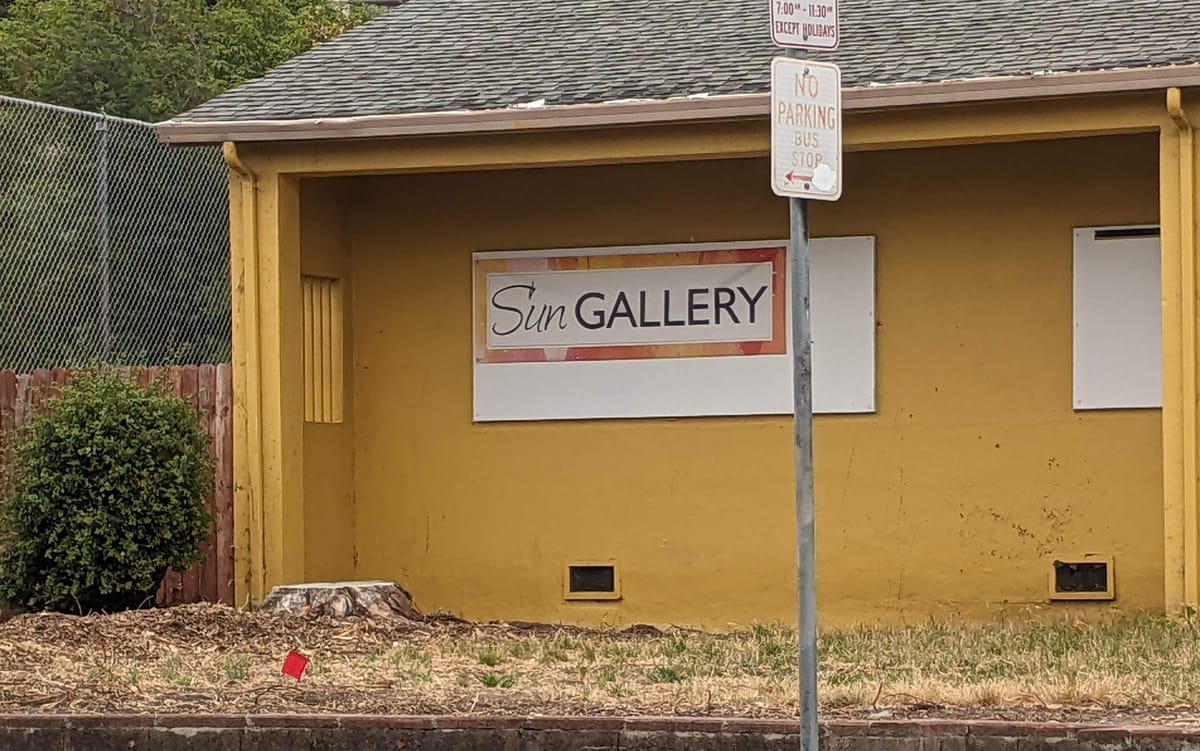
The first thing to explain is that The Sun Gallery isn’t the organization, it’s the building. The building is located in front of the Bret Harte Middle School on E Street and is owned by the Hayward Area Recreation and Parks District (HARD). HARD is the landlord for the Sun Gallery, they maintain the grounds around it, get to make decisions about what can be done to the building, and ultimately get to decide what happens to it.
The organization that runs the Sun Gallery right now started life in 1965 as the Hayward Area Festival of the Arts and later became the Hayward Area Forum of the Arts. The organization was initially created to support a Festival of the Arts—an annual event that promoted all kinds of art, including drama, dance, and music. Eventually the organization took over the Sun Gallery building and has been managing it since at least the 70’s.
The Forum of the Arts has included some notable people on its Board of Directors over time, including John O’Lague—of the O’Lague Galleria at City Hall—and Douglas Morrison—of the Douglas Morrison Theater, and doubtless others I don’t immediately recognize. The original founders set out to support a vibrant art scene in Hayward, which only had around 75,000 people at the time. And from what information I can find, it went pretty well for a long time.
According to newspaper archives, the Gallery was spinning up a robust gift shop in 1975. The idea was to sell merchandise to support both the artists and the organization. The Gallery also held multiple exhibits every year in the 70’s. A brief search through the Daily Review archives brings up exhibits focused on art by disabled children and adults for Christmas, work Mexican artist by José Luis Cuevas, photos by Stanley R. Truman, and group shows lifting up local Hayward artists.
On top of that, newspaper records show that there were regular fundraising events to support both the Festival of the Arts and the Sun Gallery itself. From white elephant gift exchanges to luncheon fundraisers, the Festival of the Arts appeared to be self-sustaining on its own fundraising efforts. It was active in the community and served as a hub for the local arts scene in Hayward for decades.
Thanks for reading Hayward Herald! This post is public so feel free to share it.
And while the newspaper archives are lacking between the 70’s an early 2000’s, the Sun Gallery appeared to be trucking along pretty well until fairly recently. However the mission of the Sun Gallery seemed to gravitate more toward art programs, presumably to both develop young talent and fill growing gaps in arts funding at local schools.
In 2002, the Sun Gallery was working with the Hayward Arts Council to sponsor shows in the John O’Lague Galleria in City Hall but also hosted a fundraising gala to fund children’s art programs. They also hosted a “Mervyn’s Saturday Art for Families 2003” where families could visit, for free, and create art under the guidance of a Sun Gallery art educator. Many of the volunteers at the Gallery were current or former art teachers from local school districts, as well.
But even in 2004, the Sun Gallery was still co-sponsoring an Open Studios Tour which highlighted the work of over 40 local artists and running shows with local artists like J. Steven Walters. A 2004 article about the Gallery’s Summer Art Day Camp explained that the shift to children’s programming was intended to fill the gap left by defunded school art programs. However, the articles highlight that much of the programming was sponsored by Mervyn’s—at the time one of the biggest employers in Hayward.
But starting in 2008, around when the Great Recession occurred, money started to dry up. A February 2008 article in the Daily Review was a plea for community support. In it, the VP of the Board at the time, Valerie Caveglia, explained that even as the City granted the Gallery $36,000 per year, the operating budget was around $90,000. “We have bills to pay and an empty checking account,” she wrote.
Anecdotally, it appears that many of the cuts outlined in the plea for funding had to be followed through. But even it its diminished state, the Sun Gallery continued to operate as one of the few public arts organizations and the only independent art gallery in Hayward. It maintained regular shows, but as an outside community member, it appeared to withdraw further into itself. My own impression was always that it was a club of older Baby Boomer artists—it never felt like a place for anyone my age.
But in the last few years, that image started to change. In 2021, the Hayward People’s Budget allowed the Sun Gallery to develop a makerspace. With more advanced manufacturing equipment like CNC machines and 3D printers, people could go to the Sun Gallery to experiment with new methods of creating.
Around the same time, a new board was appointed that seemed to have some fresh ideas for what to do with the Gallery and how to run it. There were different events happening and, with the addition of the makerspace, there was hope for a new jolt of energy in what always felt like an ailing institution.
Why You Should Care About The Sun Gallery
When I first caught wind of problems at the Sun Gallery, I knew this deserved attention. But maybe you don’t feel the same way, which is totally understandable. But there are a few reasons why the fate of the Sun Gallery is important to everyone in Hayward.
Art Is Important
Hayward is already full of art. The City has invested heavily in public pieces—especially murals—which are accessible to all people all of the time. But they’re completely separated from the people who created them. The Sun Gallery is one of the only places in Hayward where an artist can host a show and build connections to the community.
We already have artists in the community who are gaining regional recognition. Louis Jiminez, likely best known for his Nostalgic painting that made a splash on Instagram, has had installations in Fremont and Pleasanton but has only put one painting up in a Hayward gallery. Elizabeth Blancas is a local painter and print artist who’s had pieces in museum spaces elsewhere in the Bay Area. But, insofar as I know, she’s never had a dedicated installation in a Hayward gallery.
We should be celebrating these local artists—and others I’ve never even heard of—because they’re the ones creating culture in Hayward. They’re younger people of color who are creating interesting—and popular—art that are directly tied to their experience of living in Hayward. We should be embracing them, supporting them, and giving them a place to shine—the Sun Gallery could be one of those places.
The John O’Lague Galleria, one of the other galleries in Hayward, often has art openings, but it comes with implicit limitations. For example, one former Sun Gallery member alleged that the Hayward Arts Council (HAC), which maintains the galleries in City Hall, discouraged an exhibition with an overtly political message around genocide and displacement in Palestine. Having an independent place, like the Sun Gallery, away from City Hall removes any pressure to self-censor—4 of the 5 galleries managed by HAC are in government-owned buildings.
The Sun Gallery Belongs To You
And that freedom is important because the Sun Gallery belongs to the people. As a 501(c)3 nonprofit, the Gallery is operated for the benefit of the public—that’s all of us. Even if you aren’t a member of the organization, you can visit the Gallery, take in the art on display, and participate in developing the culture of Hayward. Paying members have a financial incentive to make sure that the Sun Gallery is doing the best it possibly can—their money is running it.
But in a very real way, everyone is already funding the Sun Gallery just by living in Hayward. The organization receives a lot of its money from the City of Hayward itself. Their proposed FY 25 operating budget assumed about 1/3 of the money would come from the City, but previous years indicate that up to half of the Gallery’s income came from grants—most of which likely came from the City of Hayward.
What’s To Come
Those tax dollars are also part of the reason why the Sun Gallery deserves a closer look. Having to undergo fiscal monitoring is a big deal: it means the City doesn’t think that their money has been used appropriately—tens of thousands of government dollars. These issues are the result of infighting and mismanagement at one of the only independent art spaces in the City, and that should concern us all.
So next week we’ll look into the organization’s finances. Dr. Cole-Bloom said that the Board was, at one point, not in control of their own accounts, but how did that happen? We’ll explore what kinds of grants the Gallery received, what happened to them, and why these problems may have happened.


Comments ()