
Austerity May Be New Normal For Hayward
Councilmember Bonilla pushes ranking core services for future cuts. City explains what went wrong with budget. Business License tax to get update for first time since 1978.

The City Council met for six hours on February 28th for a budget retreat, with the goal of finding solutions to the budget deficit. City Manager Jennifer Ott said that the current staffing level may be kept to build reserves, while Councilmember Ray Bonilla pushed to prioritize "core services" in the name of future austerity. If the city does nothing, it will be facing at least a $32,000,000 deficit next fiscal year, but is trying to fix bad practices, sell city land, and raise revenue to balance the budget and replenish reserves.
What Happened and How's It Being Fixed?
Hayward Mayor Mark Salinas opened the budget retreat with an optimistic note. "It is no secret that we are in this budget situation," he said. "But I think we're on a path to recovery. It's going to take some time, but we're going to get there." He said that the city should not see a service reduction while they address the budget deficit. "Simultaneously we can continue to provide high quality services."
City Manager Jennifer Ott presented a slide that outlined the causes for "Hayward's Fiscal Challenges":
- Increased staffing and programs that used one-time ARPA and grant funding
- Labor negotiations with misaligned market and fiscal realities
- Slowing and declining real estate revenues combined with overly-optimistic budgeted revenue
- Not adhering to financial best practices, like budgeting accurately for overtime, using salary savings as a crutch, and purchasing a risky real estate asset which was budgeted as a non-liquid reserve
- Leadership transitions and dilution of authority and responsibility
This, according to the slide, resulted in exceeding the FY25 budget by $30,000,000 and depleting all of the city's reserves. City Manager Ott explained that the property taxes, despite being regular, had been flat due to slow home sales, which resulted in cost increases exceeding revenue growth.
The presentation also outlined some impacts to core services, including reducing library hours, eliminating community grants, eliminating two fire companies, and longer response times for dumping removal, permit review, and inspections. More impacts are likely, but won't be explored in detail until May.
The Hayward Herald is a non-profit newsroom that is only possible because of you. In order to grow and really be sustainable, we need your support. Please consider donating to help us out.
Despite the cuts, many projects that the City Council prioritized last year are still in the works. Some have been brought into regular workload for a department and others are funded by non-General Fund revenue or grants.
City Manager Ott quickly outlined some lessons learned around the budget and some actions the city is taking to address them. They are trying to adhere to financial best practices, improve transparency and accountability, practice strong leadership at all levels, and financially constrain labor negotiations and contracts. "I wanted to acknowledge that we are learning out lessons," she said.
Finance Director DeAnna Hilbrants outlined the tactics that the city used to close the gap, including workforce reductions of approximately 15% of the entire city staff, using one-time funds from Measure C and the OPEB Trust, and concession bargaining. However, the only changes covered by labor unions were temporary: reducing minimum staffing from the firefighters (IAFF 1099) and shift changes in the Hayward Police Department.
Replenishing Reserves With Specter Of Future Austerity
Councilmember Julie Roche asked about the strategy for future one-time funding. City Manager Ott said it would be only for one-time projects or needs and for rebuilding reserves according to new financial policies. The City would also begin budgeting overtime and keep better track of salary savings. "That didn't happen before and that's what we need," Councilmember Roche said.
Councilmember Ray Bonilla pushed hard for the city to divide services into "core services" and "discretionary services" using the strategic plan and resident satisfaction survey results. "I do think that we feel like we're probably down to what the core services are," City Manager Ott responded. "And that most things that we thought were kind of discretionary have been eliminated."
But Councilmember Bonilla pressed for ranking, calling up the specter of future austerity. "I do think at some point if we're going to really talk about austerity and a budget, we're going to get to that point [of ranking services]," he said. "What services does the city provide that aren't legally, contractually, or regulatorily obligated for us to have to provide... We might just have to get to a point of saying we just can't afford it. And is it the library or is it animal services or the jail?"
Councilmember Angela Andrews agreed with prioritizing services. "I don't want to just look at cutting programs. I want to look at us being innovative."
5-Year Forecasts Look Grim Without Action
When City Staff presented a 5-year Budget Forecast, lack of action would result in deficits every year of around $40,000,000. This was with a "most likely" revenue scenario, described as neither optimistic nor conservative. Other assumptions included 2% Cost of Living Adjustments (COLA) for all bargaining groups, except for the Police Officers and Fire Department which would receive 7% and 4% COLA for the next two years. It also added previously unbudgeted expenses, like overtime.
The deficit is driven largely by CalPERS and Worker's Compensation contributions increasing to match raises, costing an additional $17,000,000. In addition, the $15,000,000 in one-time funding from Measure C and the OPEB Trust were not included.
Councilmember Syrop asked that compaction—the process of maintaining a percentage difference between classifications in the Police and Fire departments—be included in future negotiations and projections.
When City Manager Ott said that overtime is budgeted at $16,000,000, Councilmember Syrop characterized it as "a large chunk of our overall budget." However, Councilmember Bonilla disagreed and asked staff to present best practices. He said 6% of the budget on overtime "doesn't seem unrealistic to me."
Councilmember Francisco Zermeño asked when frozen positions would be eliminated. City Manager Ott said that a lot of the salary savings will be used to build reserves. The model assumed $10,000,000 in salary savings.
Refilling Reserves With Measure C And Property Sales
The city expects to use Measure C to plug the deficit until 2030. However, this would be before Measure K1 goes into effect, and would still leave at least $10,000,000 available for future infrastructure projects. Staff recommends using Measure C until the reserves reach $40,000,000 and to keep money in Measure C to balance cash flow—an issue that HUSD suffered from this past year. But all proceeds from property sales would go to the reserve, so the city may not rely on Measure C for as long as expected.
According to Real Property Manager Tracy Irvin, the city is looking to sell three properties: City Center, C Street and Main, and Cinema Place. He stressed that this was not an exhaustive list, but that these properties were the priority. The remaining 238 properties, for example, will also be sold in the future.
Mr. Irvin said that leasing was an option, but City Manager Ott stressed that it was only as a last resort. "I would like to sell these properties," she said. "I just want to be transparent about that."
Mr. Irvin agreed. "The goal is to sell these properties and... replenish the reserves," he said.
Defending Purchase Of Cinema Place
Councilmember Syrop and Mayor Salinas defended the Cinema Place purchase, which had been described as a "risky investment," as a way to save Downtown. "We, as a city, made a bold decision to make sure we didn't have a big gaping vacant hole at the mouth of our downtown," Councilmember Syrop said.
Mayor Salinas said, "If that building had been sold and had been empty, we would be having a very different conversation about how blighted downtown would have been."
Updating Business Tax After Nearly 50 Years
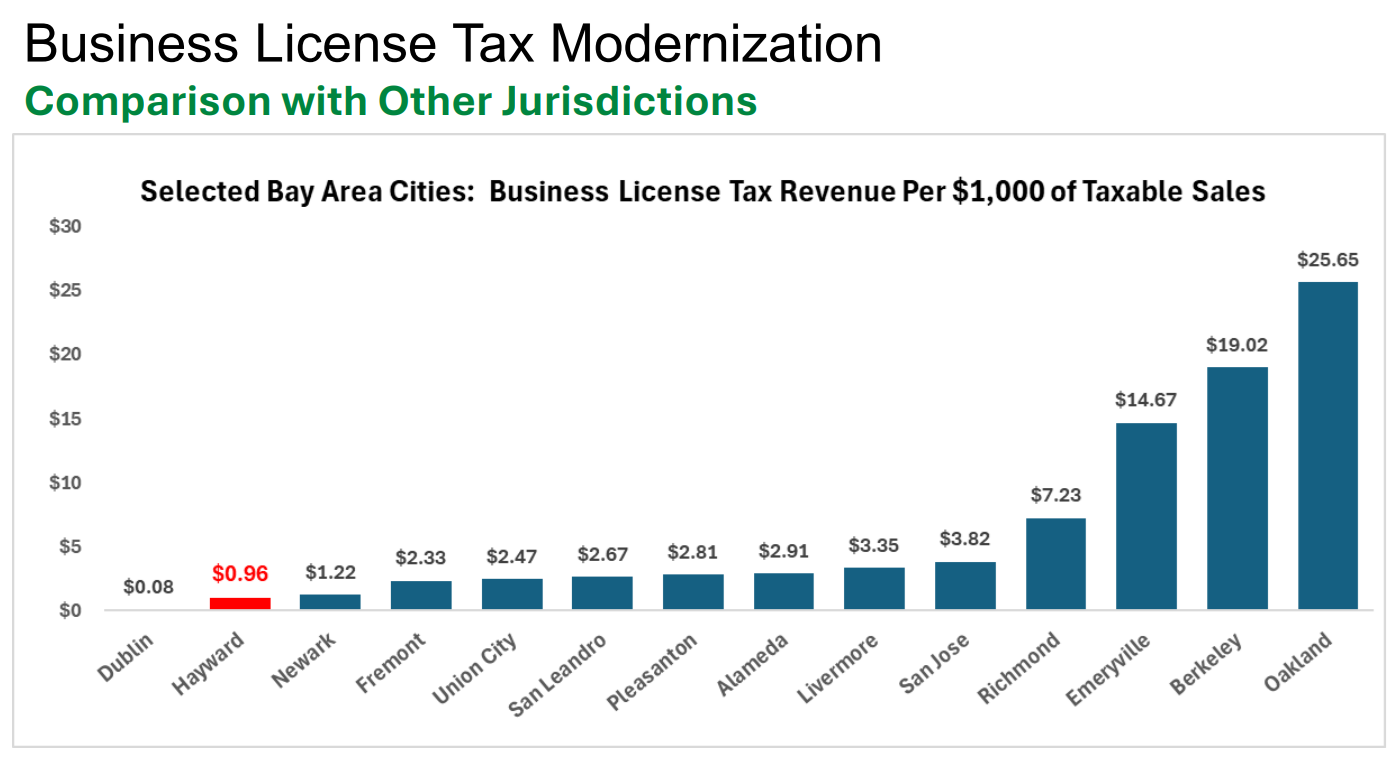
Matt Newman of Blue Sky Consulting Group presented how the city could update its business license tax, which hadn't been changed since 1978—the Jimmy Carter administration. He presented two different scenarios: Match Neighbors and 7x Revenue.
The Match Neighbors scenario would put Hayward between Alameda and Livermore on the graphic above, resulting in about 3.4x more revenue or an increase of $8,800,000. The 7x Revenue scenario would put it more on par with Richmond and Emeryville and an increase of $22,000,000. However Mr. Newman warned it might adversely affect the city's competitiveness for businesses.
The biggest increases would go to "the sectors that are less mobile" according to Mr. Newman, including large and small contractors, manufacturers, auto dealers, landlords, and grocery stores. Both scenarios also included taxing small landlords with 1-3 units, which currently pay no business license tax, despite making up 90% of the landlords.
The city plans to conduct polling to gauge the success of a future ballot measure.
Paying Fair Share Vs. Scaring Away Business
Mayor Salinas opened with concern for small landlords. "Maybe we are sort of targeting them," he said. He also worried about showing value for businesses. "What is it that businesses are going to benefit by raising taxes?" he asked, stressing the need to provide them value.
Councilmembers Andrews and Bonilla also worried about the impacts on businesses. Councilmember Andrews expressed concern about the raises on retail, restaurants, hotels, contractors, and small landlords. Councilmember Bonilla worried about costs being passed on to consumers, especially at grocery stores. Mr. Newman said, "It's not a large percentage increase in grocery prices... probably imperceptible would be my expectation." Councilmember Dan Goldstein agreed. "The numbers are actually so small, I don't really see this being a big impact," he said.
But Councilmember Bonilla pivoted to costs for landlords and how that could impact rent, despite the cost being approximately $3,400 for 50 units that bring in $1,700,000 per year—%.02 of revenue. "I'm looking at this through the lens of how this cost is going to be passed on down to the average person in Hayward," he said. "I'm just really sensitive to additional taxes."
Councilmember Syrop asked council to consider—if voters support it—the 7x scenario but not take full advantage of it, similar to the hotel tax. "I don't want to limit ourselves," he said. "Let's give ourselves the authority to really get creative with our budget." Councilmember Goldstein agreed.
Most on Council supported taxing small landlords, as well. Councilmember Syrop said that small landlords often require the most staff time due to lack of understanding. "They should be paying their fair share like everybody else, and I don't want there to be an incentive to take advantage of a loophole to avoid paying your fair share."
When City Manager Ott summed up the changes, Mayor Salinas appeared to change his mind on small landlords. "Did I say exempt? I meant not exempt," he said. But he warned that having the ability to raise taxes and not using it could give ammunition to labor negotiators in the future. "I want us to be very mindful of the pressures," he said, "because it's happening to us right now."
This is only the first half of this marathon meeting. Look out for more coverage next week!



Comments ()