
City Explores Private Partnership For HPD Build
The City Council heard a presentation about the benefits of a Public Private Partnership for the construction of the next Police HQ. Plus tenant improvements may get faster for small businesses with new TIGER Program.

During the October 6th City Council meeting, the Hayward City Council listened to a presentation from the Association for the Improvement of American Infrastructure (AIAI) which explained a potential Public Private Partnership (P3) for the construction of the new Hayward Police Headquarters. Given the city's financial hardships, it could allow the city to pursue creative financing options and lower the initial cost, despite potentially costing more in the long-run.
The Council also met the new Chief Building Officer who unveiled the Tenant Improvement Guidelines for Expedited Review (TIGER) Program, which hopes to better facilitate and speed up commercial tenant improvements. This could be helpful for properties in Downtown, many of which require upgrades to suit the needs of prospective tenants.
Speeding Up Permitting For Local Businesses
Jeff Thomas, the new Chief Building Official for the City of Hayward, presented to the City Council some of his plans for his portion of the Development Services Department. Mr. Thomas's department is responsible for reviewing and inspecting all new construction in the city, issuing over 4,000 permits per year and performing over 17,000 inspections per year on average.
His big initiative, however, is the Tenant Improvement Guidelines for Expedited Review (TIGER) Program. With the goal of supporting economic growth, qualifying small businesses would receive hands-on review processes, including pre-lease site inspection with Building and Fire. The TIGER Program would also include reduced review timelines of 10 business days, with 5 days for rechecks, that are supported by a number of different city departments.
Qualifying businesses need to have fewer than 100 employees and gross less than $15 million, be improving less than 5,000 square feet, have an occupant load of less than 50 people, and not be an Assembly, Residential, or Hazardous Occupancy. They're expecting to support uses like salons, retail, offices, coffee shops—restaurants were absent from the list.
The Hayward Herald is always keeping an eye on developments in Hayward that can help everyone from small businesses to activists to families. If you appreciate how we keep you informed, consider becoming a member!
Councilmembers were excited about the plan but urged Mr. Thomas to conduct robust outreach. He said Economic Development will help reach businesses before signing the leases. "That can be a potential roadblock for a lot of the older tenant spaces," Mr. Thomas said. Councilmember George Syrop recommended reaching out to banks where tenants would pursue a loan to ask them to share. Mr. Thomas said they were piloting at the moment, but may pursue that in the future.
The program will have no additional cost to either the businesses or the community.
New Police HQ Coming To Airport
The City of Hayward is planning a new Police Headquarters to replace the aging facility on Winton Avenue. The current building, constructed in 1973, was intended to hold 110 employees and now hosts three times as many. When planning for future growth, the city expects to need over 150,000 square feet for essential services (space for administration and all Police divisions, crime lab, dispatch, temporary holding cells, and staff areas), non-essential services (K9 training, special response unit, property and evidence, and indoor firing range), and animal services, as well as a tactical simulation building.
Two sites are being considered, the California Air National Guard (CANG) building at the Hayward Airport, and the site of the City Center building. Depending on the site, the construction is expected to cost between $337,000,000 and $352,000,000.
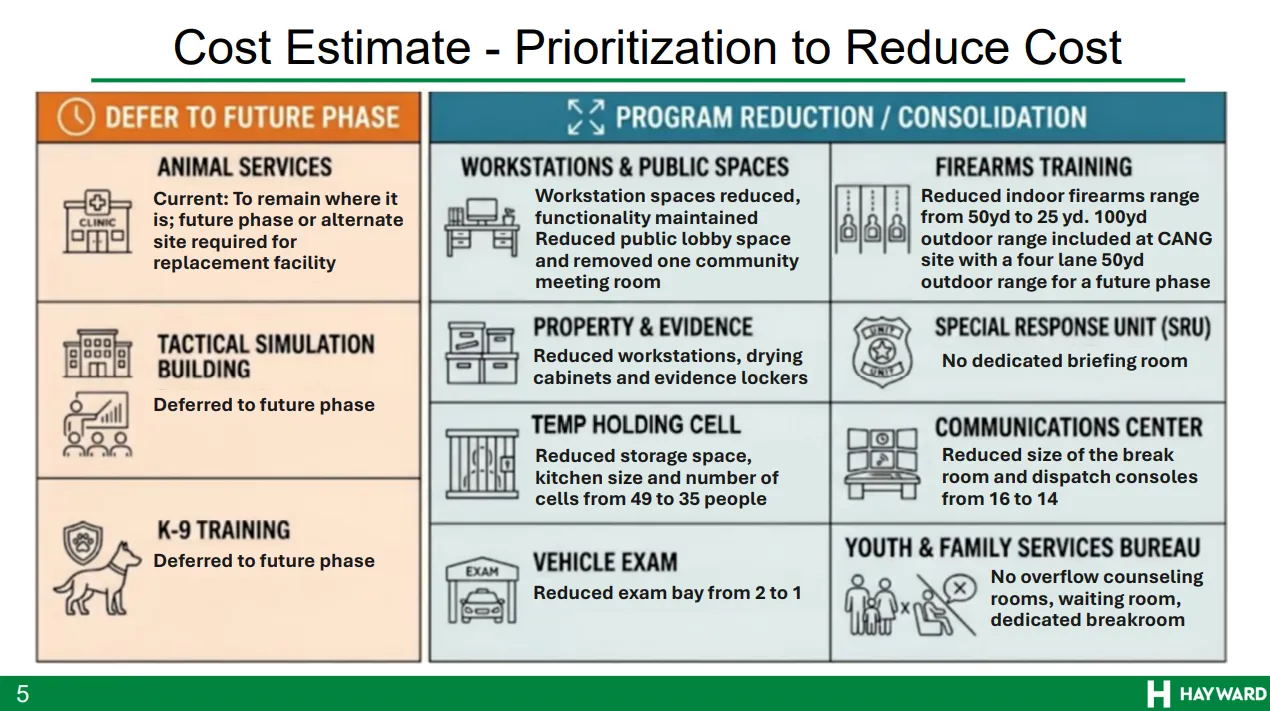
Due to the city's financial issues, staff have recommended ways to reduce cost. They suggested waiting to build animal services, tactical simulation, and K9 training portions for a later phase of construction. They also suggested reducing or consolidating certain functions as a way to reduce the cost—outlined in detail above. These changes lowered the cost by almost $100,000,000.
Staff recommended choosing the CANG site due to its larger size, proximity to the Fire Station, and lower construction costs. However, the Council Infrastructure and Airport Committee recommended prioritizing the Youth and Family Services Bureau (YFSB) spaces, and animal services facilities, as well as public spaces.
Council supported the CANG site, though some on Council wondered what would happen to the old building. Public Works Director Alex Ameri said that it would be demolished so that the site could be reused or sold—the current building needs too much work. Councilmember George Syrop, however, urged staff to consider repurposing the building or keeping certain services there as a way to reduce cost.
A New Way To Pay For Government Buildings
Measure K1 was initially supposed to pay for the Police HQ, but with rising construction costs and the city using it to balance their budget, that may no longer be possible. A group called the Association for the Improvement of American Infrastructure (AIAI) presented on a Public Private Partnership (P3) as a way to build the HQ without taking out another bond.
We're explaining this to the best of our knowledge here. We're not experts in building construction or finance, but we're working off of the best information we have. If we're wrong about something, please let us know and we'll correct it as soon as we can.
Traditionally, the city will design a building, bid the project out, and then contract with someone to build it. This is a lot of administrative work for the city and takes a lot of up-front cost. The bidding process requires the city to take the lowest bid and projects regularly go over budget and over time, with the city being the entity responsible for the success of the project.
A P3 appears to consolidate almost everything into a single set of contracts and under a single consortium of developers and project managers to do everything needed, up to and including maintaining the building. The catch is that it's all paid for like a mortgage: the city takes out a loan and pays back, with interest, over 25-30 years.
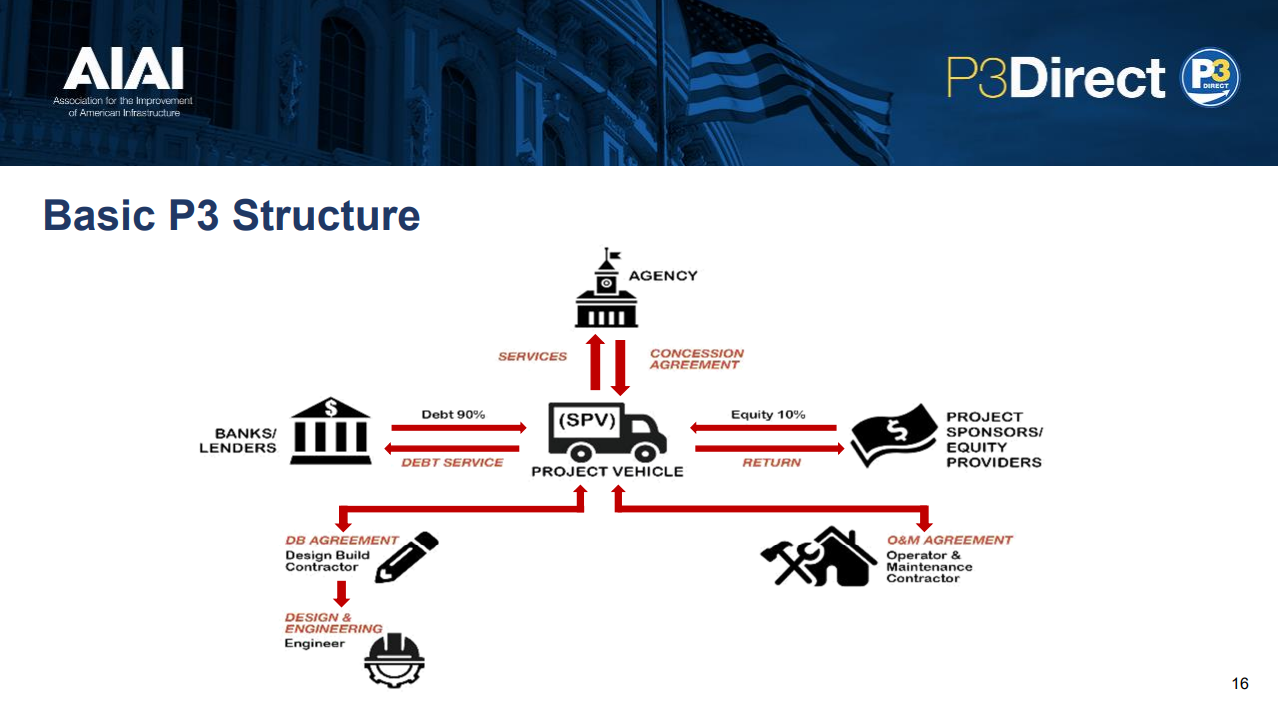
The benefits are that the city offloads the risk of the project onto the private sector—they're responsible for delivering on time, following up with contractors, and ensuring they meet the parameters of the project—so that the city has to do less managing and has less responsibility. The city retains ownership of the land and building and the private partners are held to a performance-based contract with penalties for failure.
According to AIAI, there appears to be a lot of flexibility in how things are structured and how the contracts are written. For finance, there can be differently structured loans—pay a lot early because you have the money or pay more as time goes on because the building earns revenue—and how the contracts are written. Broadly speaking, the more that gets offloaded to the private sector, the more expensive it is.
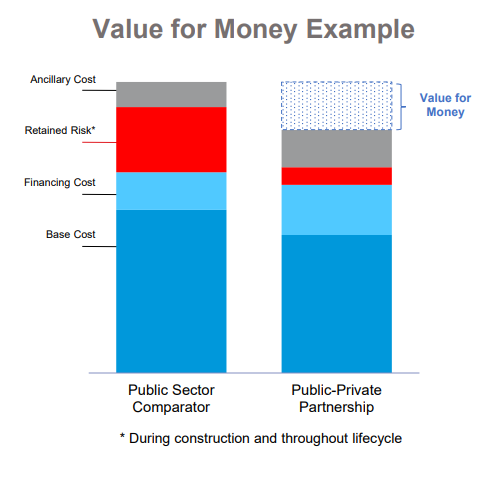
If the example above is to be believed, the idea is to reduce base cost with innovation and reduce risk by offloading it to the private sector. This is supposed to be enough to offset the increased financing and ancillary costs of the project.
There seems to be so much flexibility that it's difficult to say what's a good idea this early. But importantly, there appear to be several spots where the city can change its mind and only pay for work done up to that point. Ultimately, a lot of it depends on the ultimate contract.
It All Depends On The Contract
Council members seemed interested in the idea of a P3, but concerned about hiccups. Councilmember Angela Andrews asked about who was liable for things like procurement issues and utilities delays or particulars of maintenance. Ultimately, the contract spells out who's liable for what and AIAI frequently pointed to ways the private sector can be liable and ways the city could be liable. One consultant said that the city gets to say "this is what I want and it's up to them to make it come true."
Councilmember George Syrop asked for a ballpark annual payment for a $250 million loan. City Manager Jennifer Ott said that city staff estimated it could be between $14 million and $15 million per year, but that it's somewhat flexible. "What's the catch?" Councilmember Syrop said, wondering if the risk cost really made up for the financing premium. The consultants said it usually does, but each project needs an analysis.
Councilmembers Julie Roche and Francisco Zermeño asked about issues that could come up for the city, like running out of money for a bad financial year or being unsatisfied with the work. Time and again, the consultants said it depended on the terms of the contract.
Councilmember Ray Bonilla summed said that the city can essentially make the developers do as much as they're willing to pay for. There were understandable concerns about the ongoing maintenance, given that private maintenance could conflict with Maintenance Department contracts. However, like with everything, it can be scoped in the individual contract.
Mayor Mark Salinas asked if it was possible to pay the debt off early if the city came into a large pot of money. The consultants said it would be unusual, but it's possible to include something like that in the contract. It would just be less appealing to developers.
While they explore the P3 model, the city intends to move forward on zoning, dealing with the FAA, and environmental studies to keep the project moving. At the same time, they'll do some market research and start discussions on whether a P3 structure would work for the city.


Comments ()