
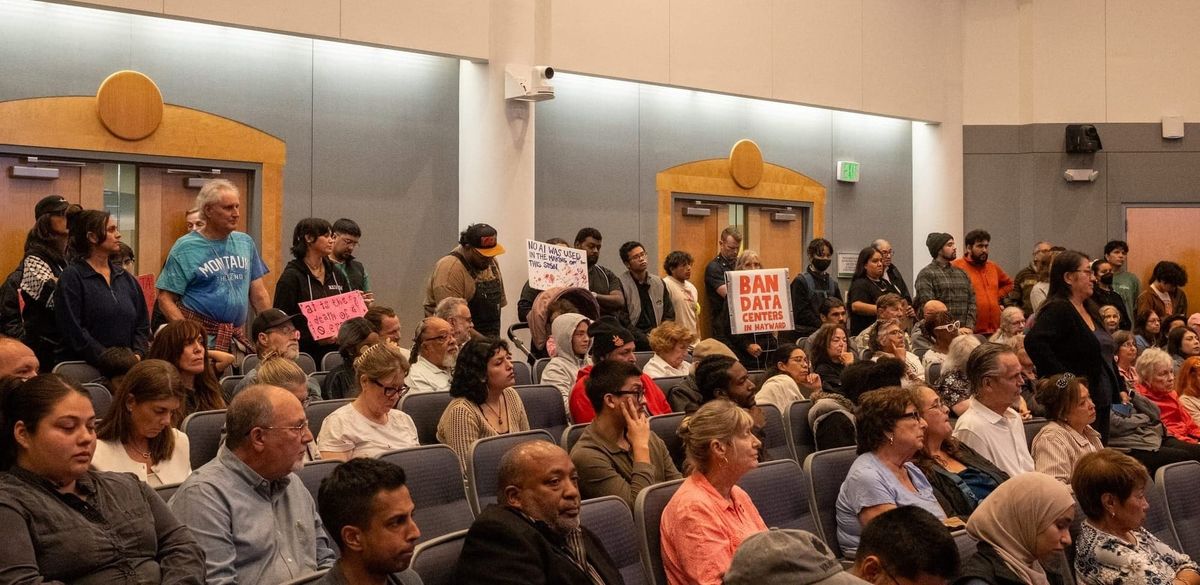
Residents turn out in force to call for data center ban, but Council pursues temporary moratorium which won't be approved until late October.
The Hayward City Council unanimously voted to develop a temporary moratorium on data center development in Hayward. The vote came on the heels of intense community pressure which has been building over the last several weeks. Despite a near-unanimous call from local residents for a full ban, the Council chose to enact a temporary moratorium to study the impacts of data center development and address community concerns.
Though Councilmember George Syrop was the only one explicitly open to a ban, other Council members reassured the community that the moratorium would halt data center development and give city staff time to develop new rules to mitigate the community concerns.
The State Of Data Centers In Hayward
The Planning Department presented on the current data centers in Hayward, the regulatory landscape, and potential paths forward. The presentation pointed out that the Stack data center is the fourth in the city, though the other three are significantly smaller. It outlined the environmental review process in CEQA and the existing approvals outlined in state law.
The Hayward Herald is the only news outlet taking a deep dive into what happens in City Hall because we care about our community. If you want to support the work we do, consider becoming a member!
Locally, the April rule change required all data centers be approved by the City Council with a Major Conditional Use Permit (MCUP). Additionally, future data centers will require a Sustainability Plan and a Community Benefits Package, regardless of size. Staff added that no new or pending data center applications have been filed since the change.
The proposed paths forward were:
- Strengthen Regulations - This would take around 6 months and allow applications to be received and processed under the current regulations.
- Temporary Moratorium - This could be enacted by the end of October and provide time to conduct research and monitor state legislation, but it can be extended from 45 days, to 10 months + 15 days, to 1 year after re-approval by 6/7 Council members.
- Permanent Ban - This would take 6 months to enact due to the process, and in the meantime data center applications must be accepted and processed until the ban takes effect.
Staff stressed that nothing would be decided that night, regardless of the path forward. Instead the Council would provide direction to staff who would deliver something actionable at a later date.
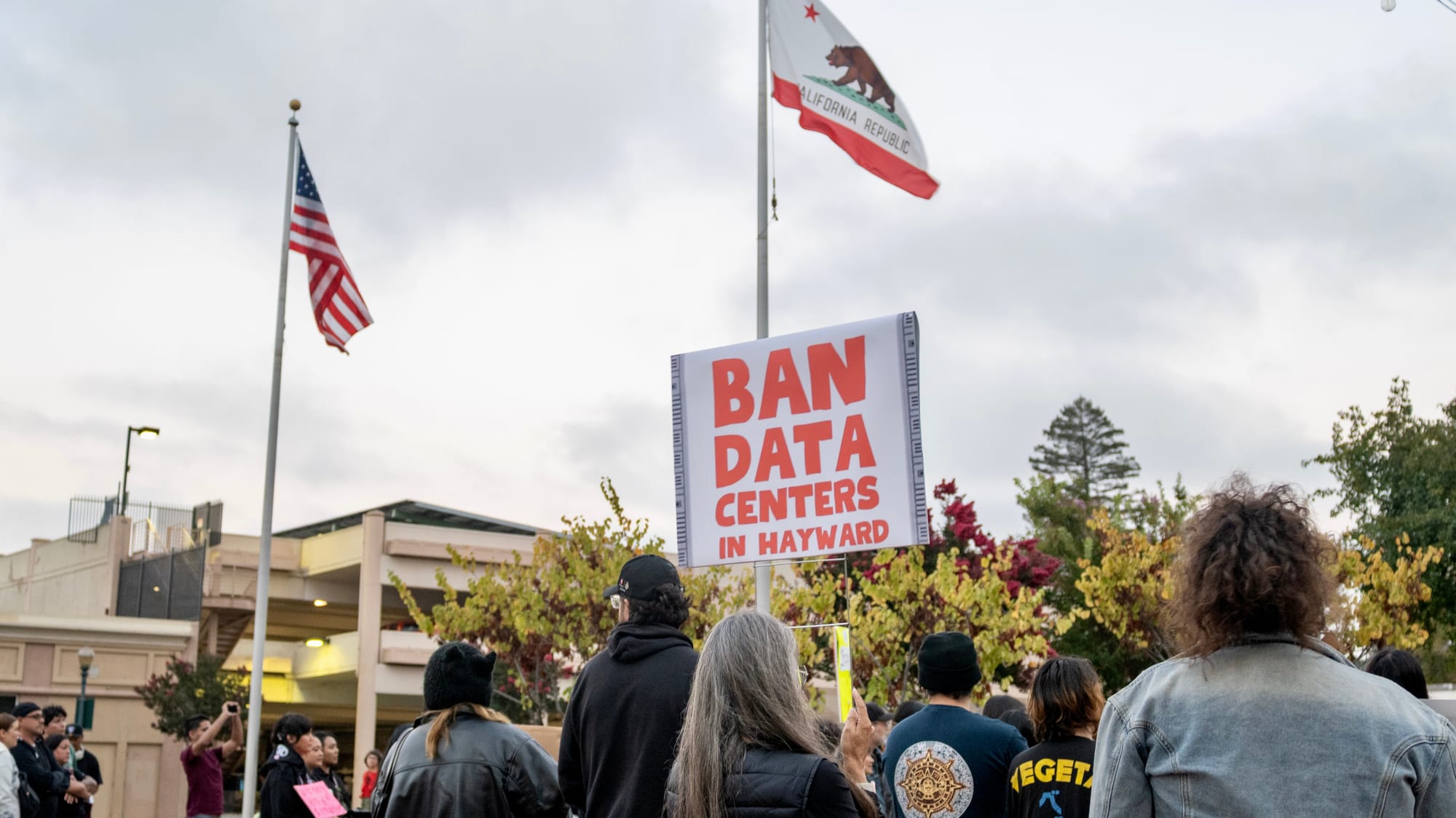
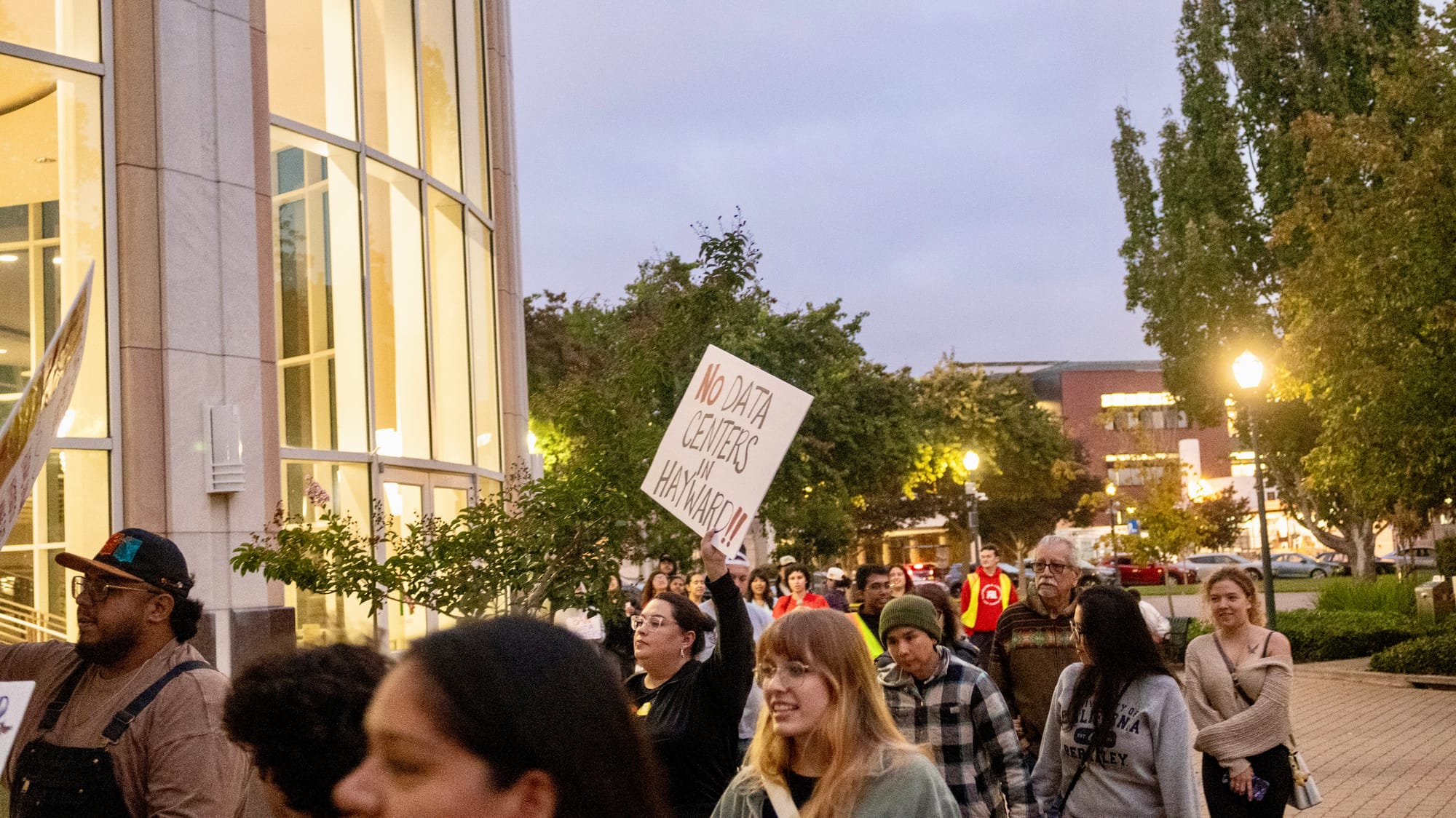
Local residents gathered outside of City Hall before entering to demand a ban on data center development. Photographs by Diego Castro.
Community Demands A Ban
Public comment for the item extended for an hour and a half, with members of the community almost universally calling for a full ban on data center development in Hayward. A number of issues were cited, from environmental concerns, air and water quality concerns, rising utilities costs, the dangers of Artificial Intelligence and surveillance, and more.
"As you can see, nobody in Hayward wants [a data center]," said a speaker identified as Marissa. "We are upset. We will keep showing up." Community organizations supported a ban, ranging from the Council on American and Islamic Relations (CAIR), the Sierra Club, to the Hayward Education Association (HEA). The overwhelming desire of residents in living Hayward and the surrounding area was for a full ban on data center development.
Mayoral candidate, Tom Wong, supported such a ban, as well. Despite his personal use of generative AI, Mr. Wong called for the Stack data center to be closed. "We should make them move out and shut them down," he said. "It does nothing for our community. It doesn't go to the restaurants, it doesn't go to our neighbors, it doesn't go to our parks." The Stack data center community benefits package included over $800,000 for Hayward park projects.
Businesses and Construction Trades Urge Caution
The dissenting voices came from the business community and construction trades. Eric Negomir of the Silicon Valley Leadership Group, which represents technology companies, called for "responsible development" of data centers. "When done right, data centers deliver significant tax revenue and infrastructure upgrades without harming residents' quality of life," he said. When he revealed that he lived in Los Gatos, however, the crowd erupted in jeers so loud that Mayor Salinas threatened to shut down the meeting.
Planning Commissioner Jeff Haman stood by his decision to approve the Stack data center. "I believe [it] is good for Hayward economically now and for the future," he said. He then cast doubt on residents' concerns by saying they were mostly "unfounded and based on misinformation."
Peter Leroe-Muñoz from the Bay Area Council, which represents 375 of the Bay Area's largest employers, also called for "thoughtful regulation" as opposed to a full ban on data centers.
Lucy Lopez from the Hayward Chamber of Commerce, which represents local business interests and landlords, called for researching and vetting the issue before making any changes that "would prohibit all future data center development." She called for increased involvement from the business community to "provide feedback and accurate information" before any policy is decided.
Representatives from the Building and Construction Trades Council of Alameda County and local construction unions called for "responsible data center policy." EJ Sire said, "A pause by itself doesn't solve anything." The construction trades have benefitted immensely from the construction of data centers across the country. IBEW recently received a $20,000,000 grant from Google to train more electricians for data center construction.
Council Supports Wait And See Approach
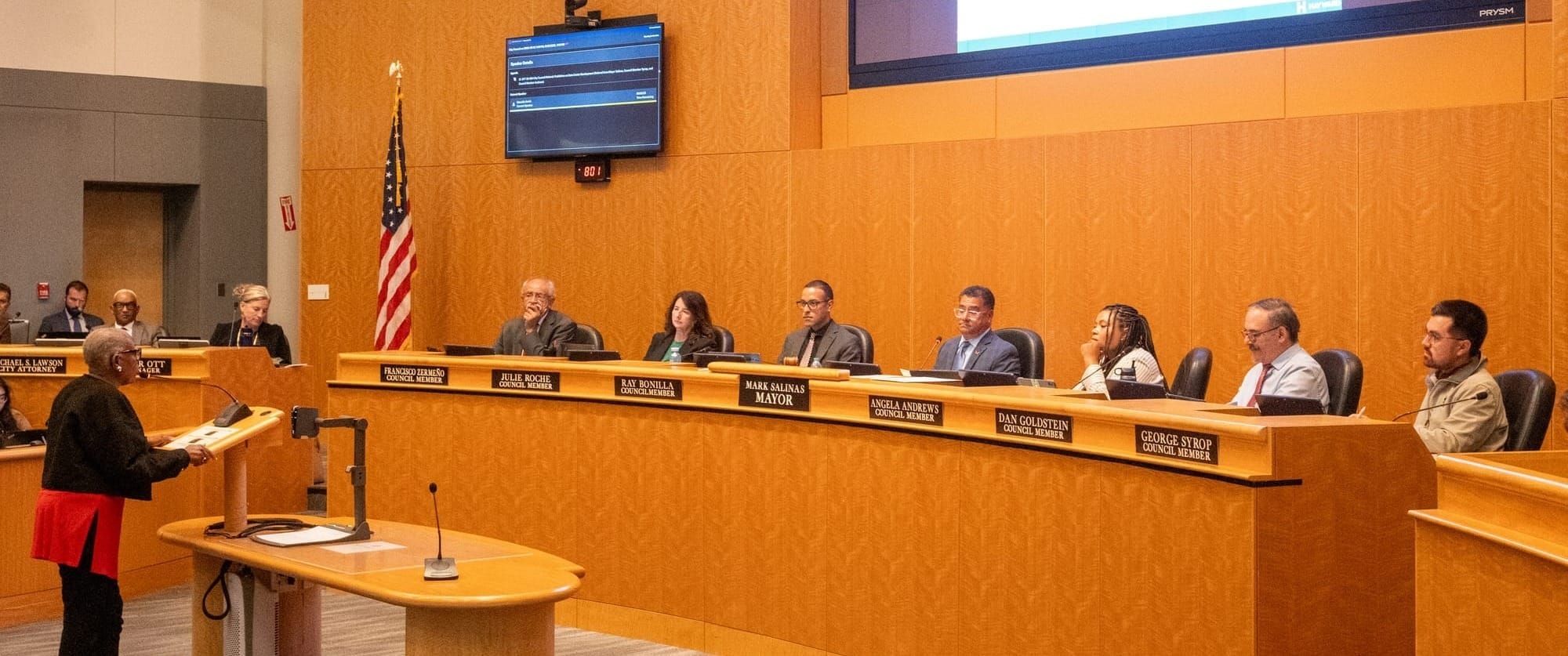
Hayward Mayor Mark Salinas set the approach that the City Council would ultimately consider. He organized the complaints from the community into three themes: transparency, accountability, and community benefits. With those in mind, he proposed a moratorium to allow city staff time to study the complaints and "to look at the existing policy... and increase the standards."
One particular issue was noticing requirements. Current rules only require notice within 300 feet of the construction area, while the nearest home is 0.6 miles away. "There is clearly a voice in here that is looking for an all-out ban," he said. But he continually framed the moratorium as a way to "evaluate the policy that we have and see how we can edit it."
Councilmember Francisco Zermeño appeared skeptical of the environmental concerns raised by the community, asking city staff if they had examined the 7,900 communities near US data centers. "Have we looked into if any of the communities around the 7,900 data centers have actually caused that?" he asked. City Manager Jennifer Ott said that staff had researched more locally. However, Councilmember Zermeño supported a moratorium to allow time to look at the pros and cons.
Councilmember Julie Roche said she shared the community's concerns, but said, "Hayward is now the strictest city in the Bay Area to bring a data center to." She supported a moratorium, but was interested in finding ways to mitigate concerns rather than halt development, "until we know we cannot mitigate all of these concerns."
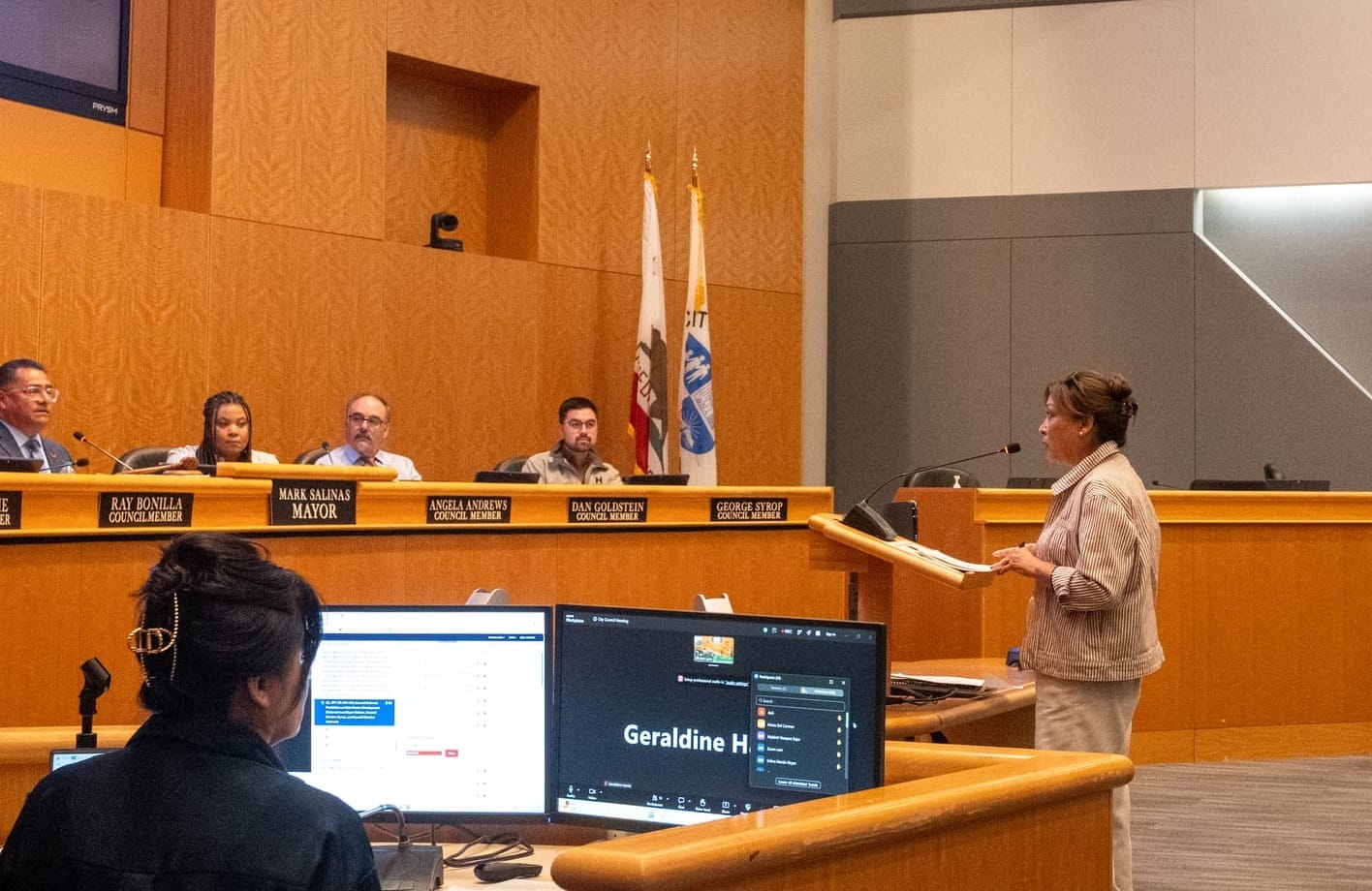
Councilmember Angela Andrews said, "We have the most community benefits out of our project for a data center in the bay area right now." She supported a moratorium, but took pains to assuage fears from businesses. "Hayward has proven itself to be business friendly," she said. "We have open arms to the business community... Let's look at this as an opportunity for Hayward not to be a roadblock."
Councilmember Ray Bonilla also called for "overall comprehensive and responsible policy" during the moratorium while placing emphasis on local oversight. "I think it's our responsibility to hold them publicly accountable," he said. It was unclear who would provide local oversight, as Code Enforcement is a chronically understaffed department.
Councilmember George Syrop was the only one explicitly open to a ban. "I still think the idea of a ban should remain on the table," he said. "Hayward residents do not want data centers." He supported a moratorium as the fastest way to pause development and committed to extending it as long as possible "until all of these new protections and practices are in place."
Councilmember Dan Goldstein supported the moratorium to give time to learn. "[It] gives us the time to investigate those blind spots," he said. He then debunked some recent claims around the Stack data center: it will use only 172,000 gallons of water per day—about the consumption of 28 homes—as opposed to 4.72 acre feet, low-frequency noise wasn't covered by CEQA, and that Stack is required to use 100% renewable energy, likely provided through the grid by AVA Energy. "It's required," Councilmember Goldstein said," It's in the documentation."
Ultimately, the City Council unanimously voted to direct city staff to explore a moratorium which would be approved in late October before the November election.



Comments ()