
City To Grow Hayward Amplified Program
The Hayward Amplified program was a success, and the Economic Development department wants to take the next step. Plus, business updates from around Hayward.

On October 5th, the Council Economic Development Committee supported the next phase of the Hayward Amplified program. The business-led activation grant gave money to local businesses looking to increase foot traffic, social media presence, spending, and build long-term capacity for future experiential events. 15 total businesses participated in the program, which included promotion for the World Cup this summer.
Economic Development staff sought to extend and modify the program to build on the success. The program will pivot from a grant program to a consultant-led planning model. Staff said this will address the issue that many business owners don't have the skills or capacity to plan large events, though the consultant is expected to cost over $100,000 per year.
The Hayward Herald isn't a business—we're a nonprofit, but we do need resources to grow. If you have the means and want to help us out, consider buying some merchandise! You'll be supporting local news and it's a more rare than a Trader Joe's bag.
City Investments Get Big Results
Earlier this year, the City of Hayward's Economic Development Department created the Hayward Amplified program. The program gave monetary grants to local businesses—up to $15,000—to help local businesses adapt to changing consumer behavior. They said consumers are now seeking "experiential retail and dining" meaning consumers are, according to Economic Development Specialist Danial Mao, "looking for reasons to stay engaged [with businesses] and share these experiences with others."
The grants hoped to drive regional spending and economic activity by creating 3rd spaces and drawing in local spending to a specific corridor or area of the city. The kinds of ideas the city funded included: live music and entertainment, watch parties, food and retail collaborations, social media-driven events, community-oriented experiences, and promotional events tied to other high-profile moments.
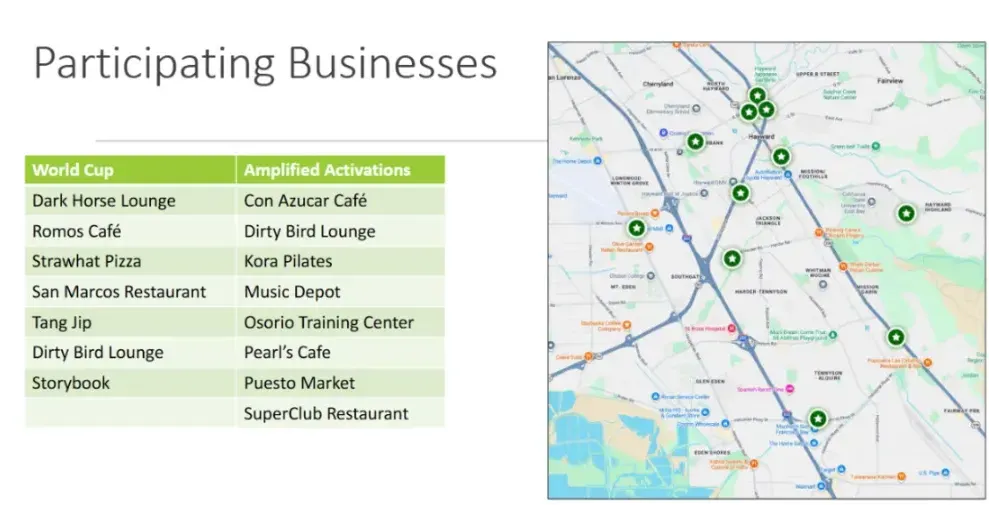
The City provided grant money, support, and technical assistance while the businesses were expected to come up with the concept, host and promote the event, and document the outcomes. The two different initiatives were for the FIFA World Cup and stand-alone Amplified Activations. The World Cup events averaged between 30-80 customers at major matches and a 30% increase in foot traffic during matches. The grant money was spent on infrastructure—TVs, projectors, sound systems, etc.—that staff hopes can be used for future, independent events.
The Amplified Activations were larger affairs, with the most prominent being Music Depot's Metalfest and Kira Pilates's Camp Foothill. The Activations generated over 3,000 attendees across all projects, over 40 local vendor partners, and at least 400,000 social media views—staff said this was a very conservative estimate. These projects activated entire economic regions by bringing in business partners, local vendors, and artists and musicians to create new reasons for people to visit Hayward's commercial areas.
Staff stressed that the marketing impact was larger than the numbers suggest. Camp Foothill and Metalfest were both featured on local television news programs and staff at the events found that some of the events had a regional draw. Economic Development Manager Paul Nguyen, said some people came to Metalfest from as far away as Napa and that, in part, it was because it was a free event. "People want more return for their value," he said.
Staff stressed that the partnerships are what made the Amplified Activations so successful. But a persistent issue was that planning big events is a lot of work and requires some special planning knowledge. Those that relied heavily on city staff for event planning turned out to be the most successful. Also, smaller businesses chose not to apply specifically because of the work involved and a lack of capacity.
What Size Is Best?
Councilmember Ray Bonilla tried to narrow down what events were the most successful and why. Staff said that the mid-size events were the best value for dollar investment. Mr. Nguyen said that a $10,000-$15,000 investment brought in hundreds of people and included spillover benefits to local businesses in the area. And that size of crowd worked the best, as well. 300-500 people provides the most economic benefit with the least amount of bad effects—traffic, parking congestion, litter, etc.
Councilmember Bonilla seemed especially interested in runs as a form of economic development, pitching a run through Downtown as a way to drive local business. However, Mr. Nguyen urged caution with larger events. "Costs are pretty exponential," he said. Closing roads, paying for police to diver traffic, moving bus routes all cost more money, possibly without enough additional benefit.
Councilmembers Angela Andrews and Bonilla both asked about ways to secure renewable, non-General Fund, funding. Staff said that they hoped the investment would allow some businesses to run their own events without City funding and that such events can be really valuable.
Councilmember Andrews urged the Downtown Hayward Improvement Association and the Chamber of Commerce to take a stronger role. "This is exactly what I've wanted for years," she said, "but I'm hoping that... these business associations are showing them how to do this, as well." Staff pointed out that the Chamber is also scaling back due to funding—even its involvement in the Downtown Street Fair.
Councilmember Andrews then suggested the Community Services Department could play a bigger role in the events, framing them as community engagement. "I'd rather [Economic Development staff] focus on getting us tax revenue on an ongoing basis than doing this work that is very much community engagement," Councilmember Andrews said.
Plan For Amplified 2.0
In the future, instead of providing grant funding for businesses, staff recommend hiring a consultant to plan the events and coordinate the effort across the city. Under this model, the city would create the activity, choose when/where, and coordinate with the businesses. This could help smaller businesses who want to participate, but don't have the capacity to plan and coordinate an event.
According to a draft scope of work, the consultant would provide:
- Program Planning and Event Development
- Business and Community Partner Coordination
- Event Logistics and Production
- Marketing and Promotion
- Budget and Vendor Management
- Evaluation and Reporting
The consultant would cost between $100,000 and $125,000 for the 6-10 smaller events in Spring and Summer 2027. Councilmember Bonilla said that it felt like the opposite of being self-sustaining, but staff pointed out that amount of work needed for the events was unsustainable with their usual workload. Camp Foothill, for example, required at least 12 meetings to coordinate, but left no time for community engagement and promotion.
City Manager Jennifer Ott said that Downtown San Francisco is using a similar approach to revitalize their area. "It's a trend," she said.
Councilmember Andrews was also worried about the cost. "Camp Foothill should have been funded by DHIA, in my opinion," she said. She pitched cost sharing between the city and DHIA, HARD, or the HARD Foundation, and City Manager Ott could only respond that she could ask.
Overall, the Committee supported 3-4 larger events over 6-10 smaller events. "Those are the ones I saw on the news," Councilmember Andrews said. She also pushed for staff to highlight the return on investment potential for the expense, given the city's continuing $30,000,000 budget deficit.
Business Updates
The Economic Development Department also presented on some local noteworthy businesses
- Cơm Tấm Bros - Opened Jun 6th on Hesperian Blvd
- Mama Seoul - Opened Jun 18th on Oliver Dr
- Elegance Factory - Opened Aug 22 on B St
- Lufts Indian Cuisine - Opened Aug 28 on Southland Dr
Other businesses are opening soon:
- Noypitz - Replacing the Hometown Buffet at Southland Mall
- iniBurger! - Replacing Rockit Char Grill on B St
- Mama Cho's - Replacing the car shop and karate studio on Main St
- Jjamppong Zizo - Replacing TTO Bong Hee on A St
Hayward's industrial area also has some noteworthy businesses:
Electrochemical Foundry (ECF) is a nonprofit solid state battery manufacturer, backed by a $28,000,000 grant from the California Energy Commission, who has a new factory in Hayward.
Codexis is a biotech company opening a manufacturing facility in Hayward.
Zoox continues to produce robo-taxis distributed across the country and is expanding its production footprint across the street of its existing facility on Clawiter.
Skydio, one of the largest drone manufacturers in the US, is expanding its production in Hayward. Skydio specializes in drones for battlefield situational awareness, policing, and inspection. They have contracts with the Department of Defense, the Israeli Defense Force, and other militaries. According to Mr. Nguyen, "Every UN ally on the planet uses a drone made in Hayward."
Skydio also has contracts with multiple large police departments across the country for their Drone as First Responder (DFR) programs. Mr. Nguyen said that Skydio is on track to be the largest or fastest growing business in the city within the next 5 years.

Comments ()