
Fighting Parking And Funding Services
In Which: The Planning Commission fights transit-oriented development, The City Council weighs services with General Fund shortfalls, and Councilmember Andrews asks CSC to act outside its new scope

Commission Fights Transit-Oriented Development
On March 27th, the Hayward Planning Commission considered the Tract Map for a previously-approved development on 21569 Mission Blvd. The development will consist of two sets of buildings: 5 three-story townhomes consisting of 27 ownership units and a four-story apartment building with 18 rental units. The project will include 1 low-income unit and 3 moderate-income units to comply with the affordable housing ordinance.
The project had already been approved back in 2020. Unfortunately, due to some weirdness with the project being on the border of Hayward and Unincorporated Alameda County, the original plan for having two separate lots wouldn’t work. So the only change from the original plan was to consolidate the two lots into one lot, and what the Planning Commission was supposed to approve or deny.
Getting Outside of Purview
Planning Commissioners, however, began by asking questions about trees--a recent hot topic on the Commission. Commissioners Lowe and Haman asked after the trees and Staff reassured them that it had already complied with the existing tree preservation ordinance when it was approved in 2020. Still, Commissioner Haman pressed on. “Any final report on any endangered wildlife nesting sites?” Staff reassured him that all environmental concerns had been taken care of already and planned for, according to existing laws, when it was previously approved.
When Commissioner Haman started asking about building colors, Staff stopped the conversation and insisted that the topic of discussion was only about the Tract Map, not architecture.
State Law: Parking vs. Public Transit
Commissioner Meyers asked a question confirming that he had counted the number of parking spaces correctly. He noted that there are fewer parking spaces than units for the development--38 parking spots for a total of 45 units on the site, as well as 22 bike parking spots. “What you’re seeing, in this case, is what we’re getting,” Staff said, and explained that the development is on a transit corridor, which allows for a parking reduction according to State law.
Commissioner Meyers said that the parking issue was his primary concern. “It’s my only level of trepidation on this whole project right now,” he said. “It’s not really against the project, it’s just toward our zoning rules we have right now.”
Commissioner Stevens, who has expressed distaste for the State laws that allow transit-oriented development despite local opposition in the past, took issue with a housing advocacy group’s letter reminding the Commission of State law. “I find it extremely annoying that [the California Housing Defense Fund] thought to remind us of state law and our obligation to comply with this.” He, again, encouraged people to contact State legislators to overturn the rules and return local authority to deny development for any reason whatsoever.
Parking was also a concern for Commissioner Franco-Claussen who went so far as to drag unbundled parking into the mix. “Unbundling parking has been a disaster in Long Beach and Sacramento.” She asked who was responsible for parking enforcement, “If we don’t have enough parking, who’s going to maintain the towing service? Who’s going to do some oversight to make sure people that do have parking, they can have access to it.” This responsibility typically falls on the HOA and/or management company for the complex.
Commissioner Franco-Claussen positioned it as an equity issue affecting working-class people with families. “[There’s] nothing worse than not having a parking spot when you’re coming home after picking up your kids after work.,” she said. “To hear that there’s not spots available, it must be a privilege to think with that approach.”
Thanks for reading Hayward Herald! Subscribe for free to receive new posts and support my work.
She went so far as to try to conduct a straw poll among Planning Commissioners--many of whom live in the Hayward Hills--about their public transit use. “How many of you took the bus here today? Raise your hand,” she said. When nobody raised their hands, she said, “My point exactly.” She defended the idea by citing public transit’s financial troubles, even positioning transit users against drivers in the event of a transit strike. “What happens when they go on on strike?” she asked. “My comment is ‘Do better,’” she said, “We have to think about people that live here and their parking.”
Chair Hardy agreed with Commissioner Franco-Claussen’s points. “It’s a little hard to accept [that the development is geared toward families] when there’s not going to be any parking,” she said. However, when it was time to vote, Commissioner Franco-Claussen was the lone “No” vote.
City Funds Fall Short Of Service Needs
The City Council considered the Community Services Commission’s (CSC) recommendations for how to allocate $455,000 in General Funds to various nonprofit service providers throughout Hayward. The CSC prioritized funding housing and homelessness, food security, and legal services programs. The largest recipients of funding were Centro Legal de la Raza, South Hayward Parish, Mercy Retirement and Care Center, and the Family Violence Law Center--though 21 agencies received at least partial funding in the recommendations.
Before the City Council had a chance to weigh in on the recommendations, Community Services Commissioner Calvin Wong spoke about the process during the Public Comment period. “It was very brutal,” he said, explaining that there were four hours of deliberations after 16 hours of back-to-back interviews with funding applicants. “The recommendations we produced were really emotionally taxing.”
Thanks for reading Hayward Herald! This post is public so feel free to share it.
Beyond the process itself, Commissioner Wong said that the need was only getting higher. “The future we’re headed into is going to be really tough and the funding available for services is not enough to meet demand or need for the community.” He encouraged the City Council to consider increasing the funding for community services, which has remained stagnant for the last 5 years even as requests have risen to 4x the available funding.
Council Sympathetic But Budget Sensitive
Councilmember Roche empathized with Commissioner Wong’s comments. “I feel Mr. Wong’s pain,” she said. “I feel like this is a problem every year.” She asked Staff when the last time the general funding had changed. They said that aside from an increase to Arts and Music funding a few years ago, it hadn’t been increased in at least 5 years. According to a graphic in the Staff Report, total funding for the CSC’s funding process appears to have actually decreased since 2017.
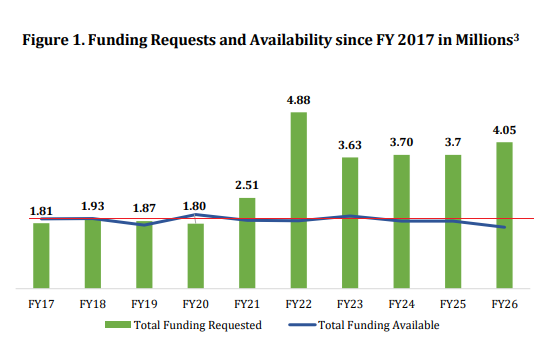
Despite her concern, Councilmember Roche did not have a clear idea of what to do. “There isn’t enough funding,” she said, “and I don’t know what to say about that right now.” Councilmember Syrop felt similarly. “Looking at this,” he said, “it’s hard for me to stomach, as well. When we hear that mental health is one of the biggest issues that our youth are facing today in our schools, seeing that we can’t fund school-based mental health services in Hayward is a very difficult pill for me to swallow.”
Mayor Mark Salinas, who spearheaded the idea of Hayward as an Education City, suggested that something like school-based mental health services should be the responsibility of Hayward Unified School District (HUSD). “I also want to be careful in investing in duplication of services,” he said. “I don’t want to recreate services that the school district is responsible for.” The Mayor has frequently criticized HUSD for not carrying its weight when it comes to funding community services that affect students.
Councilmember Syrop suggested digging into the budget to try to find more funding. “I think it’s kind of up to us as Council to decide where we’re going to find that money,” he said. The difference between what was requested and what was available was around $2,000,000. The Hayward Police Department has held onto the funding for 20 vacant sworn officer positions for the entirety of FY 25. The starting salary for a Police Officer (P200) is $131,726.40 per year, not including benefits, meaning that HPD has unused salary savings of at least $2,600,000 which they frequently reallocate for other projects as needed.
Councilmember Zermeño was also sympathetic to the shortfall, “I don’t envy the work that you do,” he said the CSC, “and I also share your frustration.” However, he was cautious about touching the General Fund. “In my mind we still have a General Fund that may run into problems. We still have streets to fix, we still have quite a few other services that we must give to our residents so we would have to study this carefully.”
Councilmember Andrews was also supportive of looking for funding, but expressed caution around the General Fund. “I also agree with other Councilmembers regarding the need to fund essential services that we are tasked with doing in the City of Hayward,” she said. She suggested that service providers look elsewhere for funding. “I encourage us to start looking creatively when we get these requests.”
Councilmember Goldstein hinted that the service provider requests don’t necessarily align with community needs. “[Requests don’t] necessarily reflect what the community need is,” he said, “it’s just that those applicants have asked for money. It’s okay to ask. It’s also okay to say no.” He told Staff he was interested in a community study to assess the impact of and need for services.
The Mayor insisted that the City budget couldn’t handle any increases. “I wish we had more money,” he said, “and I wish we were able to fund all of this. Citywide we are asking [everybody] for clawbacks or for giving back to the General Fund. I don’t say this because I don’t believe in the organizations that are here.” The Mayor insisted that “this is an issue that we face every year,” though Councilmember Syrop reminded him that
Council Asks CSC To Expand Role Weeks After Restrictive Changes
Mayor Salinas and Councilmember Andrews expressed interest in changing the CSC’s purview to include fundraising and administrative support to service providers.
Councilmember Andrews suggested that the CSC could identify alternative funding sources for local nonprofits to make up for the lack of City funding. She further suggested that CSC could take on substantial administrative tasks for service providers. “If we can include transition planning with these agencies, business planning with these agencies, strategic planning with these agencies so they can have a sustainability plan that is outside of the City of Hayward.” She clarified that she wanted “to see if that was something that the commission is interested in pursuing.”
Thanks for reading Hayward Herald! Subscribe for free to receive new posts and support my work.
Mayor Salinas also suggested that the CSC could help find ways of plugging the gap in the City’s funding. “How will the CSC sort of pivot and figure out strategies?” he asked. This attempt to add to the CSC’s duties is a pivot from the beginning of March when the City Council drastically reduced the CSC’s scope and duties. According to the Municipal Code, the CSC’s duty is to “Advise the City Council as to the most effective means of allocating available resources for community services… Promote interagency and intergroup coordination in the development of community social resources… [and] Serve as the primary conduit for resident participation in all phases of [CDBG funding].” By the Council’s own actions, deviating from that would require a change in municipal code.
Changes To Application Process Incoming
City Staff recommended a series of changes to the funding process for community services. They include:
- Moving to a 2-year funding cycle
- Create a separate Arts and Music funding process
- Align decisions with Council Priorities
- Increase objectivity and transparency for decision-making through use and publication of a rubric
The City Council was asked to weigh in on the changes, but opted against doing so before the CSC was able to do so. “I would really like to see a firm set of recommendations formed by the CSC,” Councilmember Bonilla said, “then brought back to the Council in a Work Session that we can then weigh in on after there’s consensus reached by them.”
Everyone else on Council agreed with the proposal to allow the CSC to weigh in before making recommendations on their own. Councilmember Roche, however, encouraged the CSC to listen carefully to the concerns of City Staff before making changes. “I would really ask you to listen to staff on these recommendations as well,” she said, “because they are the ones interacting with the agencies… they would have a longer arc view.”
Councilmember Syrop also agreed, but he was also concerned about what the changes to the process could mean for the CSC given the recent changes to their charge. “We recently revamped the CSC in terms of its scope,” he said, “If we’re looking at a two-year funding cycle and we’re only saying they should meet when it’s time for them to discuss funding, I don’t want to have a commission that’s meeting for a small fraction of the year.” He said he wants the Council to have a conversation around “the scope of their responsibility in relationship to an expanded funding cycle.”
The funding recommendations will be officially approved by the City Council on April 22nd.
Comments ()