
Hayward Council Approves New Drone Program
HPD to purchase 8 new drones to autonomously fly to calls for service. Council believes policies are enough to counter privacy concerns.
During its annual Military Equipment Policy discussion, the Hayward City Council approved a Drone As First Responder program put forward by the Hayward Police Department. The nearly $600,000 program would see the purchase of eight new drones which would autonomously fly to calls for service throughout the city. Police say it will improve the safety of officers and firefighters and improve response time.
City Council members supported the purchase, paid for from several non-General Fund sources, citing what they called robust guardrails and policies to prevent random surveillance. They also said it was an innovative way to supplement a depleted Police workforce, though HPD maintains its over $100,000,000 budget and over 330 full-time equivalent employees.
Annual Military Equipment Approval
During the final public hearing required by Assembly Bill 481, the Hayward Police Department presented its annual Military Equipment report. Very little in the presentation had changed since it was originally presented in mid-May to the Council Public Safety Committee as part of the Police Department's mandated public hearing.
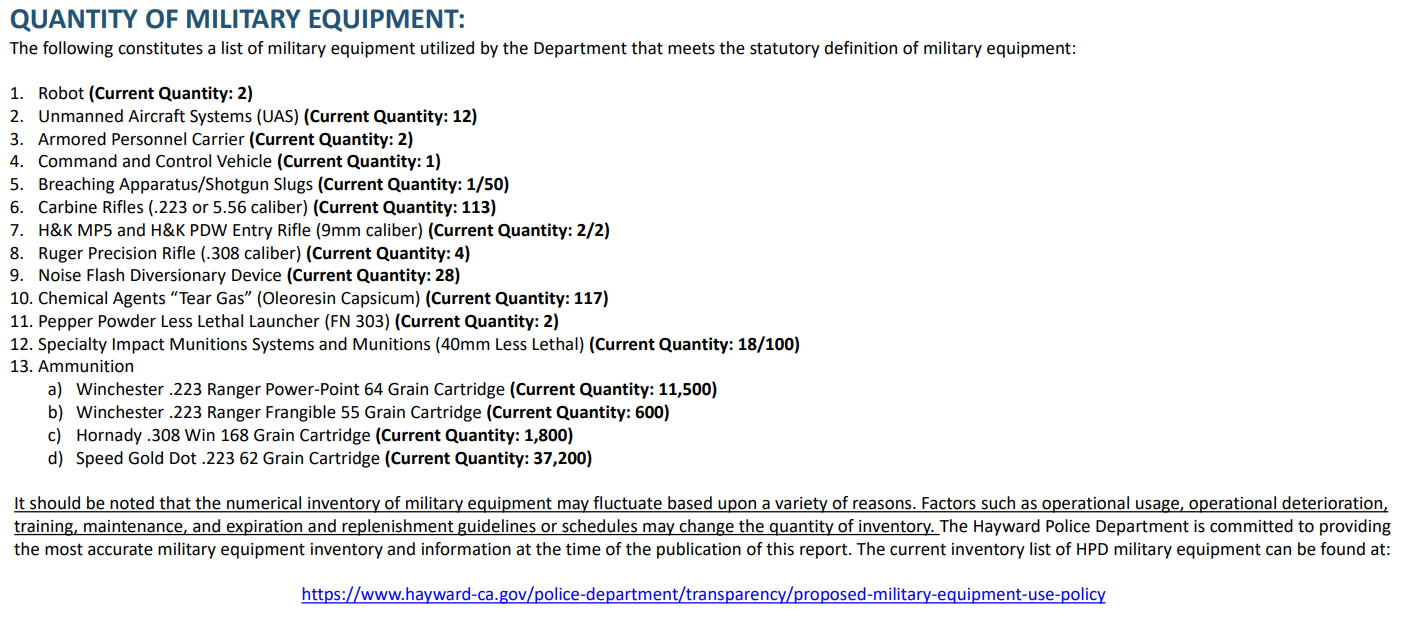
For which equipment was used, HPD deployed drones 62 times across 61 incidents and deployed the Armored Personnel Carrier (APC) 12 times. While no other equipment was used during that period, it is unclear how frequently it was deployed and unused. For example, the APC is frequently deployed during SWAT responses and most, if not all, members of the SWAT team carry some form of military equipment during deployment—either carbine rifles or precision rifles, or something else from the list above.
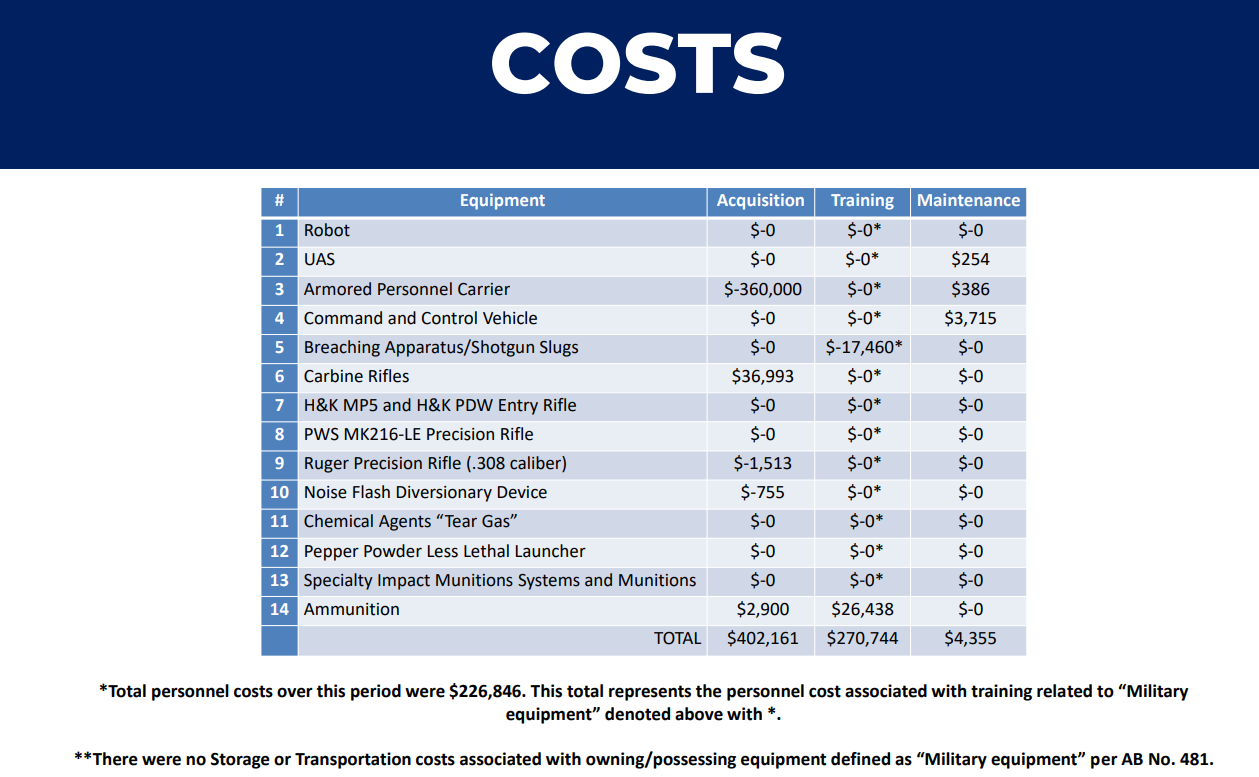
The total cost of training and equipment this past year was $677,260—more than half of which was the purchase of a new APC, which was approved in a previous year. This amounted to 0.66% of the Police Department's $103,090,230 budget.
Send The Drones In First
Police Chief Bryan Matthews presented the Drone as a First Responder (DFR) Program to the City Council for their approval. Under AB 481, drones are considered military equipment and therefore any purchase of drones or change in drone policy requires the approval of the City Council.
According to the presentation, eight drones will be positioned at strategic locations throughout the city and will be autonomously flown to the location of a call for service. Once there, the drone will be piloted by one of two Community Service Officers (CSOs)—a non-sworn civilian position reassigned from the jail. The drone will ideally arrive on the scene before an officer and send live video to the CSO who will then relay information to the officer on route.
The Hayward Herald is the only local news outlet covering the Hayward Police Department. If this kind of coverage is valuable to you, consider becoming a member and supporting our work.
The presentation touted "Undeniable Safety/Efficiency Benefits", alleging that it will enhance community safety, support de-escalation, improve response times, and contribute to apprehension and case solvability. The presentation highlighted benefits to the Fire Department, which caused Fire Chief Ryan Hamre to support the proposal at the prior meeting. Chief Hamre cited staffing shortages in the fire department as a reason the drones should be under Police Department control.
The DFR program was piloted during March and April, logging 326 flights in four weeks from one location—there is often a one month lag in reporting. The drones visually cleared 108 calls for service (33%) and provided support to officers and/or firefighters on 148 of the calls (45%). It is unclear what benefit the drone provided for the remaining 70 flights (22%).
The cost of the program is $589,000 per year over five years and will be funded with a combination of the existing services and supplies budget, grant funding, and asset forfeiture money. The presentation said that the program can be phased if funding falls short and that it is significantly cheaper than a helicopter, which they framed as the only alternative.
The drones will fall under Policy 611, which lists a number of prohibited uses. However, Chief Matthews said, "We can amend policy at any time." When Councilmember George Syrop asked who had authority over policy changes, Chief Matthews said, "Ultimately policies are set by me, the Chief." Policy 611 also gives explicit discretion to the Police Department to determine what constitutes a "security concern" or "criminal activity."
Policy Protection And Saving Money
The majority of the City Council supported the proposal, celebrating what they called a robust policy and good "discretion and discernment" from the Police Department. Privacy concerns were, according to many on City Council, largely addressed with the existing drone policy and the addition of language prohibiting a CSO from moving the horizon-focused camera during autonomous flight.
"I am not worried about some drone snooping in by back yard," Councilmember Francisco Zermeño said. "I also trust our police officers that they will not be abusing this particular technology." Councilmember Julie Roche supported "turning to technology to assist our department" and called the DFR program "a forward-thinking and reasonable endeavor that we have to look at. Every industry is doing this and obviously we need to use this in law enforcement, as well."
"This technology is here," she said. "It's here to stay."
Councilmember Angela Andrews said she did not like drones, but supported their use, especially with ACLU-approved guidelines in the existing policy. However, she also framed the drones as an inevitability of having fewer officers. "[This is] something we need to think about as a community of activists," she said. "How do we keep our community safe? I would at least like to try this program."
The language in Policy 611 was celebrated by Councilmembers Ray Bonilla and Dan Goldstein, as well, with both framing it as guardrails against abuse of increased surveillance technology. "People have been using [drones] recklessly," Mayor Mark Salinas said, "we have a policy we are comfortable with."
Lone Dissent On The Dais
Councilmember George Syrop was the lone voice against the DFR program. "I just have a lot of concern about expanding surveillance infrastructure," he said. He highlighted that the definition of a "security concern", as outlined in policy, can change. "It's up to the discretion of who's in charge," he said.
Councilmember Syrop also pointed to the issue of funding the program. Chief Matthews said that the drones are a subscription that would be paid for from different non-guaranteed sources. "If we don't have a long term funding plan for a new program," Councilmember Syrop said, "we need to be really disciplined in whether or not we move forward. I don't want this continue to balloon."
Who Is This Protecting?
Many Council members supported the drones as a way to improve officer safety. Despite agreeing that drones could be a form of escalation, Councilmember Andrews said, "But for me what outweighs that is the safety of the people involved, the safety of the officers."
Mayor Salinas also said that the drones promote a "high degree of safety" for officers. He went on to say, "The main thing that we are responsible up here for: to keep the city safe. And when I say the city, that means the people who work for the city. That's what we are responsible for."
The City Council approved the AB 481 report and the DFR program, with Councilmember Syrop voting against.


Comments ()