
Hayward Election Guide Pt 1: Propositions
With 14 propositions on the ballot, we dive into the first seven—laying it out in plain language, how they could affect us in Hayward, and who's bankrolling them.
Ballots are in the mail and bound for homes across Hayward. This November, Hayward voters will be looking at 14 different ballot measures that could have significant impacts on our city. With that in mind, the Hayward Herald is breaking down the ballot measures and specifically exploring what impact they could have on our city. But with so many propositions, we're breaking it up into two parts. This week, we'll cover Propositions 1-5, 37, and 38.
Terms To Know
Ballot measures use some very specific language that can be confusing, so we wanted to address a few terms that will come up.
Bonds
Bonds are basically just loans that a government takes out, but we, the taxpayers, repay the debt. But there are a few different ways they can be laid out.
- General Obligation Bond: This is "backed by the full faith and credit of the issuing government." This means that the state's tax revenue will be used to repay the debt, as opposed to fees from use or a special tax on only those who it benefits. In practice, this will be an additional cost for the state's General Fund to handle without necessarily adding new revenue. (We're not experts here—government financials can be very complicated—but this is our understanding after some research. Fact check us if needed, please!)
- Revenue Bond: This is only paid back from a specific source of revenue, either a tax or a fee. There are Project-Based Revenue Bonds, like the bonds Hayward is taking out for the new water treatment facility, where new fees for users will repay the bond (our rates go up). There are also Tax-Based Revenue Bonds, where a special tax is issued that will only go toward repaying the bond.
Reserves/Rainy Day Fund
This is the extra money that a government stores away—kind of like a savings account—as a buffer for when there isn't as much money as they hoped. It's usually expressed as a percentage of the total General Fund balance. The City of Hayward's reserve target is 20%—approximately $50 million.
Join Us Tomorrow!
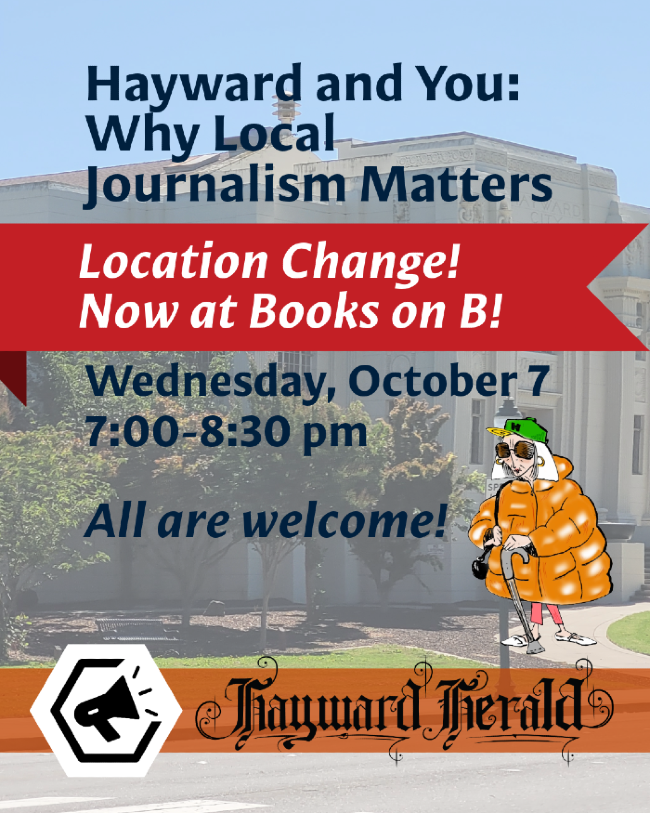
We're hosting a community conversation TOMORROW October 7th at Books on B with you, our Hayward community, to talk about Hayward and local journalism. Join us and help shape your local news outlet!
Proposition 1: Authorizes Bonds for Housing Affordability Programs
Proposition 1 would allow the State of California to issue $11,250,000,000 in a General Obligation Bond to support a number of affordable housing initiatives.
- $5.1B to build and rehab multifamily rental housing
- $2.1B to buy, rehab, or preserve affordable housing and provide supportive housing for unhoused people
- $1.25B for mortgages for CA veterans
- $1.1B for homeownership and down payment assistance
- $1B for farmworker, tribal, and student housing
- $500M for housing infrastructure
- $200M to support local housing programs
The $11.25 billion would mostly be paid for from the state's General Fund, with the exception of the $1,250,000,000 for veteran mortgages. That money would be repaid by the mortgage holders.
How This Affects Hayward
Hayward will have the chance of getting some of this money for any number of projects that could qualify. The city could use the money to work with non-profit developers to build more affordable rental housing or to provide permanent supportive housing.
However, it's likely that the funding will be a part of competitive grants and require application processes. We're not likely to see any of this money any time soon due to administrative processes, let alone how long it will take to get anything built. A recent state estimate put the housing shortage at around 2.5 million units, and given the cost of development in California, it is unclear how many units will actually be created or made available with the funding.
If you think Hayward needs more affordable housing, this is probably something you'd be interested in. Just don't expect it to be built overnight.
Financial Supporters
Airbnb, Building A Better California (a pro-business org),Western States Regional Council Of Carpenters Issues Committee, several non-profit housing developers (including Eden Housing), and Meta (parent company of Facebook).
The propositions are always a huge headache during elections. But the Hayward Herald wants to make sure you understand how these props help, or not, your community. If you find that kind of work valuable, consider supporting us by becoming a member!
Proposition 2: Increases State's Rainy Day Fund
This would allow the state to increase its rainy day fund from 10% to 20%. California relies heavily on income taxes from high earners for its revenue. Unfortunately, much of that is tied to the stock market, so when the market is bad, state revenue tends to decrease. That means that California's budget can swing wildly from one year to the next depending on the whims of the stock market.
By increasing the Rainy Day Fund to 20%, that will give the state a bigger pool of savings to pull from when revenue decreases. For context, the State Budget for FY 26/27 is $283 billion. The maximum Rainy Day fund could be 10% of that, or around $28 billion—in actuality, it is only $15 billion. Raising the cap would allow it to be closer to $56 billion.
It also extends an existing rule about debt payments toward health and pension benefits, while also expanding the number of things it can be used for. According to the Legislative Analysts' Office, "These payments could be used to make required payments to schools and community colleges, repay borrowing from other state funds, and repay certain loans from the federal government." Beyond that, it's just extending an existing rule another 10 years to 2040.
How This Affects Hayward
It won't affect us at all, at least not directly. But one thing that does affect us is when the State runs out of money and has to make cuts. You've doubtless heard that when the State has a bad budget year, everyone is fighting to keep funding for schools, higher education, social services, that kind of thing. If we have a bigger rainy day fund then, in theory, that will happen less often even when we're having a bad budget year.
As you can see above, we aren't even at the existing 10% limit right now, but if we do manage to build up some savings, that could keep some essential programs afloat when things get tight. At the end of the day, it doesn't really cost us anything.
Prop 3: Provides Permanent Funding for Schools and Health Care by Expending Existing Tax On High Incomes
This extends an already-existing tax on high income earners—over $360,000 for an individual. 89% of the money goes to K-12 public schools, 11% goes to community colleges, and any remaining goes to public healthcare. This accounts for between 3% and 10% of K-12 funding.
The tax was enacted in 2012 and is set to expire in 2031, but Prop 3 hopes to make the tax permanent. It generates between $5 billion and $15 billion per year.
How This Affects Hayward
If we lose several billions of dollars in education funding at the state level, that will trickle down to more cuts at HUSD. Our school district already suffers from the formula that the state uses to fund K-12 education, but this would just ensure that they don't suffer from additional funding cuts in the future. If the funding runs out because the tax expires, then HUSD could expect cuts.
Prop 4: Repeals Prohibition Against Public Funding of Election Campaigns
During elections, raising money can drastically swing the fortunes of a particular candidate. One way to make sure that candidates have a more even playing field—and ensure less well-financed candidates have a chance—is by making public funds available to all candidates. That way everyone has a minimum amount to spend on the campaign. People can raise more, but they'll always have a certain amount.
Every city has to vote to enact this system, but it's not an option for certain cities because it was banned back in 1988 for any cities that aren't Charter Cities—Hayward is a Charter City, for example, but Fremont isn't. All this does it repeal the ban so that any city or county in California has the option of enacting a public funding system for elections. Nobody is required to do it.
How This Affects Hayward
This doesn't affect Hayward directly at all. As a charter city, we already could enact this system of campaign funding, but haven't. Right now only 5 cities in the state use it, including San Francisco and Berkeley. But if you think that other cities around the state deserve the option to enact it if they want, then this may interest you. If other cities in the state enact it, it's possible it may be politically feasible in Hayward, but we could already do it if we wanted.
Prop 5: Changes Recall Election process for Statewide Officers
Right now, if a statewide recall happens then people actually have to vote for two things: whether or not to approve the recall and who to replace the person with if they get recalled. The more questions on the ballot, the more expensive it is. Prop 5 would change how recalls are operated in the following ways:
- Governor: If recalled, the Lt. Governor steps in for either the remainder of the term or until a Special Election is called
- All Other Statewide Offices: If recalled, the position remains vacant until filled by a Special Election or an appointment, whichever is required by existing law.
This change hopes to break up the process and make things more smooth and easier to understand. Instead of asking both: Do you want to recall this person? AND Who do you want to replace them with? Prop 5 will separate the questions. It's possible that it could save the state millions of dollars, depending on how often recalls are put on the ballot—California has only had 11 recalls since 1913 with two of them being Governors in 2003 and 2021.
How This Affects Hayward
Hopefully it would make the ballots for any potential recall a bit easier to understand. Deciding one thing at a time may make things less confusing for some people. And it would also save the county some money, since they have to pay for elections, and that means the money could potentially be used for other things. But it's only for statewide elections, so the affects on us directly are likely to be minimal.
Prop 37: Creates Loan Program For Middle-Income Buyers of Qualified New Homes
Prop 37 creates a $25 billion bond to fund a loan program for middle-income buyers to purchase "qualified new homes." The loans will provide up to 17% of the purchase price—meaning the buyer only has to come up with 3% to avoid Private Mortgage Insurance. This is a revenue bond and the repayment would come from the mortgages—only the people using the program would pay for it.
There are some caveats, though. A "qualified new home" is defined as: new construction or first sale of a converted nonresidential property that is priced below about $1 million to $1.5 million, depending on the county and adjusted annually. Buyers also need to have been California residents for at least a year, earn less than twice the Area Median Income—for Alameda County, that's less than $325,000 for a household.
How This Affects Hayward
This could allow a lot of people in Hayward to purchase a new home, assuming they could find one. The sticking point here is how they define a "qualified new home." Finding a newly constructed home in Hayward is difficult, if not impossible. Some of the newly constructed condos along Mission Blvd may count, but the majority of the housing stock in Hayward wouldn't qualify. It's possible that you could purchase a lot and build new with the money, but it's unclear from the analysis how that would qualify.
With home construction languishing, it may incentivize developers to build more homes—possibly even attempting to price them to take advantage of the program. But none of that is certain and it seems like it will be more of a benefit to exurb communities like Tracy, where farmland is being converted into tract housing, than Hayward where most of the lots already have homes on them.
Financial Supporters
Prop 37 is largely paid for by Realtors ($12,000,000) and business interests ($6,000,000), as well as various levels of the Carpenter's Union ($1,700,000).
Prop 38: Authorizes Bonds for Immunology Medical Research
Prop 38 authorizes an $8.4 billion General Obligation Bond to be taken out for the purposes of immunology and immunotherapy research, with half dedicated to cancer, heart disease and Alzheimer's disease. Half of that money, ($4.2 billion) would go to a single yet-to-be-determined research institute that partners with the UC system. The other half will go to research grants for public or nonprofit universities.
Anything that's developed with the money can only be sold in California for 20% below the national average price, and the state's General Fund will receive 10% of the licensing fees until the bond is repaid. This would cost the state between $500 million and $600 million per year for the next 20 years to repay—about 0.25% of the General Fund.
How This Affects Hayward
Lacking any ties to the UC system, it's unlikely that Hayward would directly benefit from this money. It's possible that CSU East Bay could get some of the other half of the funding, but it would likely be minimal and subject to a competitive grant process. It might reduce some of the cost of some related drugs, but it's impossible to predict what will come from the research, if it's funded.
Financial Supporters
Prop 38 appears to funded almost entirely by one man: Gary Michaelson. He's put $30,000,000 of his own money in support of it. Other legislation he's supported tends to be focused on animal welfare—though he appears to support animal testing—and educational access.
Critics, who have put forward almost no money, wonder why it is structured the way it is and why it is focused on one specific subset of medical research.
That's it for today. Next week we'll cover the last seven Propositions and how they'll help, or hurt, the Hayward community.


Comments ()