
HUSD Explores 6-8 Middle School Conversion
Starting a large committee is HUSD's first step to reorganizing middle schools. Despite good budget news from Sacramento, Special Education costs keep rising at rapid rate.
At the May 27th Hayward Unified School District (HUSD) Board of Trustees meeting, the district presented on the first steps of a plan to transition 6th graders from Elementary to Middle Schools. The Board discussed the composition of a proposed 51-person committee, with many seeking to add more people to elevate different voices. They also expressed concern about the deadline for recommendations, which would be 3 months after the first meeting.
It is unclear what changes, if any, will be made to the committee composition—there appeared to be no clear consensus among the Board. However, Trustees pushed for robust parent outreach efforts and assured the public that the committee would determine whether or not the transition moved forward in December.
The Hayward Herald is one of the few trustworthy places you can learn about what's happening at HUSD. But that's not work we can do alone. Consider supporting our work by becoming a member.
Committee Of Titanic Size
The idea of transitioning Middle Schools to 6-8 was initially put forward in February and met resistance from the teacher's union (HEA) and some Trustees. Hector Garcia, Director of Curriculum, Instruction, and Assessment, said the first step is to form a committee. The goal, Mr. Garcia said, was to be "inclusive, transparent, and grounded in sound day-to-day operations of a middle school as well as student-centered instruction priorities and needs."
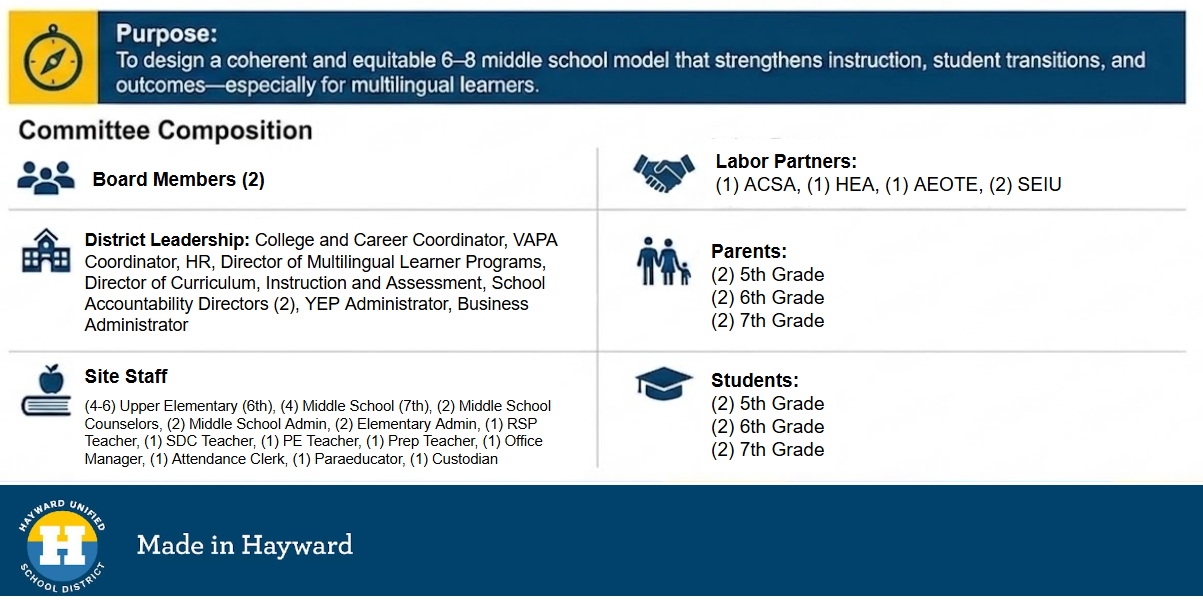
The committee would focus on operations, instructional programs, and facilities capacity. The proposed committee includes at least 51 people—half the size of the United States Senate—from a number of different areas. Board Members, multiple Program Coordinators and Directors, over two dozen site Teachers and Staff, multiple representatives from Labor Groups, and parents and students from 5th, 6th, and 7th Grades. "It's a large group of community leaders," Mr. Garcia said.
The proposed areas of discussion could include things like classroom capacity at middle schools, safety and supervision structures, credentialing requirements, scheduling implications, expansion of Dual Language Immersion (DLI) programs, and more. However, the presenters said that specific topics of discussion would be determined by the committee.
The proposed timeline would spend June-August finalizing the committee and setting the schedule of meetings. The committee would convene between September and November across at least 5 meetings before recommendations are brought to the Board of Trustees in December.
Bigger Committees Are Better Committees
Multiple Trustees recommended expanding the committee to improve representation. Trustee April Eljeiroudi (née Oquenda) wanted to include families from different backgrounds and feeder patterns. She compared the District/School representation and the Parent/Student representation saying, "It's a very heavy stack in one direction." Her primary concern was elevating parent concerns, like those of year-round families.
"What I think you need are more teachers," Trustee Ken Rawdon said. However, during later discussion it was pointed out that at least 14 teachers were included in the committee, which he appeared to find acceptable.
Trustee Bruckner-Carrillo asked about representation for Special Education, which Superintendent Chen Wu-Fernandez said would be added, but was accidentally left off the presentation. He then suggested that the Board positions and Accountability Directors could be removed. However, the Superintendent asked the Accountability Directors to stay since they would be supervising the sites in the future.
Chair Peter Bufete pushed for more parents to be included, suggesting representatives from affinity groups like AASAI and APICI, and parents of 4th graders who would be affected by the change if the transition happened on schedule. Adding more people to the committee was also supported by Mercedes Faraj, HEA President.
Why Are We Doing This?
Trustee Rawdon wanted to make sure that the change was based on educational benefit and not cost savings. "This didn't come forward as a cost-saving measure," Superintendent Wu-Fernandez said. But Trustees Rawdon and Sara Prada worried about the timeline. Trustee Rawdon recommended pushing the start until October, but Superintendent Wu-Fernandez discouraged it.
The Superintendent said that the committee recommendations may include a change to the proposed timeline, but that such changes would come from the committee itself. Trustee Eljeiroudi made clear that the timeline and recommendations would be controlled by the committee.
Finally, Trustee Bruckner-Carrillo pushed for a robust outreach strategy to families, possibly in lieu of committee membership. "We can't have hundreds and hundreds of parents part of a committee," he said, "[but we] can have hundreds and hundreds of parents weigh in through a really proactive and thoughtful engagement strategy."
Have You Ordered A Zine Yet?

If you haven't ordered your Hayward Herald Zine, what are you waiting for? Order today our new store or pick one up at one of our local independent businesses!
Enrollment Declines While Special Ed Increases
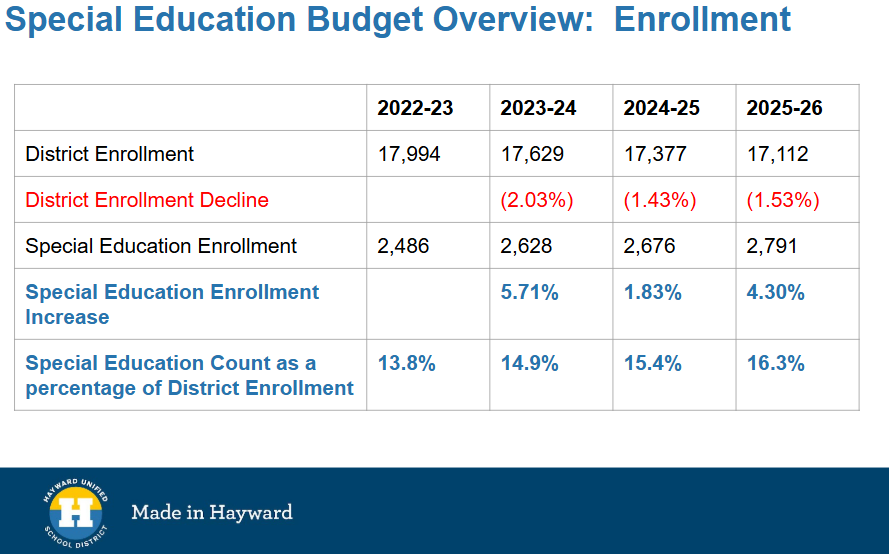
During the budget presentation, Assistant Superintendent of Business Amy Nichols delivered a mix of good and bad news. While the Governor's May Revise Budget included millions more dollars for HUSD, some enrollment trends painted a troubling long-term picture. Despite overall enrollment declining, enrollment in Special Education is increasing. This, combined with increased cost of providing services to those students, may spell budget troubles in the future.
Good Budget News From Sacramento
While the State Budget has yet to be finalized, the May Revise included around $10,600,000 in additional ongoing money to HUSD, as well as a potential $14,000,000 more as a one-time grant. The one-time funding is at the highest risk of not being approved in the final budget, but this increase, combined with the potential Parcel Tax, will put the District in a much better financial position.
One funding source is contingent on providing up to 14 weeks of Paid Pregnancy Disability Leave to District personnel, but Ms. Nichols said the money will more than offset the cost of implementing the program. The largest portion of the ongoing funding—$5,400,000 of it—is a 46% increase in funding for Special Education students. "Our students are coming to us with greater needs and this is happening throughout the state," Ms. Nichols said.
Special Education Inflation
According to the presentation, overall enrollment in HUSD has declined between 1.5% and 2% per year since 2022—between 200 and 300 students per year. At the same time, Special Education Enrollment has increased between 2% and 5% every year—between 100 and 200 students per year. This has caused Special Education students to increase from just under 14% of students to over 16% of students in four years.
Between increases in Special Education enrollment and increased cost of service provision, the budget for Special Education has increased around $10,000,000 per year since 2022. Ms. Nichols pointed out that these trends are not only happening in Hayward, but throughout the region and the state.
Despite the costs, additional funding from Sacramento and the proposed Parcel Tax will likely allow HUSD to maintain more solid financial footing in the coming years. "Just a tremendous amount of new money coming n to the district," Ms. Nichols said, "which is going to introduce a number of new conversations."
Why Is This Happening?
Trustee Ken Rawdon expressed concern about Special Education enrollment and wondered if there was a reason. Superintendent Wu-Fernandez said that the criteria haven't changed, but the number of students with Individualized Education Plans (IEPs) has increased. She would not speculate as to why, however. "We're escalating at such a rate," Trustee Rawdon said, "so we better begin to grapple with it now."
According to the California Legislative Analyst's Office (LAO), higher special education rates are correlated with lower incomes and race. Black students, for example, have relatively high rates of Special Education identification, while Asians are relatively low. While the majority of students have relatively mild need, rates of autism identification have also increased. The data from the LAO is older, ending before the pandemic, so it is also possible the lockdown learning environment had an effect. However, the LAO provided no clear explanations either.

Comments ()