
HUSD Students Behind In Foundational Math
HUSD students are far behind in middle school math, and some student groups fare particularly badly. The FY27 budget looks bad—the city used up most of its tricks this year, but costs keep increasing.

Today's Hayward Herald is going to be less detailed than usual, due to our work on the next issue of the Hayward Herald Zine. It'll be the first of our quarterly publication—we're going to publish a print zine four times per year! But that's extra work for our very small team. Expect normal coverage to resume next week.
During the May 13th HUSD Board of Education meeting, the Educational Service Division presented on the second year of the Strategic Math Plan. One of the key initiatives for the plan was to develop a standardized assessment for math achievement. The Math Plan targeted 8 priority courses, in Middle and High schools to get an idea of where students are beyond statewide assessments.
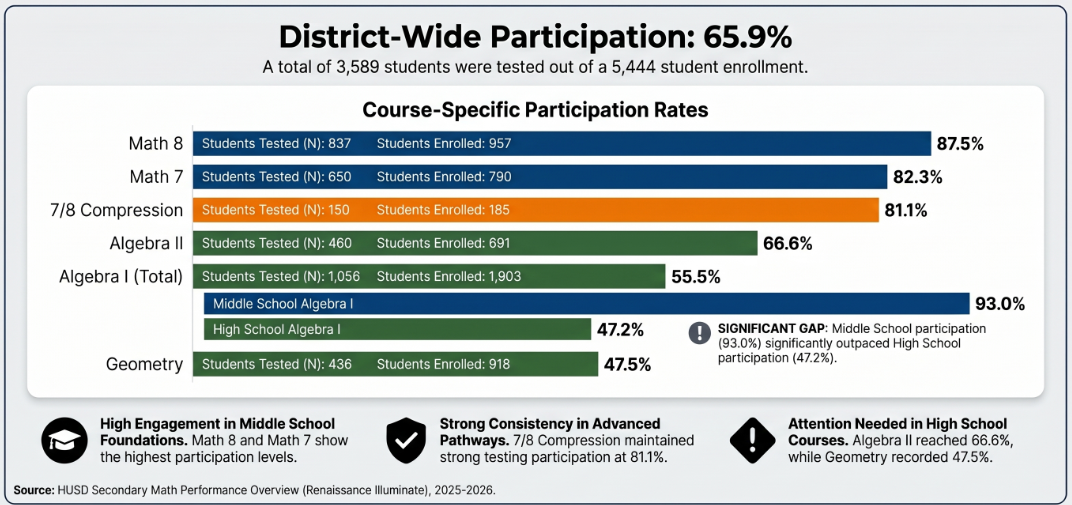
About 2/3rds of students (3,598) across the district participated in the benchmark assessment. But the participation rate varied across different courses. Only 47% of students in High School Algebra 1 and Geometry took the assessment, while 93% of Middle School Algebra 1 students took the assessment. The chart above indicates that High School courses were much less likely to participate in the assessment.
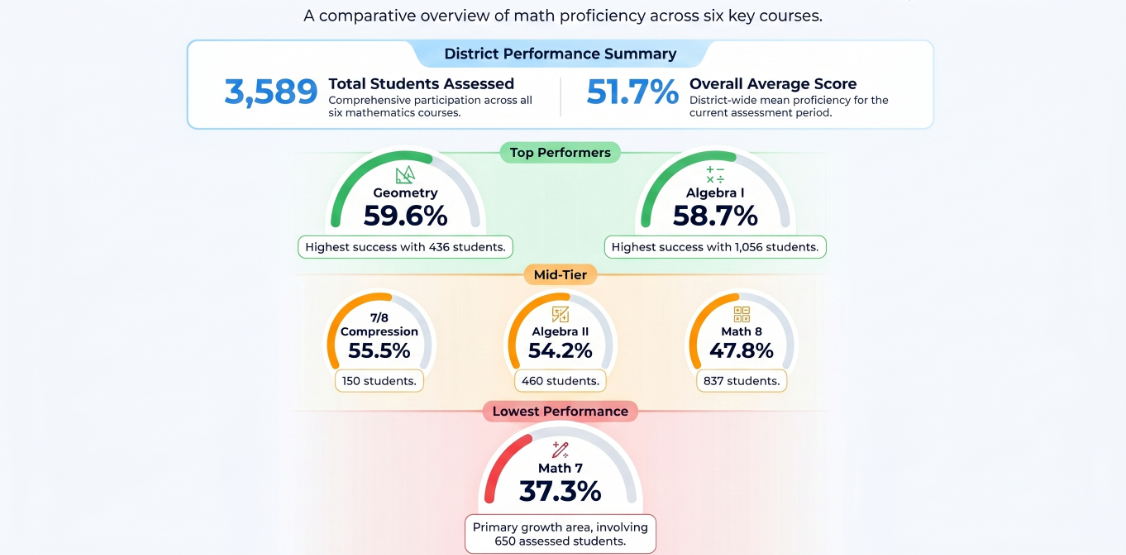
However, the actual performance told a very different story. The top performing courses, Geometry and Algebra 1, had success rates of just under 60%—fewer than 2/3rds of students. Meanwhile the lowest performing course, Math 7, had a 37% success rate across 650 students—only 240 of those students are considered "proficient" in 7th grade math.
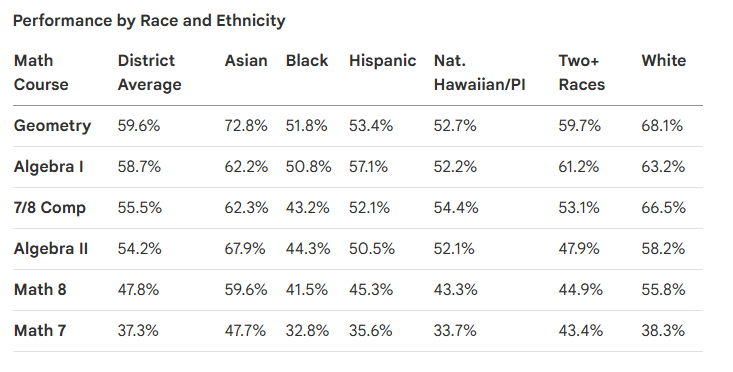
Another chart showed that the 37% success rate also includes those students who nearly met the standards, as well. Though this is likely due to the fact that the assessment was conducted in the middle of the school year. And when disaggregated by race and ethnicity, Black and Latine students are disproportionately impacted in Middle School Math. Their success rate is between 32% and 45% for Math 7 and Math 8.
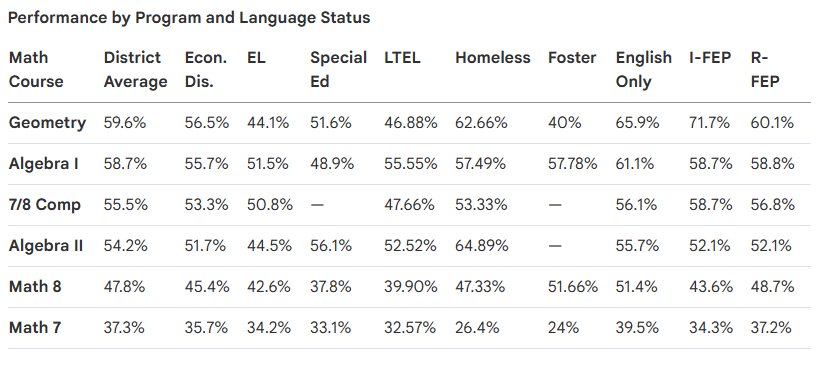
When it comes to specific student groups, English Learners and Long Term English Learners are also disproportionately impacted, with success rates below the District Average at every level—sometimes by more than 10%. English Only students, by comparison were consistently above the District Average at every level. The presentation suggests language-embedded math support for Language Learners is needed to close the achievement gaps.
Teachers hope to use the benchmark data to better inform instruction and professional learning. Next year, the Educational Services Division hopes to build a math teacher coaching network, identify and support math academies and intervention supports, and develop a 6-8 Middle School Plan for math instruction.
Do You Have Trouble Getting Your Child An IEP?
Tell us about it! The Hayward Herald is gathering information from HUSD parents who have had difficulty getting their student an IEP. We have a brief survey where you can tell us about it with complete anonymity.
Being a parent is hard and sometimes the institutions and processes that are supposed to help us wind up getting in the way. It only takes a few minutes and we encourage you to share it with other parents you know so that they can chime in as well.
Future Budgets Look Grim For City
Future budgets for the City of Hayward may continue to result in significant deficits due to reduced revenue and increasing costs. Due to stagnant property taxes and reduced sales taxes, Hayward was able to balance the budget this year, but only through a combination of one-time revenue and significant workforce reductions of approximately 15%. However, those measures will not be enough to balance future budgets, which may see shortfalls of over $40,000,000 as early as 2028.
According to the presentation, low tax revenue from a stagnant property market and reduced sales taxes due to inflation and tariffs will limit revenue and increased Cost of Living Adjustments (COLAs) and CalPERS retirement contributions will drive up costs. Some of this will be mitigated if the Business License Tax gets passed by voters in November, but that will still only add around $11,000,000 to the General Fund, leaving an almost $30,000,000 gap.
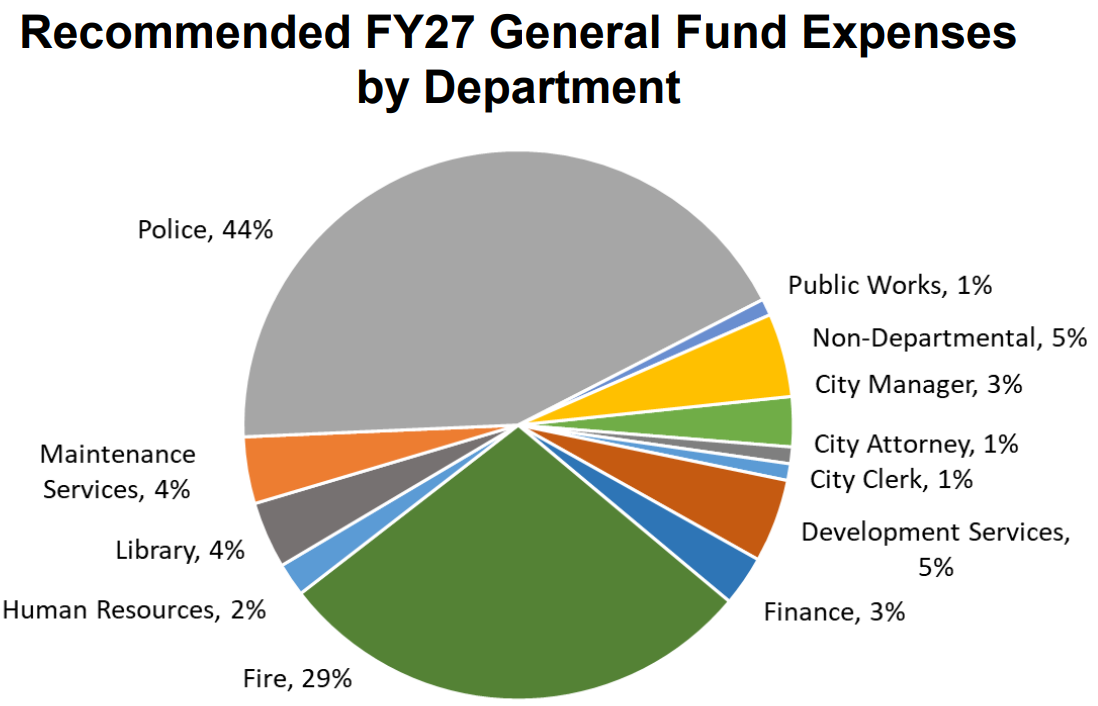
As in previous budgets, the Police and Fire Departments take up the majority (73%) of the General Fund. The next largest departments are Development Services (5%) and Library (4%) and Maintenance Services (4%).
Concession bargaining was essential for balancing the budget for this year, but many of the concessions expire in the near future, which will drive up costs even further. According to the presentation, a $30,000,000 deficit remains in next year's budget until more revenue or cost savings come to fruition.
The 2028 Budget will hopefully include additional revenue in the form of $11,000,000 from the Business License Tax, increased Utility User's Tax from data centers and streaming services of $4,700,000, and continued use of Measure C and OPEB Trust revenue of $13,000,000 every year until 2030—use of Measure C has been a point of pain for Mayor Mark Salinas.
The budget also assumes no new hires—maintaining the 15% vacancy rate —and continued overtime reductions in both the Police and Fire departments. However, even with all of those assumptions, next year's budget is presumed to be $7,000,000 short. The city plans to pursue grants to offset some costs, but it is likely that more labor concessions will be necessary in order to close the remaining $7,000,000 gap unless tax revenue improves.
Additional Risks On The Horizon
There are additional risks on the horizon that could completely cripple the city's budget, many of which may be on the ballot in November.
- California Two-Thirds Vote Requirement for Special Taxes and Charter City Real Estate Transfer Tax Prohibition Initiative (#25-0006A1)
- This measure would prohibit cities from imposing new Real Estate Transfer Taxes and invalidate any city-only transfer taxes on December 31. This would put Hayward's $11,000,000 in Real Estate Transfer Tax revenue in jeopardy.
- AB 1383: Public employees’ retirement benefits
- AB 1383 would change pension benefits, including lowering retirement age and increasing benefits multipliers. This would increase the pension costs of the City of Hayward and all other public agencies using CalPERS.
- California Property Tax Exemption for Elderly Residents Initiative (#25-0035)—Not yet approved for the ballot
- This will exempt certain homeowners aged 60+ from property taxes. The presentation estimates this could cost California local governments between $10,000,000 and $16,000,000 per year.
- Repeals Voter-Enacted Changes to Property Tax Rules for Transfers Between Family Members (#25-0017)—Not yet approved for the ballot
- Would allow inherited property transfers without reassessment to market value, essentially allowing Prop 13 to apply to inherited property. This would reduce local government revenue by $1,000,000,000 to $2,000,000,000 per year statewide and gradually erode Hayward's property tax base.
The meeting for this presentation was over five hours long, but the Hayward Herald will cover it in detail in the coming days. Check back here soon to find out what your Council members had to say about the looming budget issues!


Comments ()