
HUSD Still Faces $11 Million Deficit
In Which: HUSD still has a structural deficit after $50 million in cuts, Rezoning gets contentious around agriculture, and Commissioners push back on State law
HUSD Preps For Up To $11 Million In Cuts
During the September 24th HUSD Board of Trustees meeting, Superintendent Chen Wu-Fernandez gave a budget update that included up to $11,000,000 in cuts for the coming fiscal year. This is part of the District’s continuing efforts to balance the budget and restore the state-mandated 3% reserves. The Board will approve a plan and timeline for the impending cuts on October 8th, with the next Fiscal Solvency Plan looking to be approved in February.
The Alameda County Office of Education (ACOE) conditionally approved the FY 26 budget that HUSD submitted in June, but Superintendent Wu-Fernandez explained that since the actuals for FY 25 were better than expected, the FY 26 budget is in a better place, as well. The District is poised to maintain the 3% reserves for this coming year, however the remaining deficit will bring the reserves down in subsequent years.
The picture for this year is also still changing. Superintendent Wu-Fernandez said that the Average Daily Attendance (ADA) may change due to increases in Transitional Kindergarten (TK) enrollment, which will be adjusted in November. Any unexpected expenses may also change the situation, though she stressed that the Business Office is closely monitoring expenses.
While she did not go into details, Superintendent Wu-Fernandez said that the District has a $4,000,000-$6,000,000 structural deficit--meaning that the District is spending that much more than it is bringing in. She also said that $5,000,000 of one-time money is being used to support 27 Full-Time Equivalent (FTE) employees. Right now, the District is assuming that once the money runs out, it won’t be replaced. So if the District wants to keep those positions, it will have to find even more savings from elsewhere.
Federal Funding Concerns
Multiple Trustees were concerned about the status of Federal funding. According to the presentation, HUSD receives around $21,000,000 in Federal funding for a number of programs throughout the District. The majority of the funds--just under $13,000,000--helps fund Special Education programs. The next largest pot of money comes from Title 1--$5,700,000--pays for support services, instructional materials, and English Learning specialists for school sites with low-income students. There are also hundreds of thousands of dollars in funding to other programs including professional development, multi-lingual learners, and homeless and Foster youth.
Thanks for reading Hayward Herald! This post is public so feel free to share it.
Trustee Rawdon also expressed concern about the Youth Enrichment Program (YEP), which provides after school care to students at a very low cost to parents. He had been under the impression that YEP mostly used Federal funds, but Superintendent Wu-Fernandez said that the situation has changed in recent years. “At one point it was heavily federal funded, because they’ve gone through different iterations of funding.”
The Superintendent said that YEP receives most of its funding from the State of California, though it does have some Federal funding. “At this point, most of the federal funding that we receive for YEP is actually related to secondary programs that we run,” she said. “I guess when it comes to Federally funded stuff,” Trustee Rawdon replied, “the shoe could drop at any time, anywhere, and nobody knows the day nor the hour.”
What They Need To Approve A Timeline
Trustee Prada said she wanted to see a report on the impact of the previous Fiscal Solvency Plan before approving even the timeline of the next plan at the October 8th meeting. “I would need the negative fiscal impact on reductions for this 25/26 school year and also impact data on all of our sites, if possible,” she said. She highlighted the impact of half-time Vice Principals and reduction of Attendance Clerks.
Although the school year only started in mid-August, Trustee Prada continued to press for data. “It is, in all honesty, something I’ve been asking for for several months,” she said. “And I do understand in some sense we had to wait for the school year to start, but I think in order to approve a timeline I need to see the impact of the last decision of the Solvency Plan.” Superintendent Wu-Fernandez said that Staff would try, but that it would be difficult. “I’m not sure we’ll be able to fully capture the effects of it,” she said.
Trustee Bruckner-Carrillo supported the need for an impact assessment. “Decisions that we made with perhaps the best intentions,” he said, “but the execution has been flawed and have therefore ended up costing the District money.” He pointed to summer school funding, VAPA, and attendance clerks--specifically at Eldridge Elementary--as issues he would like to see explored.
Trustee Bruckner-Carrillo also highlighted other desires, including a true report out on Special Education, progress on how contracts are reported to the Board, an evaluation of the Facilities, Maintenance, Operations, and Transportation Department (FMOT), and a clearer understanding of how the one-time funded positions were funded historically. “I want to make sure that there is no perception that we are shifting around funding last minute to save administrators,” he said.
Superintendent Wu-Fernandez explained that many of the items have full agenda items scheduled, including Special Education, so they would not be available by October 8th. Trustee Bruckner-Carrillo then clarified that he hoped those kinds of items would be included in the timeline when it is approved.
Recommendation In Defiance Of State Law
On September 25th, in defiance of California State Law, the Planning Commission recommended against rezoning a parcel at 900 Calhoun Street from Agriculture to Low-Density Residential. Citing concerns about non-existent future plans for subdividing the property and a slippery-slope argument around changing the character of the area, the Planning Commission voted against recommending the City Council approve a zoning change.
The parcel at 900 Calhoun already has an Accessory Dwelling Unit (ADU), which is allowed by-right, and seeks to divide the property into two parcels. The property owner has no plans to divide the property further, and many geographic barriers exist that would prevent adding too much housing. These include steep slopes, landslide zones, and a fault line that runs through one corner.
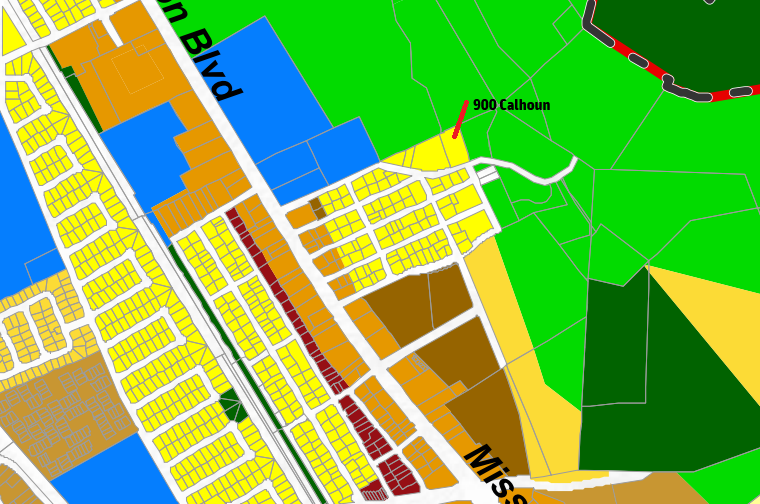
Notably, the Hayward General Plan (seen above), designates the parcel as the north-easternmost parcel in that area that is designated as Low-Density instead of Agricultural. According to City Staff, the parcel has been designated as Low-Density for decades—before even this General Plan, which was completed in 2014.
The parcel and the one adjacent to it tried to rezone in 2015, but were denied by the City Council at that time. According to City Staff, changes in State law have allowed the General Plan designation to trump the local zone. This means that, regardless of what happens, the property owner is legally allowed to build up to 4 homes on the property, which is allowable under the General Plan.
What About Agricultural Uses?
Commissioner Lowe asked if the property could be still be used for agriculture if it was rezoned. Staff said that it could be used for “ancillary” agriculture—like having a garden or some chickens, but not a full-blown farm. Commissioner Lowe then asked about stables, since the property used to be a horse boarding business, but Staff said that wouldn’t be allowed.
But What Is Really Planned Here?
Commissioner Haman asked about the development potential of the lot. “It does have development challenges,” City Staff admitted. He then asked what the plan was for the property after the zone change. Staff reiterated that the applicant was only looking to divide the lot into two different units. Commissioner Haman pressed about the applicants future development plans, but Staff could only reiterate that the property owner was looking to subdivide the property between the existing buildings. “He is allowed to submit an application and propose a zoning change,” Planning Manager Lochirco said.
Flaws In The General Plan?
Chair Hardy asked about the General Plan. She said that during the 2015 meeting, the City Council at the time took issue with the General Plan. “It is not a priority for the City to change the General Plan on this property,” City Staff said. When asked if the General Plan had changed at all in that time, Staff stressed that it was not in that area.
Neighbors Fear Change
Multiple neighbors spoke against the zoning change. Many of them focused on the impact that future development could have on some of the last Agricultural Zones in Hayward. Despite no development being planned and the change being limited to one parcel, neighbors feared a change in property value, future zoning changes in the area, and a loss of agricultural culture in the area.
When Commissioner Lowe asked about any impacts to other properties in the area, City Staff said, “He is just rezoning his property and so it is just the boundaries of 900 Calhoun.” When Commissioner Lowe asked about public commenter assertions that it would affect other properties, Staff said, “I am not entirely certain how we got there.”
There Are Guardrails For The Future
Commissioner Yorgov opened by recognizing the feelings of the public commenters. “I’m really sympathetic to your requests,” he said. Your stories are really moving and the community is clearly so strong here.” However, he recognized that no real change would happen right now. “I don’t think we have the right, based on what’s here, to challenge the General Plan.”
He then highlighted the fact that any further development would have to be approved before it gets built. “Any decisions to build anything on these sites will be separate decisions that can also be challenged are why I’m going to vote to reluctantly follow Staff’s recommendation.” However, he was the only one who felt that way.
This Can Happen Regardless Of Your Decision
Planning Manager Lochirco stressed to the Planning Commission that the General Plan trumps zoning. “So whether or not this rezoning went through,” he said, “the applicant is still entitled—per the General Plan—to build out to the full low density residential land use, which would be anywhere between four and eight units. That’s his legal right.”
Commissioner Stevens then questioned why this was even being discussed. Mr. Lochirco clarified that the General Plan sets the density, but not the lot size. If the zoning is denied, he can’t subdivide the property. “So we do have local control,” Commissioner Stevens said. “The bar to deny that is really really high,” Mr. Lochirco said. He also said that not approving it would put the property even further out of compliance with the General Plan, which may anger the State.
Show Me The Plans
Commissioner Haman said, “I still have some concern about how many dwellings are going to be on this property.” Despite there being no plans to add any more dwellings at this time, he continued. “For me to approve the zone change, I’d like to see a site plan… I believe we’d be better off waiting to see that the future plan is a viable plan.” Staff responded, “An applicant doesn’t have to have a development application paired with the zoning change.”
It’s The General Plan That Is Wrong
Commissioner Stevens took aim at the General Plan. “When the General Plan was established,” he said, “it was probably unsuitable to begin with.” His reasoning was at least partially based on his love of horseback riders. “For me, personally, when I see folks riding horses up and down that street… I think that that is a very unique experience that’s unlike most of the East Bay and creates a special place for Hayward.”
He, once again, then took aim at the State Government. “We’ve lost so much of our agricultural roots and the criminal actions of the State Legislature and the Governor to take away our local control—this is our only way of controlling land use.” He then appeared to come close to openly defying the State’s laws on the matter. “I don’t really care if this is—,” he said, though did not finish the sentence.
Commissioner Meyers also recognized the bind the City was in over the General Plan. “On the one hand, we have the General Plan which says it can be done whether we agree or not here,” he said. But he continued to search for ways to deny the change for fear of a slippery slope. “Are there any grounds, legally, that we can deny this?” he asked. “I don’t know that there’s any grounds to deny the application because there’s not a development proposal,” City Staff said.
Chair Hardy took issue with the whole premise. “I’m going to respectfully disagree with the assessment that we cannot vote no on this,” she said. She said that the City should have changed the General Plan in response to the 2015 City Council’s wishes. “It was something that the City Council asked for to happen,” she said, “So I feel like it’s something that could have and should have happened because it was asked for.” She finished by questioning the reason for the rezoning at all. “What’s missing for me here is the purpose of subdividing this property at all,” she said.
Commissioner Yorgov asked what was involved in changing the General Plan, and City Staff pointed out that it’s a big undertaking. It involves a CEQA analysis, recommendation by the Planning Commission, and approval of the City Council. On top of that, there is another wrinkle. “We are not able to downzone properties unless we upzone other properties in conjunction,” Staff said, because of State concerns about housing shortage. Planning Manager Lochirco stressed that the process is significant.
Despite not having grounds to do so, the Planning Commission ultimately voted to recommend against rezoning the property. However, the decision ultimately rests with the City Council. Although some on the City Council were serving in 2015, with a new Council and new set of circumstances, it is unclear if they will feel the same way they did 10 years ago.



Comments ()