
Labor, Outreach, and Lunches at HUSD
In Which: Noon supervisors protest wages and work conditions, Outreach on more cuts are incoming, and HUSD takes a long look at school nutrition.
Do you have thoughts? Are you of an age? Do you consume news content? TAKE OUR SURVEY and tell us about them! We want to know more about you to serve you better. There are only a few questions and it’d really help us a lot.
Noon Supervisors Protest Wages
At the October 22nd the Hayward Unified School District (HUSD) School Board meeting, representatives of SEIU 1021’s Education Unit admonished the Board of Trustees over labor negotiations for Noon Supervisors. Alleging low wages and overwork, multiple noon supervisors urged the Board to negotiate in good faith. Notably, Noon Supervisors seem to have only recently gained union representation by SEIU.
“It’s literally worker abuse and/or exploitation,” the SEIU 1021 Director of the Education Unit said during public comment. He said that many Noon Supervisors only recently began receiving $17/hr—even those who had been working for over twenty years—and that the District bargaining team insists on keeping their pay below $20/hr. The School Board discussed labor negotiations in Closed Session earlier that night. “It’s not only unacceptable, the SEIU 2021 representative said, “it’s obscene.”
Another Noon Supervisor said she was “upset… at the lack of support, care, and thought for our well being by this District.” She said that some Noon Supervisors were overworked and stressed to the point of suffering from chronic illnesses and injuries, don’t receive any health insurance, and have inconsistent hours. “We are the lowest paid members of this School District,” she said.
Another Noon Supervisor spoke about conditions that include one Supervisor needing to watch 400 students at once. Parents and other District Staff spoke in support of Noon Supervisors, highlighting the importance of having someone who watches students during lunch time—often without any additional support. Other demands from the Union include recognizing years of service, additional support, substitutes, and better ratios of Noon Supervisors to students.
HUSD Budget Outreach Incoming
During their standing Budget item, the Hayward Unified School District (HUSD) Board of Trustees received a draft list of outreach efforts that the Finance department will be conducting to get input on upcoming cuts. On top of the eight internal meetings that will be conducted in November alone, at least five public Town Halls will be held between November 12th and December 11th, as well as at least five meetings with parent stakeholder groups like DELAC, AASAI, and APICI.
Despite substantial cuts this calendar year, HUSD still needs to cut another approximately $11,000,000 from its General Funds in order to maintain the State-mandated 3% reserve balance. While some pleasant surprises ensured that the District will have the 3% reserve this year, it will dip below that threshold in the 26/27 school year without action. As we’ve covered before, the District has a priority list of solutions to explore:
- Use restricted or grant funding to sustain existing programs and services
- Generate revenue with a Parcel Tax, medical billing, and leasing surplus properties
- Controlling costs for supplies and contracts
- Reducing extra duty compensation where possible
- Staffing reductions
- Program and service reductions
Assistant Superintendent of Finance Amy Nichols stressed that they plan to pursue solutions in this order, with staffing and program reductions as a last resort. But the District hopes to get feedback from the community to better understand what priorities should be. The five public Town Halls are:
- Wednesday, November 12, 2025: 5:30pm-7:30pm at Hayward High School
- Saturday, November 15, 2025: 10:30am-12pm at Mt. Eden High School
- Special Education: Tuesday, November 18, 2025: 6pm-7:30 pm at The HUB
- Tuesday, December 2, 2025: 5:30pm-7:30pm at Tennyson High School
- Thursday, December 11, 2025: 5:30-7pm online via Zoom.
There will also be presentations and opportunities for feedback at District-wide parent committees and affinity groups between November 19th and December 10th during their regularly scheduled meeting times. The idea, according to Superintendent Chen Wu-Fernandez, is to present information to the community and then facilitate breakout groups where more intimate discussion can take place. “We’re trying to be thoughtful,” she said, “about how we can structure that and the way that we can hear all voices as we engage in this process.”
Facilitation at the Town Halls will be available in Spanish, Mandarin, and Farsi.
Clarifications And Requests For Even More Outreach
Trustee Ken Rawdon asked for clarification around the Medical Billing that could help generate revenue for the District. Superintendent Wu-Fernandez explained that recent changes at the State level allow for the District to get reimbursed for certain services like counseling services. “Folks who are supporting our students to get care,” she said, “like our cost specialists, potentially.” However, she said that the money is not guaranteed at this time.
“It must be a lot,” Trustee Rawdon responded. Superintendent Wu-Fernandez said that it depended on the hours and the dosage of services rendered. “[There] could be substantial revenue from it,” she said. When Trustee Austin Bruckner-Carrillo asked if it was similar to a program that was mentioned last year, Ms. Wu-Fernandez said it was different. “[It’s a] very new program,” she said.
Trustee Bruckner-Carrillo asked if there was a date when larger items—like school closures—might be considered off the table for cuts. Ms. Wu-Fernandez said that she didn’t want to say anything was off the table before the Town Hall meetings, which will gather community priorities. “I’m not sure that I can commit to almost a pre-list before the list is daylighted,” she said, “because it’s probably going to take all the month of November and most of the month of December to get through the public discussions.”
“Last year the presentations that our former Superintendent gave to the public said that we were not considering school closures,” Trustee Bruckner-Carrillo said. “That’s a huge topic and to roll that out in January and to keep that floating out there… does not sit right with me.” He further pressed to have presentations to individual School PTAs and PTSAs, but Superintendent Wu-Fernandez refused to commit to that due to capacity issues.
Unions Unsure About Process
Mercedes Faraj, President of the Hayward Education Association, appeared to cast doubt on the accuracy of the District’s financial projections. “Taking actions on projections,” she said, “while it is the norm, is a very dangerous trend unless you do your homework and you really have an analysis of the budget.” She further pushed for an impact assessment of the last round of cuts, which only went into full effect this last July.
Deisy Bates, President of The Association of Educational Office and Technical Employees (AEOTE), appeared to take issue with the Board of Trustees asking questions about the budget outside of public meetings. She also called for another, better-designed, survey for the community to give input outside of the Town Hall meetings, and expressed concern about enrollment. She alleged that many Transitional Kindergarten students left HUSD for Castro Valley Unified because of enrollment issues caused by cuts to Office Staff.
A Deep Dive Into School Food
Director of Student Nutrition Services, Lucky Vasquez, presented on the progress his department had made in the five years since he had been hired at HUSD. He highlighted initiatives aimed at making food more nutritious, delicious, and sustainable, as well as improving back-end systems in his department to improve service. However, he revealed that most of his attention has been aimed at the District’s three High School sites, as opposed to the 19 Elementary School sites.
“I was one of those kids that grew up on a free lunch program,” Mr. Vasquez said. “That was one of the only meals I would get during the day.” He recalled the shame he felt around participating in a free meal program, a feeling that is no longer an issue since the State Government continued the COVID-era universal free meal program.
Mr. Vasquez said that his goal is to make meals nutritious, delicious, and sustainable—in that order. Nutrition standards need to be met in order to get reimbursed by the State, but after that, it’s important to make sure the students eat the food. The sustainability portion is both for environmental and financial benefit.
However, Mr. Vasquez said that at times his desire for food with less additives comes into conflict with student demands. He recalled a time he attempted to remove a popular item, Taco Nada. “I took a pre-packaged item off the menu,” he said, “and nearly got stoned for doing it from the students.” After popular outcry, he put it back on the menu because, “They think it’s delicious.”
However, in other areas, Mr. Vasquez insisted that challenging student tastes is important. He cited the 100% maple syrup, which may not taste like what they’re used to at home. “I think we owe it to our students to let them experience new flavors,” he said. He said that those changes set the stage for better choices later in life.
Other initiatives include offering more equitable vegetarian options, reducing pre-packaged food and high-fructose corn syrup, producing over 40% of the food in-house, and ensuring all beef products include 100% beef and chicken products include only whole breast chicken meat.
To showcase the results of his approach, Mr. Vasquez showed that participation in Lunch and Breakfast programs has increased over the last three years. In 2021/2021, there were 1,906,099 meals served in the district, and by 2023/2024 the district served 2,693,979 meals—an increase of over 40%. “It doesn’t matter if food is free or not,” he said, “If you don’t like it, you will not eat it. The numbers don’t lie. Students like our food.”
Mr. Vasquez also explained that his department is a self-sustaining and does not impact the General Fund for the District. “If we don’t make money, we don’t exist,” he said. Between State reimbursements, he also highlighted the over $2,000,000 in grants that he had brought to his department in the form of Food, Infrastructure, and private fundraising grants, and including HUSD in the Community Eligibility Provision from the USDA.
The importance of the CEP is that it maximizes Federal reimbursements, increases District funding, ensures that, even if California ends the Universal Meals Program, students at HUSD will eat for free for at least the next three years. Mr. Vasquez recognized that something could happen to this Federal program in the future, but did not seem to think it was at particular risk.
The presentation included images of school lunches and how they had improved over the last several years.

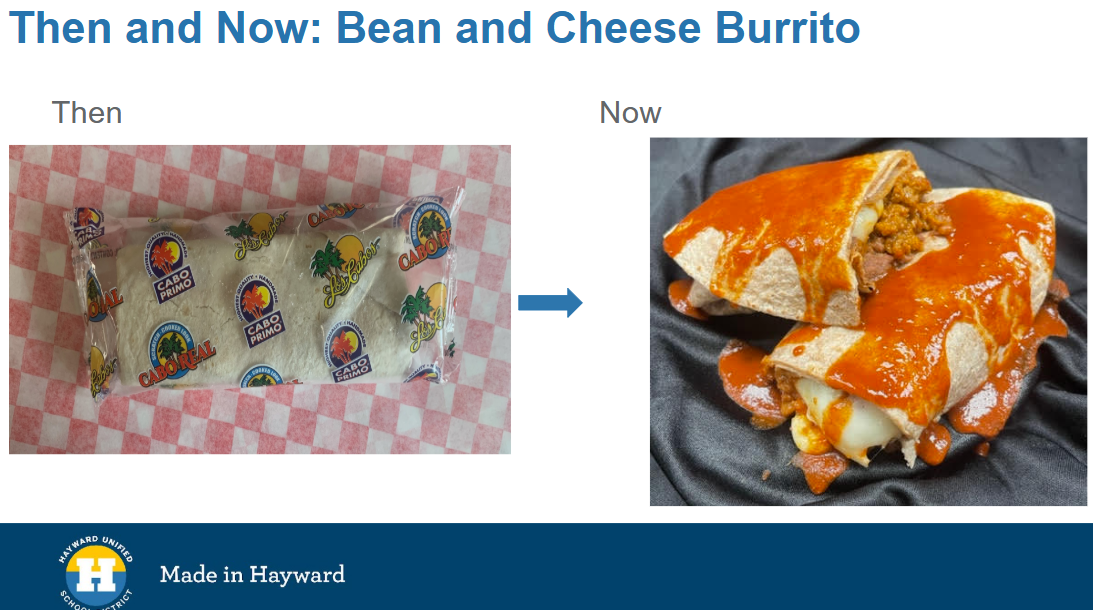
Plans for the future include purchasing 100% organic thin-skinned fruits. “I don’t think we cannot afford to do it,” Mr. Vasquez said, “it is the best health for the student… we have the money to do it.” He’s also planning to include condiment bars at all schools, converting so-called commodity purchases to produce, getting away from processed cheese, and sourcing local meat that would also be halal.
“I won’t be able to satisfy every single cultural need there is,” Mr. Vasquez said, “but bring me a medical certificate that you have celiac and you better believe it that I’ll provide it, with variety.” Finally, there is a goal to purchase more from minority-owned businesses.
Board Supports Progress And Wants To See More
Board President Peter Bufete started questions and commented that he was the one who had asked for the item to be on the agenda. “I made sure that the Board itself has tried the food from Elementary all the way to High School,” he said. He asked if there were any pork products offered, since there was such a focus on beef. Mr. Vasquez said there are no pork products offered at all—possibly to address a wide range of cultural restrictions.
Thanks for reading Hayward Herald! This post is public so feel free to share it.
President Bufete asked how much food Mr. Vasquez would like to see made in-house. He responded at least 60%, in a perfect world. President Bufete asked how many Staff make use of the school meal plan, though the numbers weren’t immediately available. “It’d be really great to see,” he said, “with the food being so good that staff is subscribing to it.” It would also increase revenue for the program.
President Bufete then asked about cultural cuisine, especially for cultural recognition months. But Mr. Vasquez said it was a slippery slope for him, because of concerns about providing culturally correct food. He cited an example of potentially providing Thai food, only for someone to accuse him of being Lao. “[We] try to provide culturally diverse food but not in any specific month to honor that.”
Trustee Rawdon celebrated the quality of the food. While he was a High School teacher for 30 years “I ate school lunches every day,” he said, “They’ve come a long way.”
Trustee Oquenda also praised Mr. Vasquez. “You are teaching our kids who might not be learning it at home what nutritious food is,” she said. She said she very much enjoyed the food she tried from the different sites.
Different Areas of Responsibility Around Food
Trustee Brucknker-Carrillo recalled that he, also, grew up on free lunches at school and blamed it for poor nutritional choices as an adult. “I eat like I’m five,” he said. He then asked about composting and food sharing at school sites. Mr. Vasquez said he was happy to compost, but expressed a need to work with custodial to make sure there are compost bins to put the food into.
On the subject of food sharing, Mr. Vasquez said that happens in the Multi-Purpose Room which is outside of his responsibility. Having a food share table is up to individual site administrators to implement. “Most of the schools do it,” he said.
President Bufete asked about the potential to have students train on food preparation. But Mr. Vasquez pointed to issues around Labor partners and students taking their work. Trustee Prada also asked if there was any potential to work with Eden Area ROP for job site training in food prep, but that also involved issues with Labor.
Concerns About Elementary Cuisine
President Bufete commented that the food at elementary schools didn’t seem as good as the food at High Schools. “Overall, it tasted a lot better,” he said. Mr. Vasquez said he was focusing on High Schools specifically as a smaller area he could control and that young adults had a more diverse palate. “It should be restaurant-quality food,” he said.
When it comes to Elementary Schools, “Their palates are less sophisticated,” he said. He said they prefer grilled cheese and that he follows student direction. They need to eat the food, at the end of the day.
Trustee Prada also noticed a difference in quality, sharing comments from her 4th Grader that the pizza isn’t good and that many kids complain about the food. She said she was happy with what she saw, but couldn’t square it with comments from the largest student group. During public comment, Maria del Carmen Espinoza also pointed out that, when she volunteers at her school site the cheese pizza is frequently thrown away.
Trustee Prada also expressed concern about Elementary breakfast. “There’s a lot of sugar content in that,” she said. “I do believe there’s a lot of opportunity for growth.” Ms. del Carmen Espinoza asked why the parfait had disappeared from elementary school breakfast. According to local parents, elementary school breakfasts consist of sugary breakfast cereals like frosted flakes and cinnamon toast crunch.


Comments ()