
Rental Cars Coming To Downtown
In Which: Security and environmental hazards are discussed, We outline how sidewalks get repaired, and Council worries about homeowner liability
If you’re free on Saturday at any time between 4:30 and 9pm, come on down to the Hayward Night Market at St. Rose Hospital! We’ll be there with dozens of other much more interesting vendors, but we’ll have a zine. Here’s a little preview of the cover, for those who want a sneak peek. It’s got art and news, and it’ll be 100% Hayward-made by Teamsters! Plus it’s free to everyone who wants one, so what do you have to lose? Swing by and grab your copy this Saturday!
Second Enterprise Location Coming To Downtown
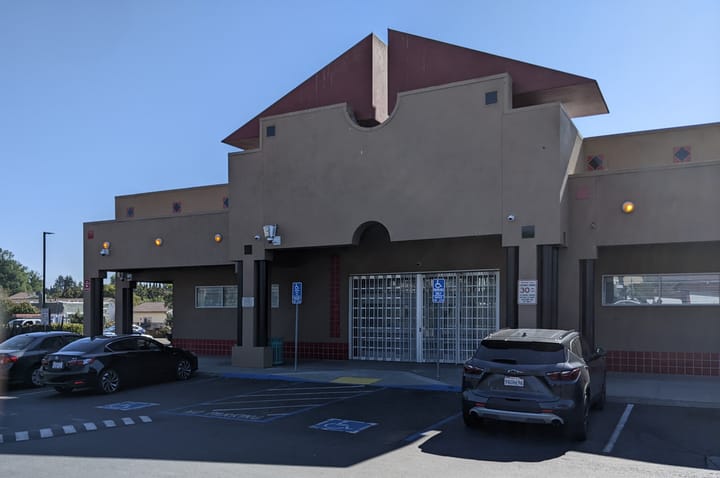
Last week, the Planning Commission approved a second location for Enterprise Rent-A-Car that will be located at 1045 C Street—across from the MKC Project and adjacent to the Hayward Fire Department. The location will largely remain unchanged aside from some upgrades to the 1,200 square foot building, a wash pad, and a 6-foot decorative fence at the East and South property lines. The lot has been vacant since 2019.
Hayward’s Third Rental Car Location
The new Enterprise is in addition to the existing business on 25900 Mission Blvd, which primarily serves South Hayward. Enterprise mostly makes their money in Hayward from providing rental cars to people who need it while their car is being repaired, but shuttling people to and from their existing location is a long way.
The C Street lot is located close to the multiple auto repair shops in North Hayward and Cherryland, as well as providing a way for those in new apartments with less parking to rent a car for longer road trips.
City Staff placed some Conditions of Approval (COAs) on the new location. They are not allowed to park rental cars on the street or in any public right-of-way, the cars can only be washed and vacuumed on site by hand—no detailing or repairs are allowed—and the decorative fence is required, as well. This is, according to Staff, “to minimize impacts on neighboring properties.”
Looking For Hazardous Materials
Commissioner Haman asked if the wash pad was reused, and Staff assured him that it was brand new. He commented that the COAs require the Hazardous Materials office to be contacted to install the pad if there are any issues, “So if it’s new, probably, it wouldn’t be any reason to contact them, I’m guessing,” Commissioner Haman said. Staff agreed.
Commissioner Haman then asked if there were any hazardous materials on the site. Staff said, “Our Hazardous Materials department approved it.” They said the only chemicals stored on site would be basic cleaning supplies like window cleaner and soap. He was then curious about potential for overspill into the storm drains, which flow directly to the Bay. But Staff said that the wash pad was approved by water pollution control, “So, no, it shouldn’t happen.”
Security Concerns In Downtown
Multiple Commissioners expressed concern about the security plans for the Downtown location, which mostly consist of security cameras. “So things seem pretty safe over there?” Commissioner Haman asked. The Enterprise representative said, “We don’t see us having a problem here,” and that security cameras would be sufficient. The U-Haul located on Jackson also has light security consisting mostly of cameras.
Commissioner Goodbody asked if there would be some kind of after-hours drop box for keys, but the Enterprise rep said that returns would only be allowed during business hours. “So there will always be an employee there to grab the key,” he said. She then asked about locks on catalytic converters and whether all the cars would have them. The Enterprise rep said that the fleet moves around to different locations. “I can’t say that all of our cars would have that,” he said.
The Enterprise rep said, multiple times, that security had been an issue at the Mission Blvd location after the COVID lockdown, but that the incidents had died down quite a bit. In Planning Commissioner questions submitted before the meeting, Staff said that the 25900 Mission Blvd location currently has an active Code Enforcement case regarding an unpermitted electric fence—the C Street location would not be allowed to have an electric fence. This was not mentioned during the meeting and it is unclear if the unpermitted electric fence played a role in reducing thefts.
Commissioner Goodbody also expressed concern about lighting. “It seems like it should need more lighting,” she said. Staff, however, disagreed and didn’t think any more lighting was necessary. Commissioner Yorgov also asked about any concerns about theft, but the Enterprise rep insisted that cameras are enough.
Attracting Out-Of-Town Money
Chair Hardy asked if it was possible for Enterprise to, instead of relying on broken down cars, try to bring in people from out of town. “Right now,” she said, “we really are looking to try to attract other people, too, not just our Hayward residents.” The Enterprise rep said that although the insurance replacement was their “bread and butter,” they rent to anyone for any number of reasons.
Commissioner Yorgov shared that he was one of those people who would likely use their service. “I am one of the people who wants to rent a car sometimes to get to LA,” he said.
Chair Hardy asked if there was any data on the number of non-Hayward residents who used the service, but the Enterprise rep said that he didn’t have that information on hand.
The permit for the rental car business received unanimous support from the Planning Commission, who is the final deciding body for this process.
Clarifying Sidewalk Repair Liability
No, wait! I promise this isn’t boring!
The City Council looked at a proposed change to Municipal Code that would clarify how liability is shared between the City and homeowner when it comes to sidewalk repair. Not only does Hayward have over 430 miles of sidewalks, there are multiple overlapping ways that sidewalks get maintained throughout the City: property owners, Maintenance Services, and Public Works.
Property owners have been liable for the sidewalks in front of their home in California since 1941—over 80 years. The City creates the sidewalks, but it is up to the homeowner to repair them. This means they can be liable if someone gets injured on a sidewalk in front of their home and if a problem is identified and not repaired, the City can put a Special Assessment against the property—basically, a fee that gets added to property taxes.
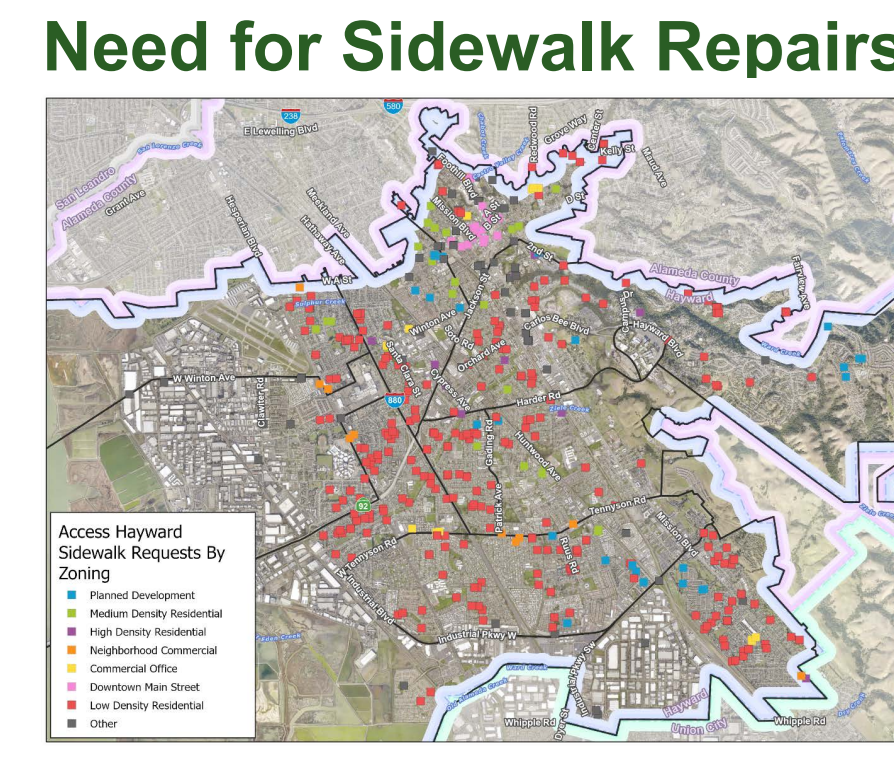
Maintenance Services comes in when someone files an Access Hayward request about a sidewalk. This appears to be paid for by the Special Assessments, though the Staff Report did not go into details on that. But Maintenance does repair a lot of sidewalks, as is demonstrated by this map.
Public Works repairs sidewalks on a rolling basis as a part of the Capital Improvement Program (CIP), just like they repair roads throughout the City. This is paid for out of a different pot of money than the General Fund, usually from things like water bills, grants, and other fees.
But most of the responsibility for repairing sidewalks lands on the homeowners, as does the liability if anything happens. The whole point of this item is to clear that up in writing. “[This] seeks to clarify the duty of property owners to fix the sidewalks and subsequently hold the property owners liable,” a lawyer with the City said.
If the language isn’t clarified, the whole City may be liable if someone gets hurt on a sidewalk that hasn’t been maintained. This could cost the City big money in claims and Staff time defending those claims, regardless of the budget situation. City Attorney Lawson said, in a meeting last year, that the City Attorney’s office has no budget and spends what it needs to, so limiting liability ultimately saves tax dollars.
What’s Our Communication Strategy?
Councilmember Syrop asked about a communication strategy to share this information with homeowners. City Staff said that they could put a notice in a Stack newsletter article, if needed. “But realistically, there’s little change that property owners will see in the day-to-day operations.” The change would only be noticed for any owner that winds up facing a lawsuit.
Councilmember Syrop liked the idea of a hardship program, and City Staff outlined a few different ways it could be structured. Ultimately, however, it would impact the General Fund no matter what, and creating such a program was outside the scope of the change they’re trying to vote on.
Councilmember Bonilla suggested improving communications with neighborhoods around when sidewalks will get repaired, preventing an issue where someone pays for a fix only to have Public Works replace it a few months later.
Repairs vs. Liability
Councilmember Zermeno supported the change, but was concerned about how street trees—often planted by the City—damage the sidewalks. Staff said that the change only deals with liability and nothing else changes. What caused the damage is a different discussion. This seems to suggest that if a street tree damages a sidewalk, the City may cover the repairs, even while the homeowner is liable for any injury caused by the sidewalk.
A Different Kind Of Homeowner In Hayward
Councilmember Roche was skeptical of the change and ultimately pushed to revisit it at a later time. She asked if homeowners insurance typically covers sidewalks, and Staff said it often covers liability defense. But Councilmember Roche alleged that some policies are exempting sidewalks when cities pass ordinances like the one proposed.
“So I am concerned,” she said, “about the situation where somebody having a catastrophic trip and fall in front of somebody’s house, they’re not liable for that and they could be liable to the tune of hundreds of thousands of dollars, potentially, even though I hear they’re co-defendants with the City.” Councilmember Roche also alleged that other cities are phrasing their ordinances differently and only holding the homeowner liable if it’s their fault.
“I am very concerned about what we’re putting on the individual,” she said. And despite concern about the budget impact if the City is liable, “I’m just not sure this is how I want to do it, on the backs of homeowners.” She directly contrasted homeowners in Hayward with those in Danville. “I mean, if you’re talking Danville, sure shift the liability,” she said, “in hayward, I think your average homeowner… it would be really difficult to even come up with $5,000, $10,000 for your average settlement.”
City Staff clarified that the full liability can’t be placed on the homeowner and even then, insurance does cover the cost. “Case law is very clear,” they said, “in that the City cannot shift full liability to the property owner. Practically speaking, most of the homeowners we’ve encountered in these lawsuits are covered by insurance.” They also stressed that this only becomes an issue when homeowners don’t fix the sidewalks like they’re supposed to, by State law.
Thanks for reading Hayward Herald! This post is public so feel free to share it.
Councilmember Roche didn’t believe that it was clear to homeowners that they are responsible for their sidewalks. “That is not intuitive,” she said. “I didn’t understand that when I bought a house.”
City Attorney Michael Lawson stepped in to clarify that the issue is only that the Ordinance is unclear. “We’ve never had a homeowner or property owner whose insurance did not cover the expense or the risk or refuse to defend,” he said. And also stressed that the City never absolves itself of liability, but the issue only happens when liability is disputed, as it is in the current ordinance.
Councilmember Roche suggested that the language be changed to clarify that the City will share some liability. Councilmembers Andrews and Bonilla supported that idea. “I do completely agree with Councilmember Roche, as well,” Councilmember Bonilla said. “I don’t think there’s clarity around this.” However, he ultimately agreed on the idea behind the whole thing. “I guess it’s not shifting the liability because the liability is already shared,” he said.
City Staff agreed to bring back a reworded ordinance for City Council approval at a later time.

Comments ()