
City Council Approves Undoing The Loop
City shows off plan to undo The Loop to increase safety and economic vitality to Downtown. Plus, Council passes balanced budget, but not without heavy reliance on Measure C funding, which some take issue with.
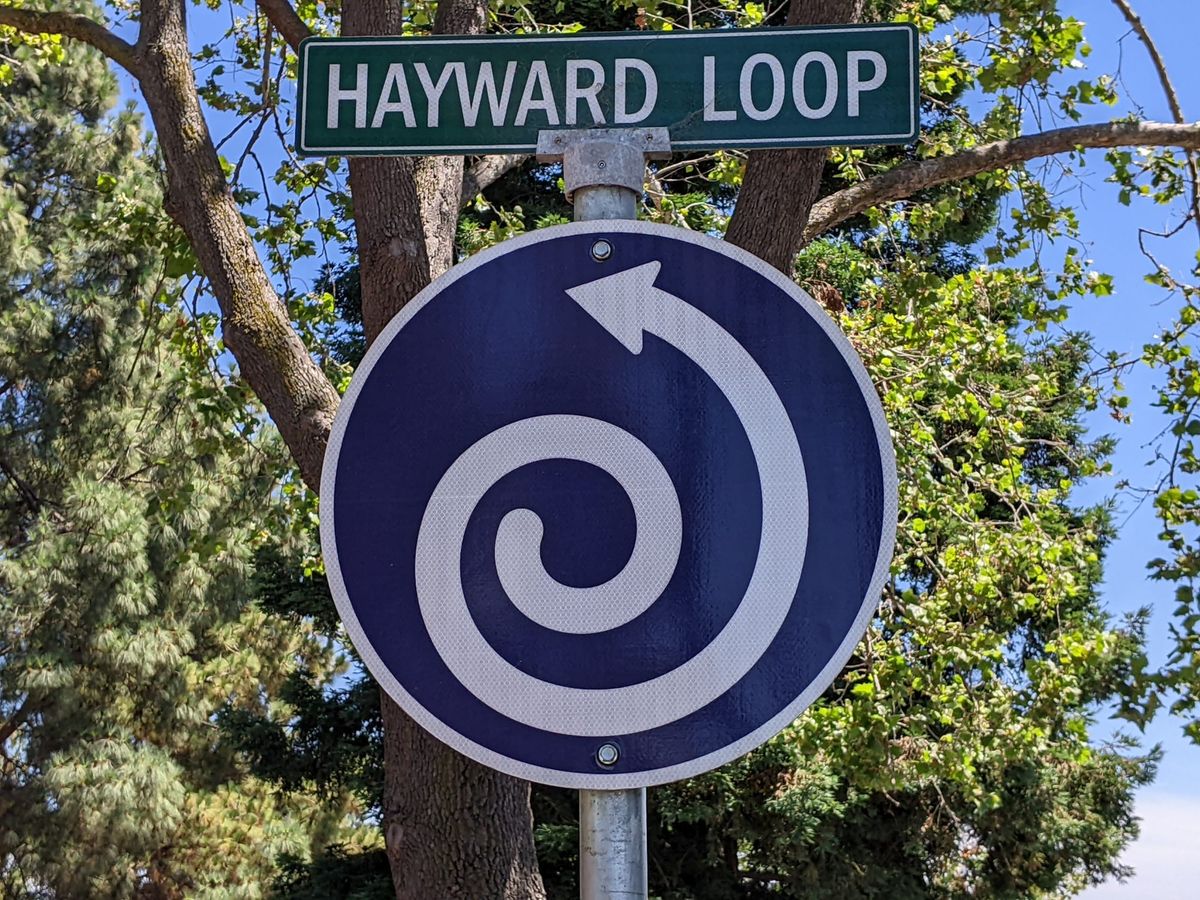
At the June 2nd Hayward City Council meeting, Public Works staff presented plans for undoing The Loop. After several rounds of community and stakeholder feedback, a plan titled Civic Avenue was approved which will greatly alter traffic flow in Downtown. Foothill Boulevard will remain a connection for through-traffic from 92 to 580, but almost all one-way streets will become two-way and both A Street and Mission Blvd will be narrowed to one lane in each direction.
We know that The Loop is a big issue for our city, and the Hayward Herald is the only place you'll find out what the city has planned for the worst piece of infrastructure in Hayward. Help support our work so we can keep you in the know.
Councilmembers, advocates from Bike Hayward, and the majority of community feedback supported the plan, however this is just the first of many steps. The work won't be done for a number of years, according to Public Works Director Alex Ameri, and the city would have to find funding to do it when the time comes.
Addressing Some Longstanding Issues
The proposed changes to the Loop were, according to city staff, "addressing some of the longstanding issues with downtown Hayward, which is the loop and how to fix it." Completed in 2013, the loop was created in an attempt to improve through traffic after the abandonment of the 238 bypass. However, according to the presentation, a collision happens on the loop every 11 days and 1.5 people are seriously injured or killed on the loop every year. A majority of residents, 76% of those surveyed, have concerns about the loop.
With a priority of safer streets, city staff conducted extensive outreach with the community and local stakeholders and landed on two different plans: Downtown Grid and Civic Avenue.
Downtown Grid
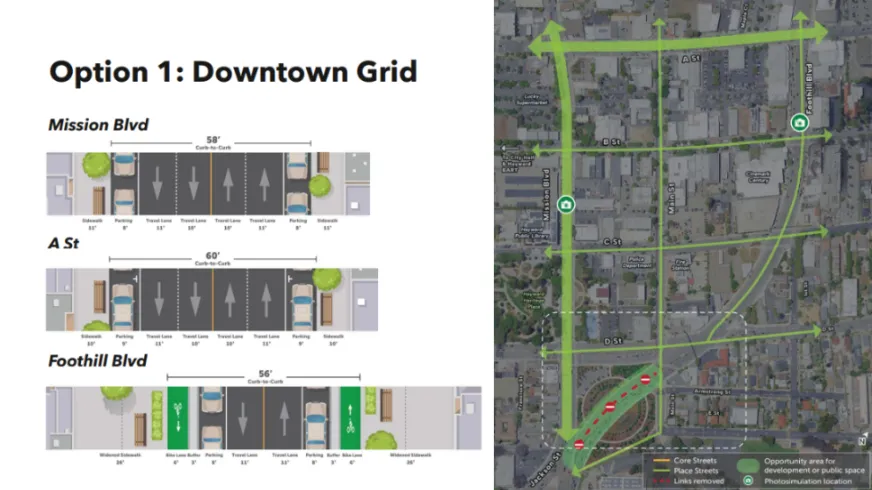
The Downtown Grid would undo the connection between Jackson and Foothill and return Downtown to a grid configuration. Mission Blvd and A St would each be 4 lanes wide (2 in each direction) and handle most of the through traffic. Meanwhile Foothill would be narrowed to 2 lanes and walkability would be restored in the easterly direction.
Civic Avenue
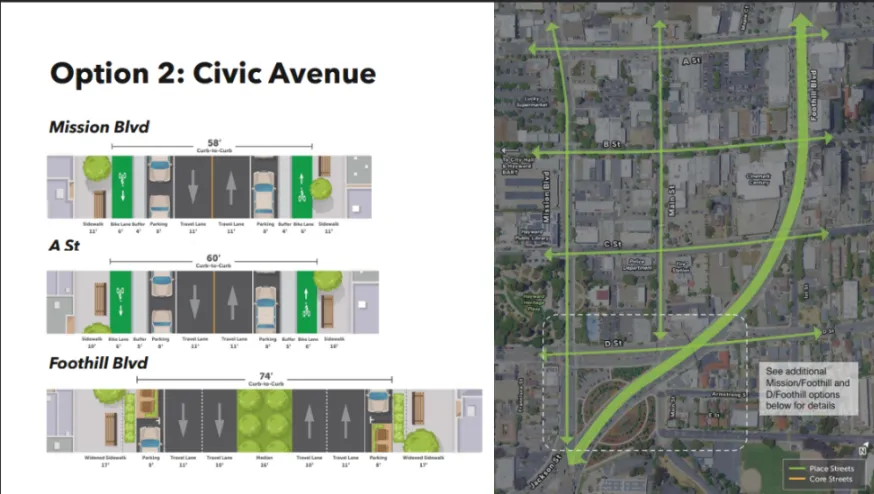
The Civic Avenue approach would keep the connection between Jackson and Foothill as the main path of travel for through traffic. All streets would become two-way and Mission Blvd and A St would become 2-lane streets with bike lanes. Walkability would be restored to the north and west, connecting those areas to the downtown core.
D Street
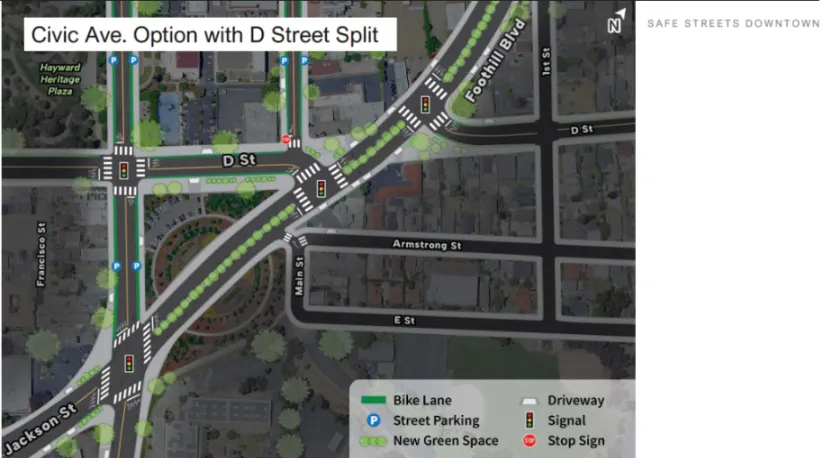
Another question was what to do about D Street. As it is, the intersection of D and Foothill is very large and skewed, which reduces visibility and increases risk of accidents. The options to address this are to either split the D and Foothill intersection into two pieces or keep it continuous. The split is shown above.
B And C Streets
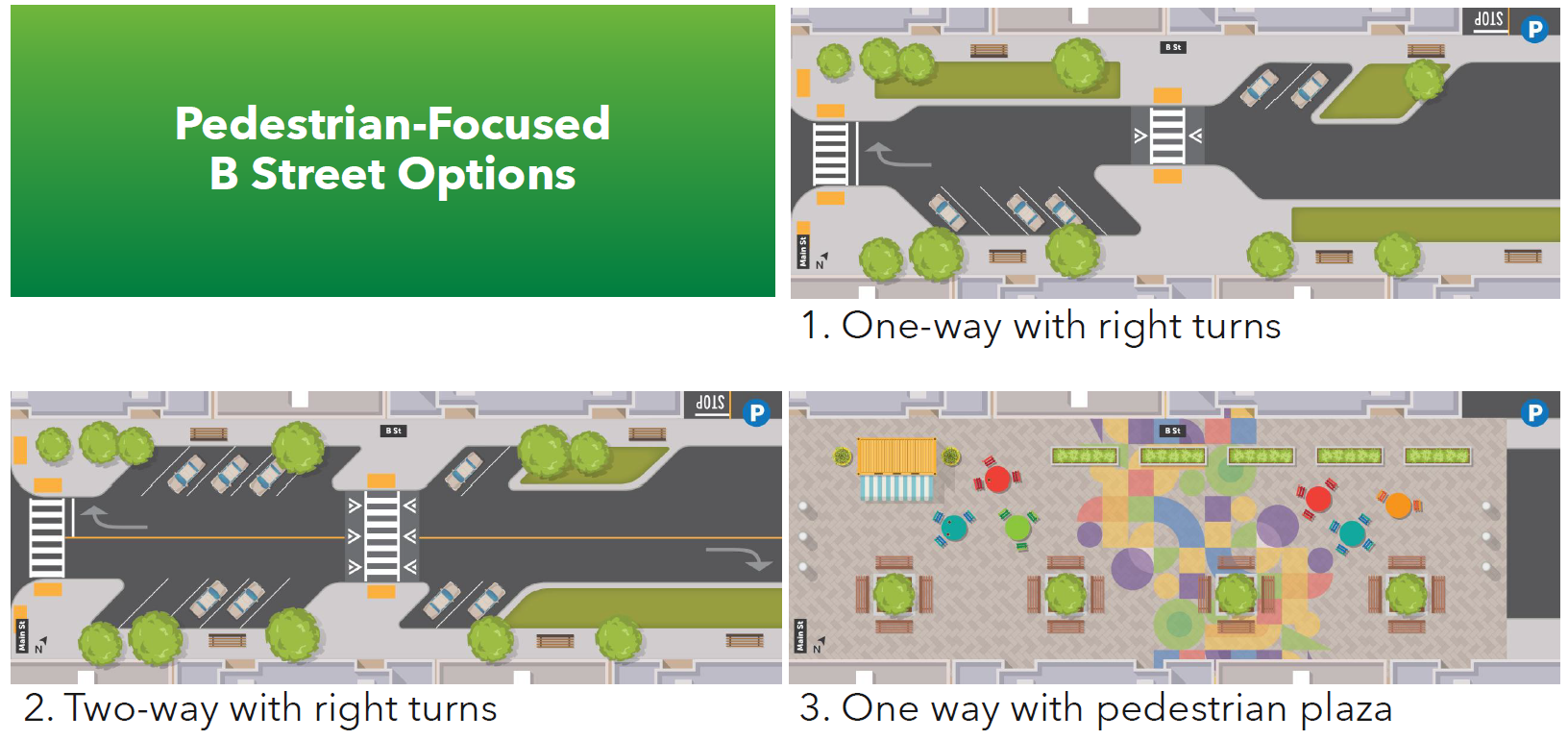
In an effort to increase the pedestrian-friendly nature of B Street, staff proposed 3 different options:
- Keep B street one-way
- Make B Street two-way
- Make B Street one-way with a pedestrian plaza
Finally, staff proposed making C Street two way between Mission and Foothill with a two-way cycle track on one side. The stretch between Watkins and Mission, by the library, will stay one-way due to the narrow right of way.
City Staff And Survey Respondents Agree
When considering which of the two options to recommend, city staff conducted a congestion analysis and compared each plan with the current configuration. Both options would increase congestion at nearly every intersection, however the Downtown Grid option would more than triple wait times at certain intersections, whereas the Civic Avenue option would only increase wait times slightly at most intersections.
The addition of significant congestion from the Downtown Grid option was the primary reason that staff recommended the Civic Avenue option. This was also supported by the majority of survey respondents (58%), with many of them concerned about the reduced capacity of Foothill Blvd.
Most respondents also supported a continuous D Street intersection and a pedestrianized B Street. However, ultimately warned against pedestrianizing B Street too quickly and recommended a two-way configuration with the option of temporarily closing it for special occasions to see how businesses and residents responded.
Council Supports Civic Avenue Plan
Members of the City Council unanimously supported the Civic Avenue plan, with many hoping for reduced through traffic and increased economic vitality in Downtown. "This Civic Avenue option, to me, is our chance to correct the past mistakes of the loop," Councilmember George Syrop said. When asked if he was worried about through traffic, Public Works Director Ameri said, "Most traffic is thought to be cut through traffic, regional traffic, and that's what's going to be affected."
This seemed to please Councilmember Francisco Zermeno. "I want us to ensure that the residents of Hayward have an easier time getting to Downtown and shopping in Downtown," he said. "I really don't care about the people who go from San Mateo to Livermore through our city." However, Mayor Mark Salinas felt differently. "We care about all traffic because we hope they stop and shop in Hayward," he said. Councilmember Syrop agreed. "This is to make visitors enjoy our Downtown as well," he said.
Many Council members asked specific questions about bike lanes and infrastructure, but Director Ameri assured them that the details haven't been finalized yet. Councilmembers Angela Andrews and Francisco Zermeno supported fully pedestrianizing B Street, but conceded that taking a phased approach may be best. Councilmember Julie Roche recalled studies that showed that pedestrianizing too early can be an issue if there isn't enough foot traffic already.
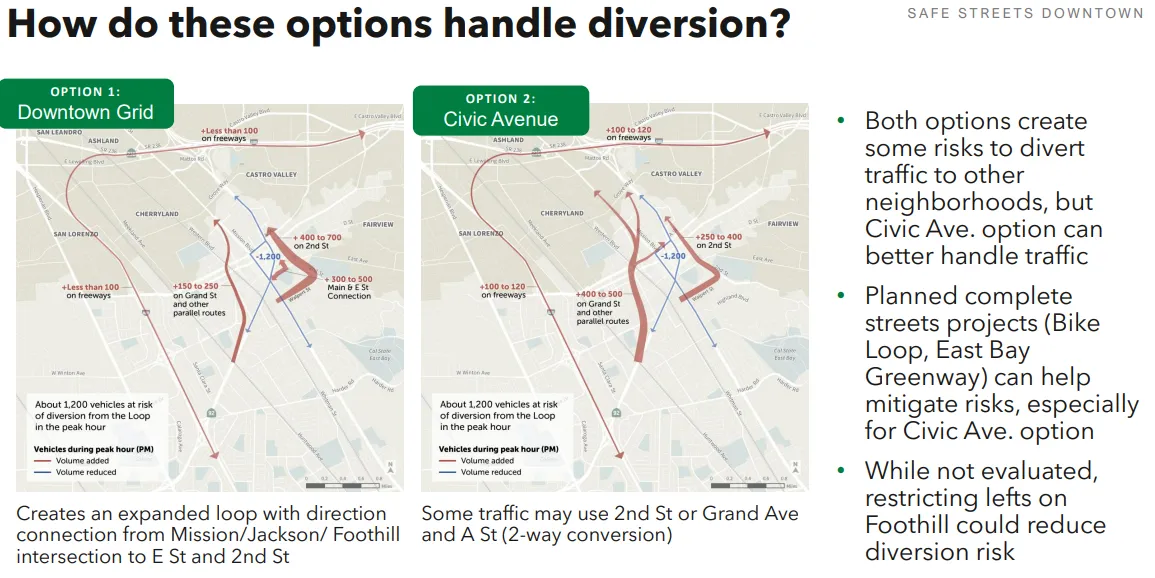
Councilmember Dan Goldstein worried about navigation apps finding alternate routes through otherwise quiet neighborhoods. Staff admitted that it was a risk, but that it was impossible to know for sure how bad it would be and which streets would be affected. According to a diversion analysis, both changes would reduce traffic by around 1,200 vehicles at the peak hours, with each affecting different side streets differently.
New Budget Balanced And Approved
The Hayward City Council approved the FY27 budget on June 2nd, which was balanced despite a lingering $30,000,000 structural deficit. The budget relies on multiple one-time funding sources, including Measure C revenue, to fill the gap, as well as significant concessions from labor groups--many of which will expire the following year. 85 vacancies are still being maintained across the city, though Staff has stopped the practice of using salary savings due to them being difficult to manage.
Finance Director DeAnna Hilbrants said the budget is "balanced but stretched" with there still being a risk of issues if revenues come in below expectations. However, the increase in Utility User's Tax from streaming services and data centers coming online will likely provide a boost to city coffers--to say nothing of the Business License Tax, if it passes in November.
Council Thanks Labor Groups For Concessions
Every City Council member thanked labor groups for the concessions, ranging from foregoing Cost of Living Adjustments (COLAs) to reduced overtime use. And, because of those concessions, the Council felt as though the budget was on the right track, if not completely secure. "We still have more to do," Councilmember George Syrop said. "We're not out of the woods yet."
With changes in financial practices, Councilmember Julie Roche felt "confident" in the budget, a sentiment which was echoed by Mayor Mark Salinas. However, many also lamented having to rely on Measure C funding--which was often seen as being for infrastructure projects--despite it being allowable.
In Defense Of Measure C
One group which did not appreciate the use of Measure C funding is the Hayward Concerned Citizens. Two members called in to public comment and took Council to task about the continued use of Measure C funding. One paraphrased prior comments from Mayor Salinas, claiming he said the excess money from Measure C was "gravy."
Mayor Salinas took time to point out that most of the infrastructure promises from Measure C had already been fulfilled: the new library, the new fire house and training center, and La Vista Park are all either complete or under construction. "Promises delivered," Mayor Salinas said.
However, he condemned the comments from the Concerned Citizens. "To say that I made reference to using Measure C money as gravy? That's ridiculous," he said. He again said that the current City Council is "the most transparent when it comes to this process" and said, "this Council has done a phenomenal job of getting the budget back on track."


Comments ()