
New Business Tax Rates For November Ballot
Hayward City Council approves updated Business Tax for voter approval in November. And with only one more tranche of votes left, we dig into local election results and their implications.

During the June 2nd Hayward City Council meeting, city staff presented the final revisions of the proposed Business License Tax modernization. The final version was influenced by feedback from city staff Unions, especially SEIU and IFPTE. If passed in November, it should bring in over $12,000,000 additional dollars to the city per year.
It would be a large increase from the current rates, which haven't been updated since 1978. However, the modernized structure would put Hayward's Business Tax between modernization proposals from San Leandro and Newark, but well below the likes of Berkeley, Richmond, and Emeryville. The proposal will go to voters in November and will be worked into the city budget in December, if passed.
Changes At Union Request
The last time the new Business License Tax rates were presented was at the April budget meeting. Shortly before the meeting, Union representatives proposed changes to maximize revenue. Specifically, it included two new brackets for those making between between $25-$50 million and those making more than $50,000,000. Rates were also increased on data centers and landlords, in an effort to maximize revenue for the city.
The Hayward Herald is keeping an eye on how local matters affect you. From taxes to bond measures, you deserve to know what's coming. If you can, please consider supporting us by becoming a member.
The changes are expected to bring in over $15,000,000 per year which is over $12,000,000 more than is currently collected every year.
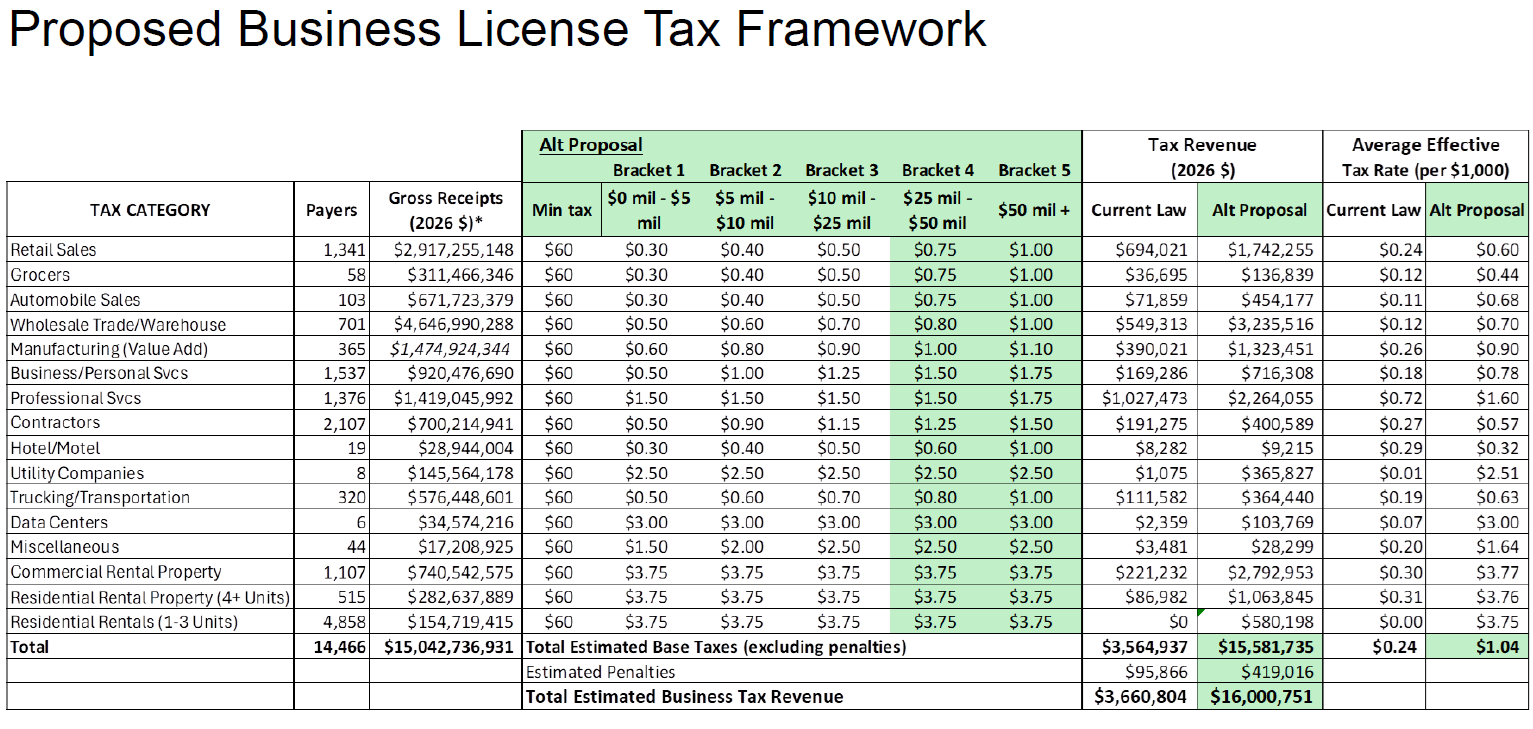
Under this structure, certain industries can expect higher increases than others. Landlords of residential rentals between 1-3 units will begin paying a Business Tax, which they do not pay under the current structure. Big increases are also expected for Wholesale Trade/Warehouse businesses, Professional Services, and Commercial Rental Property landlords.
According to city staff, feedback from the Chamber of Commerce and the business community has remained mixed. Some are in favor of the modernization, while others are opposing any new taxes.
Fitting In With The Crowd
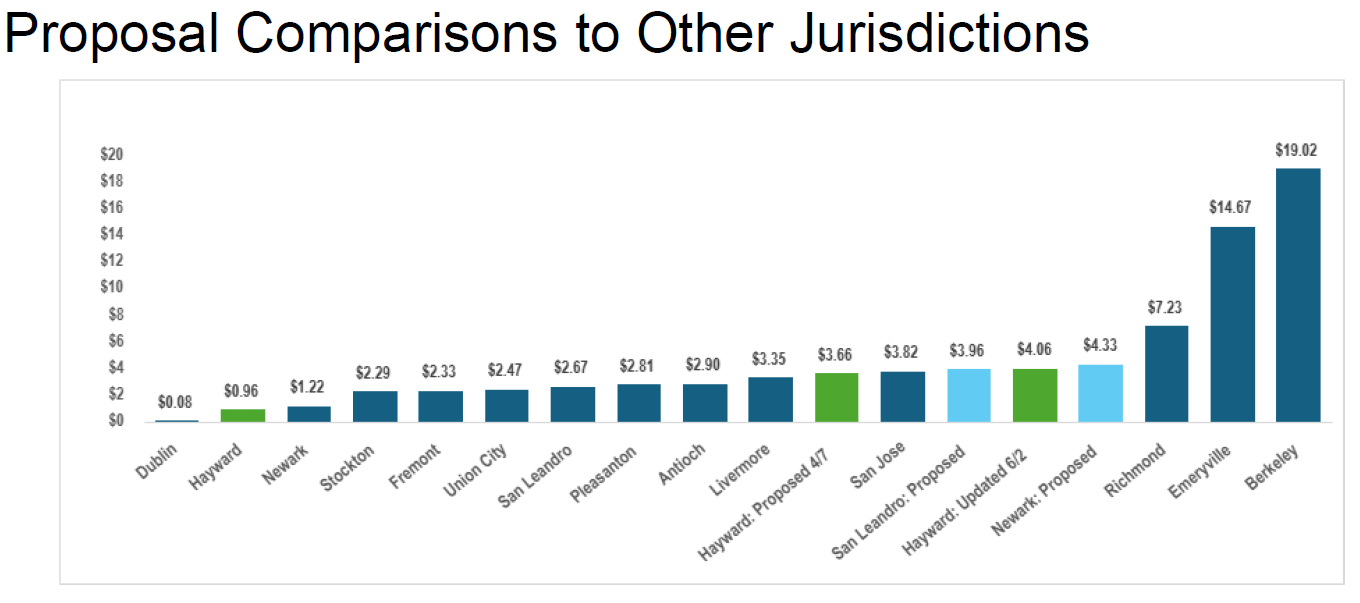
The City Council wanted to ensure that the new rates weren't too big compared to neighboring cities, for fear of businesses moving. The original April proposal landed Hayward somewhere between Livermore and San Jose. However, the new proposal puts it in between the newly proposed rates of San Leandro and Newark, both of which are higher than San Jose, but lower than Richmond.
Ultimately, it will be up to Hayward Voters to decide whether or not to increase the Business Tax. In November there will be a ballot question which reads as follows:
HAYWARD BUSINESS LICENSE TAX MODERNIZATION: Shall the measure updating the Hayward Business License Tax for the first time since 1978, to support general city services, including neighborhood police protection, firefighting, 911 response, libraries, and pothole repair, generating an additional $12 million annually until repealed, with a minimum tax of $60 and rates from $.30 to $3.75 per $1,000 of gross receipts, with higher rates for higher-grossing businesses, as stated in the ordinance, be adopted?
Council Thanks Unions For Support
The City Council unanimously supported the proposal, and each Council member thanked labor groups for developing a proposal and working with city staff to develop it. "[Thank you for] helping us think through how we get out of this deficit," Councilmember George Syrop said. "I appreciate the progressive nature of how we went about developing this Business License Tax modernization," Councilmember Ray Bonilla said. And Councilmember Julie Roche referred to it as a "balanced approach."
No real changes were proposed, though Councilmember Syrop asked about adding the phrase "which cannot be taken by the state" in an effort to ensure the money stays local. Unfortunately, the existing language is already at the word limit.
According to Councilmember Syrop, members of the Chamber of Commerce had asked if the increases could be phased in. But City Manager Jennifer Ott said that consistency is important and that changing over time would be confusing to business owners.
Councilmember Bonilla took time to assuage fears from business owners who may not think the taxes will not benefit them. "This is money that's going to be well spent," he said, "in making sure our businesses have a thriving environment that they would be successful in."
The revenue from the Business License Tax will fill almost half of the structural deficit of $30,000,000. And although polling suggested that 68% of residents would support the new tax, the margin of error was nearly ±6%. With the apparent defeat of Hayward Unified School District's Measure G parcel tax, the City Council may need to additional support to reach the 67% threshold.
Election Results Update
The results of the 2026 June Primary Election have been trickling in for a week and a half, and the count is almost complete. As of publication, Alameda County Registrar of Voters estimates only 20,000 ballots left across the entire county. So with that in mind, let's get into what the results mean for our local candidates and ballot measures.
HUSD Measure G
Needing 67% support to pass, the Measure G campaign appears to have fallen short. At just under 62%, it seems unlikely that the additional votes will materialize--if our calculations are correct, it would need no more votes against and nearly 3,000 votes in support.
- YES - 17,340 - 61.99%
- NO - 10,632 - 38.01%
A similar measure for Castro Valley Unified School District (CVUSD), which needed a mere 55% support, also failed to pass. Given the compressed timeline of the ballot measure--which was accelerated to get access to the revenue sooner--it appears as though there was not enough outreach or community support to ensure passage.
It is unclear at this time what caused voters to not support Measure G, whether it was low turnout--Alameda County had 40% turnout, knock-on resistance from the anti-Measure E campaign in Oakland, rising costs from the war with Iran, or a lack of voter education, this is a stark departure from past campaigns. Historically, bond measures from HUSD have enjoyed broad community support, sometimes passing with as much as 80% support.
The District may still have breathing room, however, if the State budget remains similar to what was proposed in the May Revise.
House of Representatives CA-14
- Aisha Wahab - 56,684 - 38.45%
- Melissa Hernandez - 25,140 - 17.05%
- Wendy Huang - 19,457 - 13.20 %
- Rakhi Israni Singh - 18,954 - 12.86 %
- Dena Maldonado - 17,955 - 12.18 %
- Victor Aguilar, Jr. - 3,082 - 2.09 %
- Matt Ortega - 2,488 - 1.69 %
- Carin Elam - 2,031 - 1.38 %
- Suzanne Chenault - 1,615 - 1.10 %
Former Hayward City Councilmember and current State Senator Aisha Wahab will be advancing to the November election, along with BART Director Melissa Hernandez. Republicans Wendy Huang and Dena Maldonado appeared to have split the conservative vote which would have otherwise allowed one of them to the general election.
Senate District 10
- Scott Sakikihara - 51,256 - 29%
- Linda Price - 41,090 - 23%
- Anne Kepner - 26,969 - 15%
- David Cohen - 26,581 - 15%
- Carmen Montano - 16,811 - 9.5%
- Raymond Liu - 13,928 - 7.8%
Total = 176,646 [91,358 from Alameda County and 85,288 from Santa Clara County]
Union City Councilmember Scott Sakakihara is in first place with 29% of the vote followed by Republican Linda Price with 23% of the vote. Anne Kepner came in at 15%, though she conceded the election to Sakakihara last week.
Kepner caught the ire of the California Association of Realtors and other business owners, who funded multiple mailers against Kepner. Meta (formerly Facebook) and the landlord lobby spent nearly $2,000,000 in support of Sakakihara, and Sakakihara himself spent nearly $1,000,000 of his own money to bankroll his campaign.
Although Independent Expenditure Committees are legally prohibited from coordinating with candidates, the fact that Meta and landlord interests spent so much in support of the candidate who is now most likely to win in November means they believe Sakakihara will be a sympathetic ear in Sacramento. Individual state legislatures have been pursing regulation against companies like Meta, Google, and other tech companies in recent years.


Comments ()