
Surveillance And Data Centers At City Hall
Residents continue to oppose the Stack data center while the City Council approved nearly $3 million in police surveillance technology.

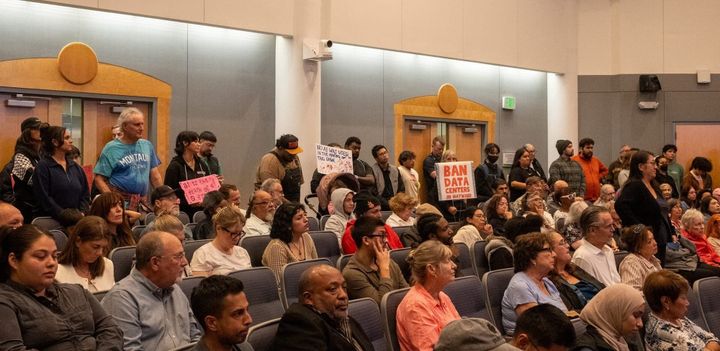
At the August 18th City Council meeting, unhappy residents continued to speak out against the Stack data center, currently under construction on Eden Landing Road. Shortly afterward, the City Council approved a nearly $3,000,000 contract with Axon for the acquisition of a number of surveillance technologies. While public outcry against data centers and the AI/Large Language Models (LLMs) that power them, the majority of the City Council was supportive of the expansive surveillance technology, despite many of them also relying forms of AI.
Residents Continue To Oppose Data Centers
Over half a dozen speakers took to public comment to urge the City Council to take action against the Stack data center. Despite construction already being under way, speakers called for construction to halt while the impacts are investigated. One speaker, Gina Paldo, cast doubt on the information provided by the developer. "I think... there is a lot of information that is very dubious, questionable, and possibly illegal," she said, though she provided no specifics.
According to many speakers, was a feeling of being taken advantage of and a lack of community input. "Most residents were, like me, not even aware of the data enter being approved in March of '25 [with] construction currently underway," said Marla Sather, a 40-year resident of Hayward.
Concern over a lack of resident notice and input was a common theme, with another speaker lamenting the lack of local news which could highlight certain projects. "I think if we still had more newspapers," said Caitlin Keliiaa, "more people would've been hearing about it on a larger scale." She said residents were "taken advantage of" by the developers, perhaps because of loopholes or lack of oversight.
The Hayward Herald is a local news publication that connects the issues we're facing today. From surveillance to data centers to land use to local government, we cover what nobody else does. If you're able, consider becoming a member to support our work.
Mayoral candidate Tom Wong also spoke against data centers, despite one of Mr. Wong's websites relying heavily on AI-generated images and content. He called for a moratorium, which is already under under consideration, and alleged that 4 data centers were already built with two more under construction. Though, according to research by Naomi Powell-Ha, there are currently two data centers completed, with two more under construction.
"I think this is an existential crisis in our community," he said. He then asked if the Stack data center received a tax credit, while public records show that Stack offered a $2,000,000 public benefits package to a number of local projects and causes. "The little bit of money that we do get to help with services are not enough," he said. Though Stack alone was predicted to generate around $9,000,000 in tax revenue per year by 2029.
After comments were over, Mayor Mark Salinas reminded attendees that he and Councilmembers George Syrop and Angela Andrews have authored a referral to discuss a data center ban on September 15th.
Hayward Police Expand Surveillance
The Hayward Police Department will be signing a 5-year almost $3,000,000 contract with Axon to replace 64 Flock Automated License Plate Readers (ALPRs), acquire 8 Drones as First Responders, and a number of technologies meant to support a Real-Time Information Center (RTIC). The contract would consolidate the majority of HPD's surveillance technology under a single vendor, with the RTIC being a central location where information can be accessed.
One resident, Arianna, called for the contract to be delayed until there was a full audit of the technologies. She expressed concern over vulnerabilities, especially in regards to the Fusus product which powers the RTIC. She also expressed concern about AI use. In the past, Chief Brian Matthews has said that the Drones as First Responders (DFRs) automatically fly to the scene of the call, and the staff report says that the Fusus product provides "real time translation capabilities."
HPD also contracts with Axon for their Evidence product which, in the promotional video on their website, shows what appear to be automatically generated summaries of evidence documents. Axon also provides HPD's body worn cameras which highlight automatic translation in the field and "automatically drafting police reports," both of which likely rely on AI technology to function.
On top of replacing the 64 ALPRs in place throughout the community, HPD also uses Axon dashboard-based ALPRs. These likely use the same technology as the post-mounted ALPRs, which rely on AI to constantly read license plates and automatically compare them to a list of wanted vehicles.
However, other speakers were supportive of the technology, including the Hayward Concerned Citizens. Theresa R., a member of the Concerned Citizens, said, "I'm much more in favor of safety even if it's reducing a little bit of our civil liberties."
Another supporter, District 1 candidate Brian Schott, said, "The technology, to me, is what we need in this city." He continued, "What price do you put on public safety? If you can reduce crime at $68/hour, that's a bargain." It is unclear, however, whether the technology is correlated to a reduction in crime.
Council Mostly Supportive
Councilmember George Syrop was the lone critical voice on the dais. While he welcomed moving away from Flock as a vendor, he maintained his concerns about surveillance. "I don't think it addresses the underlying issue of the expansion of mass surveillance infrastructure in our communities," he said. When it came to the cost savings, he said, "What price do we put on our own civil liberties when we have neighbors that are being kidnapped by ICE?"
Chief Matthews dismissed stories of people arrested for false positives as human error and said that nothing of that kind has happened in Hayward.
Councilmember Ray Bonilla suggested that the concern was around inappropriate access to the data. When asked about his confidence, Chief Matthews said, "We are confident in [Axon's] ability to protect our data." He said there was a monthly internal audit of access logs of both internal and external users, like other law enforcement. Captain Dan Olsen also said that the ALPRs don't have a pan, tilt, or zoom, though Councilmember Syrop pointed out that Flock said the same thing and was lying.
Councilmember Angela Andrews asked if the technology complied with ACLU standards which, among other things, recommends open audits and oversight which the current policy lacks. Chief Matthews said that a former ACLU attorney helped to develop the drone policy in 2022, suggesting that was sufficient.
Councilmembers Francisco Zermeño and Dan Goldstein were very much in favor of the purchase. "This is honestly the most cost-effective force-multiplier that we could possibly apply," Councilmember Goldstein said. Councilmember Zermeño dismissed the idea of abuse in HPD entirely. "I don't think we have that kind of personnel in our police or firefighter force," he said.
Mayor Salinas was vehemently supportive of the surveillance technology, dismissing concerns about over-surveillance. "This world is full of cameras," he said, "There's cameras everywhere... In this case, we're using cameras to protect people." He all but blamed the City of Richmond's removal of ALPRs for the abduction of a child, suggesting that the best way to keep children safe was to expand surveillance technology.
Ultimately, the vote for the Axon contract passed with Councilmember Syrop as the lone dissenting vote.


Comments ()